Milwaukee Bonsai Society Hosts Elle Nieto-Brodnick for Spring Juniper Demo and Workshop
Elle Nieto-Brodnick, who trained under Bjorn Bjorholm and Mauro Stemberger, brings her juniper demo to Milwaukee Bonsai Society on April 4.
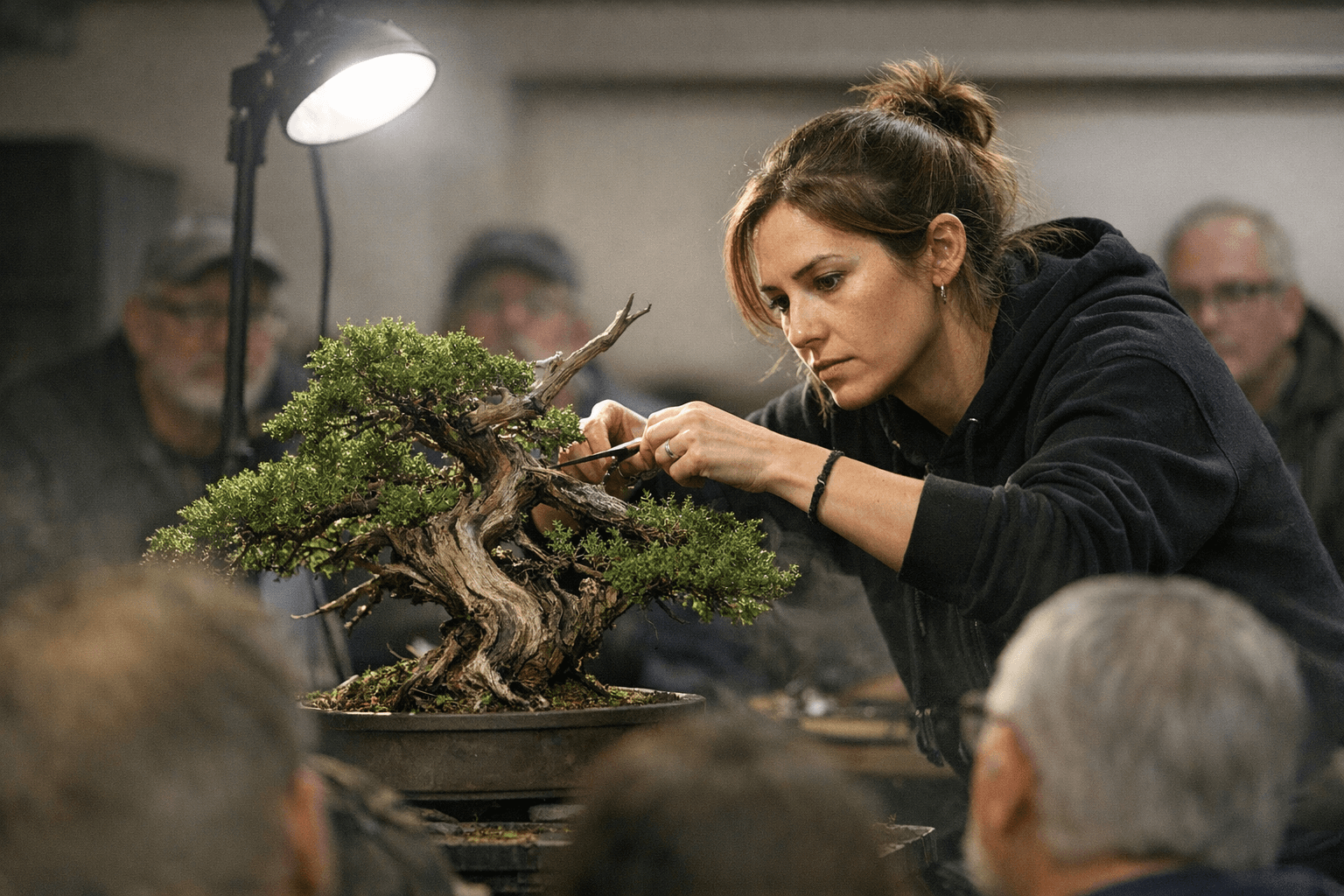
The juniper is unforgiving in the way that matters most for learning: every decision shows. A poorly angled primary branch, foliage pads compressed without space to breathe, deadwood that overwhelms the living mass rather than balancing it - these mistakes don't hide the way they might in a dense deciduous canopy. They read immediately, from across the room. That's why the Milwaukee Bonsai Society's choice of a juniper as the demo tree for their April 4 general meeting is an invitation to watch something genuinely instructive happen in real time.
The artist working that tree will be Elle Nieto-Brodnick, a Chicago-area practitioner whose trajectory over the past four years represents one of the more striking ascents in the Midwest bonsai community. Nieto-Brodnick discovered bonsai during the COVID-19 pandemic while working in healthcare, entering the art form the way many contemporary practitioners do: through online videos and literature. But she moved quickly from self-directed study into hands-on learning with practitioners at the highest level. Her training has been shaped by workshops and classes with Andy Smith, Owen Reich, Will Baddeley, Julian Tsai, and David Cutchin, alongside intensive study under Bjorn Bjorholm and Mauro Stemberger. That's a lineage spanning continents, and its influence shows up in the rigor she now brings to teaching Bonsai 101 at The Hidden Gardens in the Chicago area. She has already demonstrated at Dai Ichi Bonsai Kai in California and through Eastern Leaf. Milwaukee joins that regional circuit on April 4.
What makes her appearance significant is not just the resume. Regional clubs, their Fundamentals and Skills classes, their member-driven programming, build competent practitioners who can wire correctly, pot appropriately, and maintain trees through the seasons. What's genuinely harder to transmit in that format is the decision architecture that precedes the wire: how an experienced artist looks at an unworked tree and generates a hierarchy of choices before anything gets removed. Nieto-Brodnick works from mentors who operate at exactly that level of thinking. Bjorholm's methodology at Eisei-En, Stemberger's European classical grounding - these are influences that produce artists who read trees structurally, not just artists focused on surface execution.
On a juniper, structural reading starts with the primary branch. Before anything else gets touched, that first branch establishes the tree's energy and central argument: where is this tree going? Its angle and placement relative to the nebari and apex create the frame against which every subsequent decision is measured. Watch where Nieto-Brodnick's eye settles before she picks up wire. That attention tells you how she has learned to assess raw material, and it's the part of the demo most worth studying if you're trying to develop your own pre-wiring analysis.
The wiring itself carries its own instruction. Juniper foliage masses want to settle into natural cascading planes, but achieving pads that read as resolved rather than merely arranged requires precision at the secondary and tertiary branch level, not just the primary scaffolding. The angle between wire wraps, the transition from heavier to lighter gauge as branches taper, the way opposing wraps are anchored without over-torquing the cambium: these are the mechanics that separate finished work from work in progress. Owen Reich's approach to collected and semi-refined conifer material - his emphasis on understanding a species' natural movement before imposing design - is the kind of foundational thinking that tends to surface in demo work from artists who have trained through him.
Deadwood is where the demo will likely generate the most conversation among Milwaukee members. The proportion of jin to living vein, of shari to foliage mass, is not a formula. It's a narrative decision about what story the tree is telling. A juniper with too much deadwood becomes an exercise in carving technique rather than a designed tree. Too little, and the species' inherent drama is suppressed. The balance Nieto-Brodnick strikes on this specific material, and whatever reasoning she makes visible in the process, is the portion of the evening most directly transferable to practitioners working on their own conifers and collected deciduous stock through the season.
The skill gap Milwaukee's programming is directly targeting with this invitation is the space between wiring competence and wiring intention. Fundamentals instruction produces members who can wire correctly. What's harder to acquire through class format alone is the capacity to enter a tree with a clear design hypothesis - a resolved image of the finished work that guides every subsequent decision rather than emerging by accident. Demo format externalizes that internal sequence in real time. The progression of what gets removed, what gets refined, what gets held for a later development stage: that's the curriculum that doesn't fit on a handout.
The bring-your-own-tree workshop that follows the demonstration compounds that effect. Members arriving with their own material immediately after watching Nieto-Brodnick work through a design problem on the juniper will approach their trees with a recalibrated eye. The demo functions as preparation for the practitioner's perceptual apparatus; the workshop tests that recalibration against actual material. The sequencing is deliberate, and it's one of the more effective learning structures a club can offer.
The demo tree won't stay in the studio. After April 4, it heads to auction as part of the Milwaukee Bonsai Society's Annual Exhibit weekend, giving it a second pedagogical life: members and visitors will be able to study Nieto-Brodnick's finished work at close range, track how the design holds through the season, and potentially continue its care themselves.
Spring programming at the club extends well beyond one evening. Fundamentals and Skills classes are running concurrently, and a burning-bush dig is scheduled, combining invasive species removal with the kind of raw material acquisition that normally requires wilderness access. Euonymus alatus provides working stock members can develop without the pressure of irreplaceable collected material. The club's Discord server rounds out the infrastructure, offering a rapid-response channel for the in-season care questions that can't wait for the next general meeting.
The regional circuit of guest artist demos is how contemporary technique migrates across geographic boundaries in American bonsai. What Nieto-Brodnick works through on a single juniper on April 4 stands to reshape how Milwaukee members approach their own trees through the rest of the growing season.
This article was produced by Prism’s automated news system from verified source data, official records, and press releases, then run through automated quality and moderation checks before publishing. The system is built and supervised by the people who set the standards it runs under. Read our full AI policy.
Did this article answer your question?