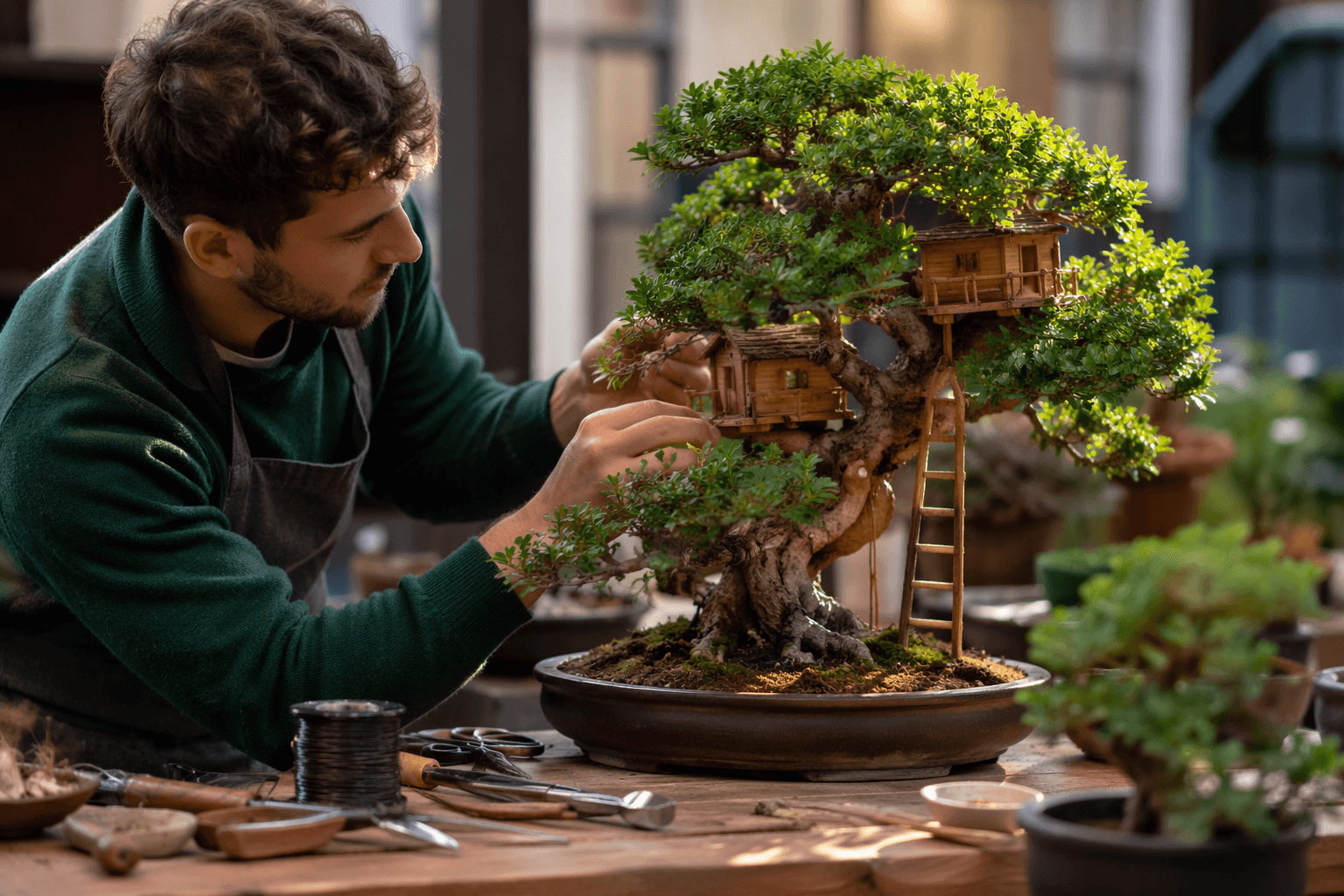
Shanghai's Guyi Garden Showcases Spring Flowering Bonsai in Classical Jiangnan Setting
Crabapple, forsythia, and peach bonsai bloom inside Shanghai's 500-year-old Guyi Garden through April 19, in a show that no club exhibition hall can replicate.

Photographs of bonsai shows don't lie, exactly. They capture the trees, the pots, the refinement of the work. What they cannot capture is what happens when a 30-centimeter crabapple in full pink bloom is placed against a whitewashed Jiangnan garden wall, or when forsythia's bare yellow branches catch light that has first filtered through a grove of centuries-old bamboo. That gap between screen and experience is precisely what Guyi Garden's current exhibition, "Spring Flowers Like Brocade: Guyi Garden Spring Flower Bonsai Miniature Exhibition," is built around.
The show opened March 29, 2026, and runs through April 19, placing it squarely inside Shanghai's peak spring flowering window. The venue, Guyi Garden in the Nanxiang area of Jiading District, traces its origins to the Jiajing era of the Ming dynasty (1522-1566), making it roughly 500 years old. It was extensively remodeled in 1746 under the Qing dynasty's Qianlong era, and in 1789 the local gentry purchased it to serve as communal cultural property, a status it has maintained ever since. The garden ranks among the five most important classical gardens in Shanghai, and no rented convention center operates inside that kind of accumulated authority.
Three Species, Three Curatorial Arguments
The exhibition centers on crabapple, forsythia, and peach. The choice is not arbitrary: it's a considered yellow-to-pink-to-deep-pink-red progression that mirrors how Shanghai's spring unfolds climatically, and it gives the display a coherent seasonal arc rather than a jumbled collection of whatever happens to be in flower.
Forsythia opens the sequence. Its yellow blooms appear on bare branches before any leaf has broken, making it one of the cleanest flowering studies in the show: pure branch architecture adorned with color, without foliage complicating the silhouette. This is a species that Western practitioners tend to underestimate as a bonsai subject, treating it as a starter tree and moving on. Display-stage forsythia in the Guyi show is an argument against that instinct. When ramification is developed over years and bloom timing is managed carefully, the species produces something genuinely contemplative. The bare branch structure under yellow flower is as much a drawing as a tree.
Crabapple (海棠, haitang in Chinese bonsai culture) is the centerpiece species and carries the deepest resonance in the Jiangnan context. In Chinese literati painting, garden poetry, and seasonal symbolism, crabapple occupies a position comparable to ume in Japan: it signals the arrival of refined spring rather than just warmth. As a bonsai subject, crabapple is rewarding and demanding in roughly equal measure. The key cultivation challenge is managing nitrogen inputs carefully to avoid driving vegetative extension at the expense of flower bud set. Push the tree too hard in development mode and it leafs out vigorously but blooms sparsely; back off too much and the ramification stalls. The Guyi exhibition puts display-stage crabapple bonsai in an environment where the species also appears as full-scale garden trees elsewhere on the grounds. That juxtaposition, miniature form and mature landscape tree sharing the same visual field, is exactly what a club show in a rented hall cannot produce. The miniature becomes a distillation of its surroundings rather than an object imported from outside.
Peach closes the trio with the most vivid color and the deepest symbolic weight in Chinese culture. Peach blossom appears in everything from Tao Yuanming's 5th-century "Peach Blossom Spring" to contemporary spring festival imagery, and its pink-red saturated blooms photograph exceptionally well, which drives social sharing in ways that more subtle flowering species do not. As a bonsai subject, peach is more technically demanding than crabapple or forsythia: the species is vigorous and shorter-lived than most display-quality bonsai trees, and timing peak bloom for an exhibition window requires deliberate temperature management in the weeks before display. Kept cool through late winter to delay bud development, then moved into warmth as the show date approaches, a well-timed peach bonsai can hold its moment for a week or more. The Guyi exhibition's April 19 closing date extends coverage into the period when peach reliably hits full expression in the lower Yangtze valley.
The Role of Stone and Accessory Pairings
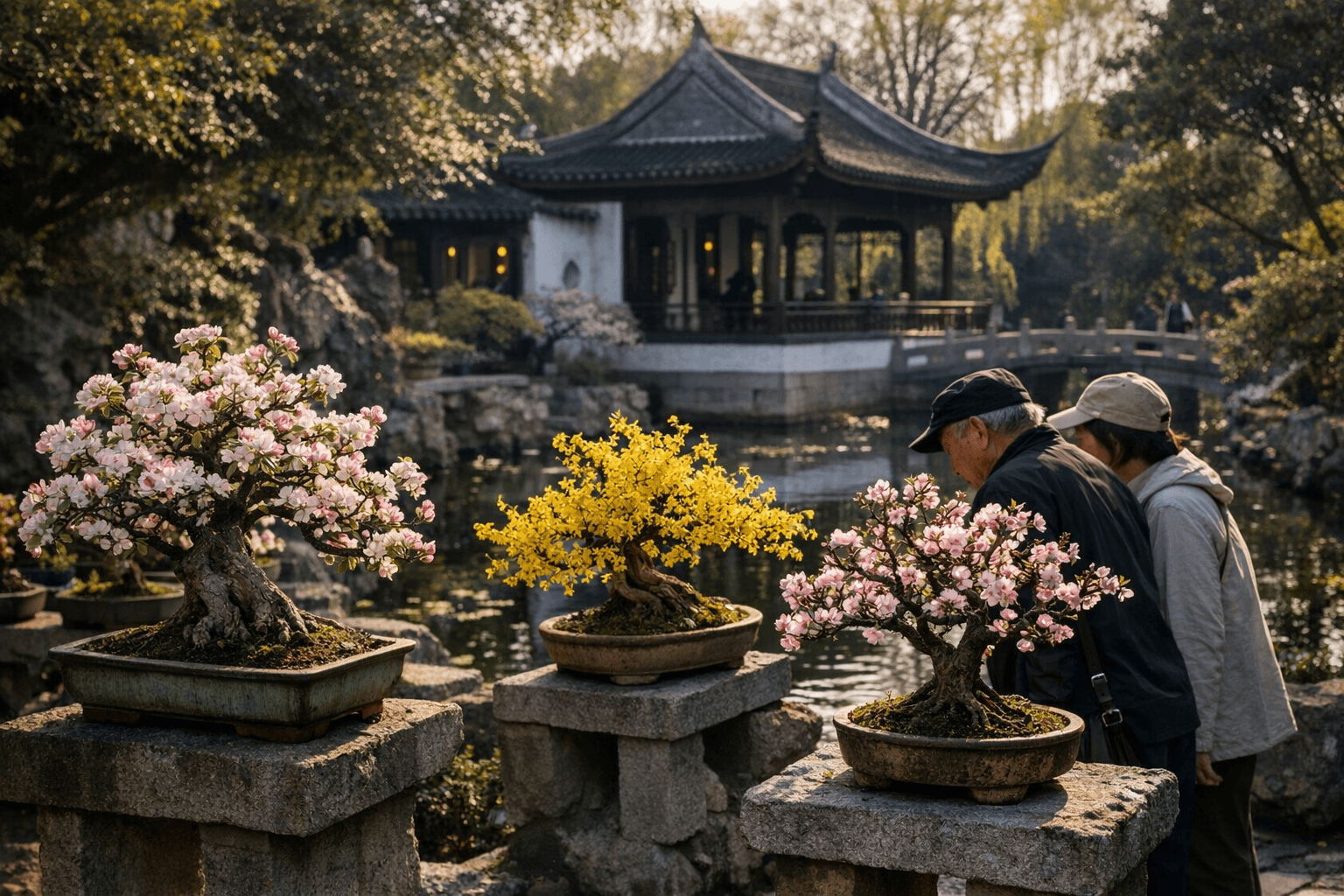
Each miniature tree in the exhibition is paired with stones and accessories chosen to suggest a scene rather than merely present a specimen. Red, pink, yellow, and white blooms are set against carefully selected stones, and the overall composition is designed to evoke a poetic spring mood in the classical Chinese literati sense. This is the same display logic that governs how scholar's rocks are used in classical garden arrangements throughout Jiangnan: the stone's texture, color, and form complete a seasonal narrative that the tree alone cannot fully carry.
For anyone developing accent compositions for azalea, ume, or wisteria at home, the Guyi display is a useful study. The relevant principle is that the stone is not decoration applied after the tree has been placed; it is a co-equal compositional element chosen before the tree is set, to establish the mood the tree will inhabit. When the stone choice is wrong, the most technically accomplished bonsai reads as a disconnected object. When the stone is right, the composition holds even after the flowers have dropped.
What a 500-Year-Old Garden Enables
The organizers acknowledge the inherent unpredictability of bloom timing. Visitors are advised that flowering schedules may shift slightly with weather conditions, and off-peak visiting hours are recommended for anyone who wants to study the displays without crowd pressure. That guidance reflects a reality every practitioner who has tried to hold a flowering bonsai at peak for a show weekend already understands: the tree operates on its own calendar, and three weeks is not a long window.
For practitioners calibrating azalea, ume, or wisteria timing in North America or northern Europe, Shanghai's spring rhythm offers direct reference. Shanghai's climate is broadly comparable to coastal mid-Atlantic regions of North America and parts of southern England. Forsythia in those zones peaks in late March; crabapple follows in early to mid-April; wisteria trails both, typically opening from late April into May. If your ume is finishing as your forsythia opens, you're in a climate rhythm not far from what is on display in Guyi Garden right now.
The single most transferable principle from the exhibition's curatorial approach is the commitment to bloom-window accuracy over extended display period. The show is not designed to catch each species at three stages across its run. It is designed to open at the right moment and close before the narrative becomes untidy. That discipline, building the exhibition calendar around the trees rather than building the tree schedule around the calendar, is what separates a flowering bonsai show that moves people from one that simply puts plants in a room.
One detail noted in visitor coverage of the exhibition will not appear in any curatorial statement: a resident orange cat has taken to sitting on the stone display shelves among the bonsai. Guyi Garden has, apparently, met its match in literati composition.
This article was produced by Prism’s automated news system from verified source data, official records, and press releases, then run through automated quality and moderation checks before publishing. The system is built and supervised by the people who set the standards it runs under. Read our full AI policy.
Did this article answer your question?