Tokyo Studio TOUFU Reimagines Bonsai as Preserved Design Objects in Taipei
TOUFU TOKYO's RE BONSAI arrives in Taipei: preserved specimens made from dead trees, tagged "do not water," open URA.219's inaugural gallery program through April 19.
When a bonsai dies, most practitioners see failure. Yoshio Suzuki, creative director of Tokyo studio TOUFU TOKYO, sees raw material.
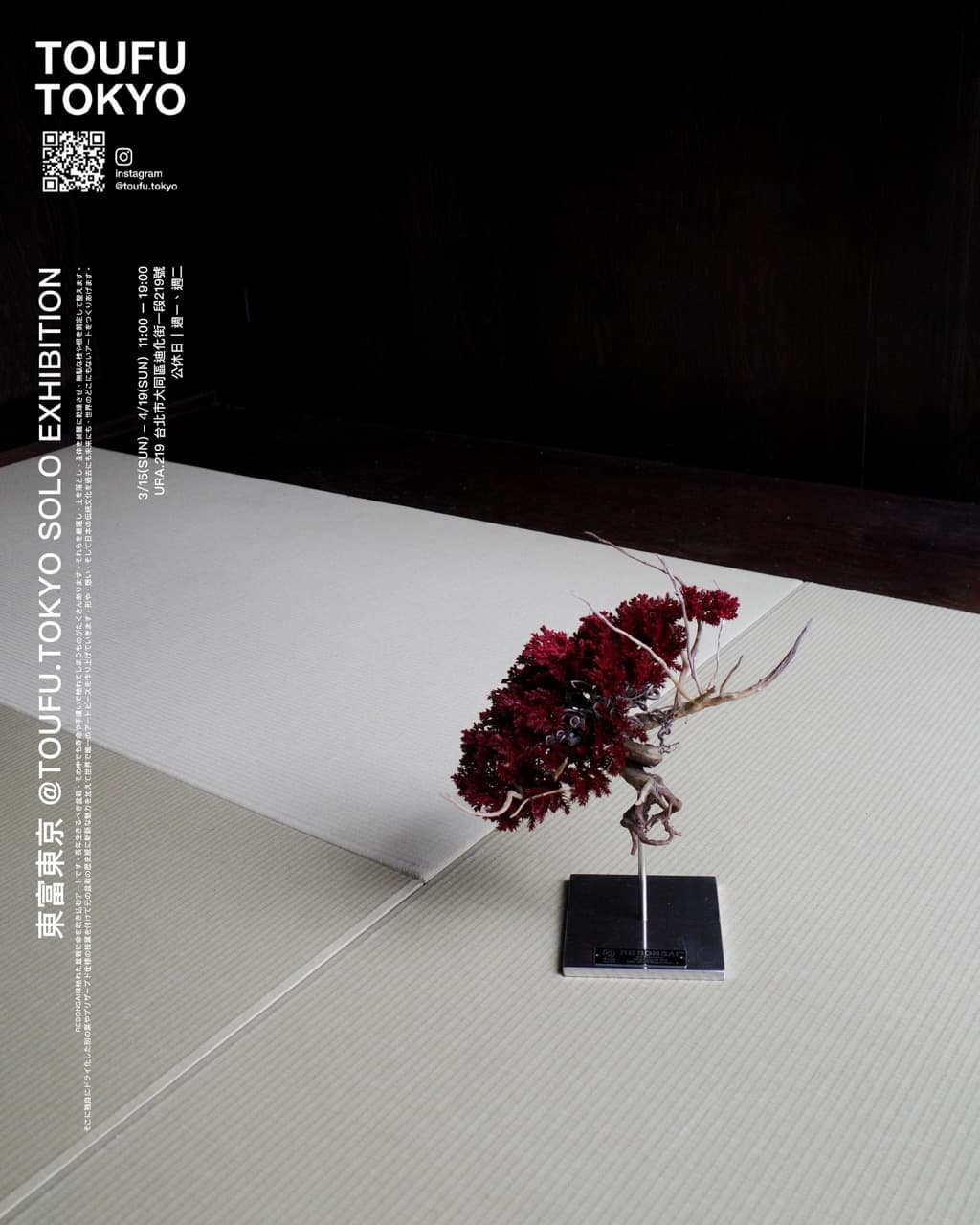
That inversion is the engine behind RE BONSAI™, a series of preserved, maintenance-free bonsai objects that opened their first overseas gallery presentation at Taipei's URA.219 on March 15. The show runs through April 19 at 迪化街一段219號 in Dadaocheng, where it marks the inaugural program of URA.Gallery and brings Suzuki's long-running experiment in what he calls "regeneration" to an audience already living at the intersection of heritage preservation and contemporary design.
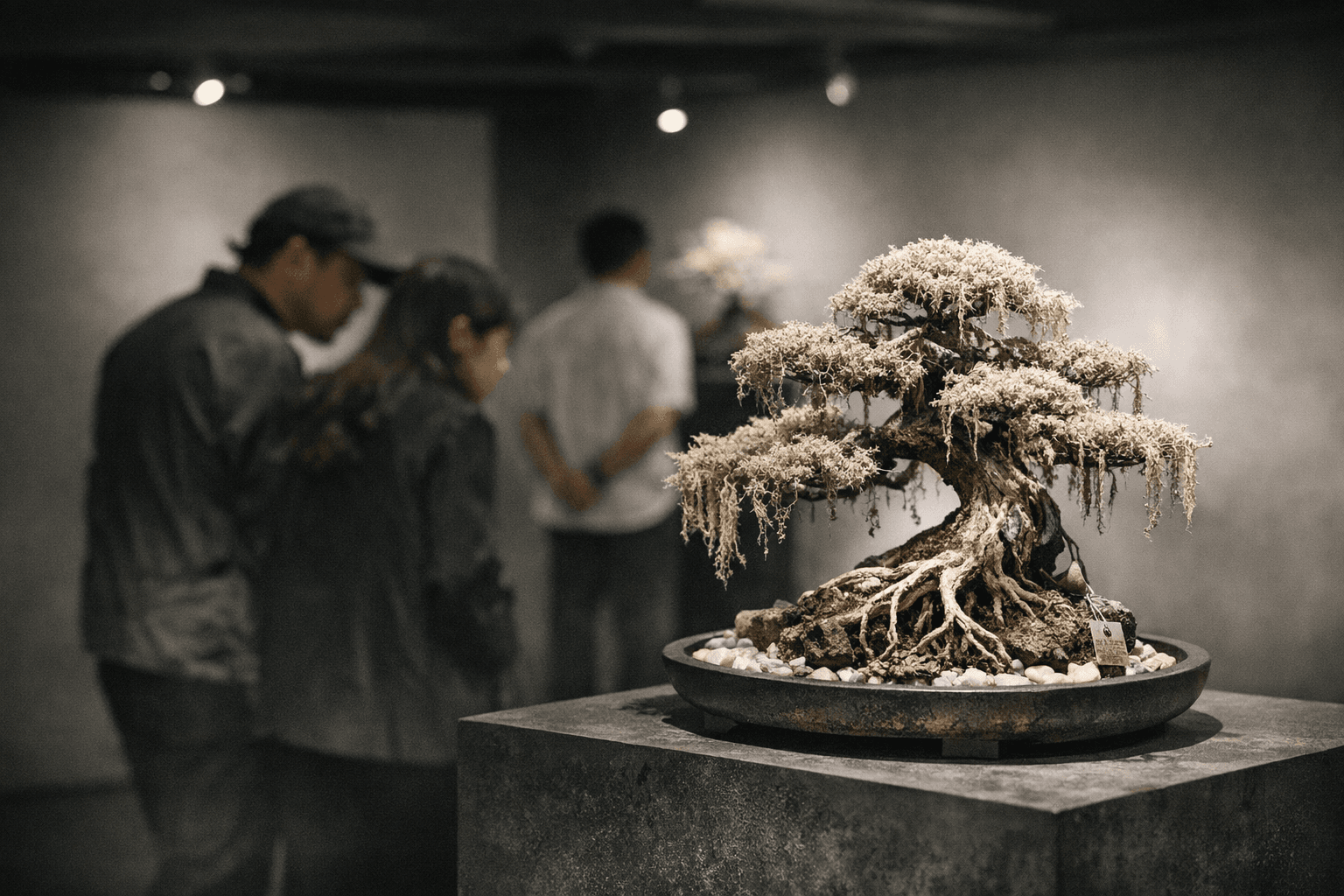
The name RE BONSAI is a portmanteau of REBORN and BONSAI, and the process behind each piece is more surgical than the branding implies. Suzuki and his team begin only with bonsai that have already died, never harvesting from living material. Soil is stripped away, exposing the raw structure of root plate and nebari. A proprietary drying method then arrests decomposition across trunk, branch, and root, while expert pruning removes structurally weak or visually redundant material to sharpen the final silhouette. Suzuki reattaches carefully selected dried foliage, often chosen for chromatic intensity, reconstructing what functions as a new canopy over the preserved deadwood. Every completed piece receives a photocatalytic coating that produces active oxygen on contact with light, neutralising bacteria and viruses and filtering indoor air in the process. The result is, in the studio's own framing, "semi-permanent" in form: the shape will not change, though bark and branch tips may slowly transform in ways TOUFU describes as "the natural course of art that was once alive."
The instruction tag reads: do not water.
For practitioners who have spent years calibrating watering schedules to season, pot depth, and species, that directive lands with specific force. Traditional bonsai is, at its core, a discipline of sustained attention: repotting cycles, fertilisation windows, the delicate management of jin and shari on species like shimpaku (真柏) juniper or black pine (黒松). The practice's depth is inseparable from its demands, because the visible evidence of a tree's development, the taper, the movement, the tension in deadwood, is the accumulated record of that relationship between practitioner and plant. Suzuki's proposition cuts the relationship entirely and asks whether the visual and spatial intelligence encoded in a century of bonsai aesthetics can survive without the biological life that generated it.
Within the tradition, that question has no clean answer. The wabi-sabi dimension of bonsai, the way impermanence and seasonal change are made visible in a living tree, is not merely ornamental philosophy: it is what makes the practice a discipline rather than a product category. A RE BONSAI piece carries the silhouette of cultivation history, but not its ongoing conversation. The branch angles speak of past decisions; nothing about the tree will respond to the next season, the next watering, the next wire. For practitioners shaped by that continuity, the preservation of aesthetic form without the living substrate is either a profound act of cultural rescue or a sophisticated erasure of the thing being preserved.
The design world has answered less ambivalently. RE BONSAI™ has shown at Nihombashi Mitsukoshi, appeared in a dedicated installation at Kyoto's Nijo Castle, and holds a permanent retail presence at Narita Airport Terminal 2, where TOUFU collaborated with JAL Engineering to combine aircraft waste components with dead bonsai in an upcycled sculptural series. High-end pieces in the range have reached 13 million yen, with major specimens, including 100-year-old shimpaku reconstructed with striking coloured foliage, listed at 2.75 million yen. Those price points position RE BONSAI firmly in the collector-grade contemporary art category. The studio also produces more accessible work for retail platforms, but the gallery-program framing in Taipei signals a clear upward push in institutional ambition.
Suzuki, born in 1978 in Tokyo's Edogawa ward, does not come from a classical bonsai lineage. His background runs through painting and urban design culture, and he has described his practice as "challenging from the Far East to the world." That outsider trajectory is not incidental to what RE BONSAI does: it enables Suzuki to treat bonsai's formal vocabulary as design language rather than living inheritance, to deploy proportion, negative space, and aged surface texture as compositional tools without the stewardship obligations those elements were historically inseparable from. TOUFU's Instagram following now exceeds 89,000, and the Taipei presentation is the studio's first dedicated gallery program outside Japan.
The venue amplifies the conceptual stakes. URA.219 was established in 2022 through a collaboration between fashion designer brand Professor.E and Yangmingshan-based antique planting brand Urayama, and the space transforms the courtyard of an old house on DiHua Street into what its founders call an "ink color Japanese-style landscape." Placing RE BONSAI inside a gallery that is itself engaged in translating Japanese spatial aesthetics into a Taiwanese heritage context is deliberate. The Dadaocheng neighborhood, with its preserved Qing-dynasty merchant architecture and concentration of heritage craft businesses, makes RE BONSAI's questions about preservation and cultural continuity land with additional weight beyond what a white-cube gallery could generate.
The curatorial framing positions the series as "a sensory experiment" in regeneration and cultural translation, with local design coverage describing the works as "neither traditional horticulture nor mere decorative object, but a contemporary design reinterpretation." That framing is constructed precisely to hold off the most obvious critique: that Suzuki is packaging dead plants in collector-grade containers and marketing the aesthetic authority of a tradition he is no longer bound by. The photocatalytic coating argues functional benefit; the sourcing exclusively from already-dead specimens argues sustainability and frames each work as an act of rescue rather than extraction; the technical specificity of the drying and reconstitution process argues craft knowledge. Whether that adds up to a legitimate extension of the bonsai lineage or a sophisticated appropriation of its symbolism is exactly the question this Taipei show has been staged to generate.
The URA.Gallery program runs through April 19, with visiting hours 11:00 to 19:00, Wednesday through Sunday.
The trees are real. They just don't need you anymore.
This article was produced by Prism’s automated news system from verified source data, official records, and press releases, then run through automated quality and moderation checks before publishing. The system is built and supervised by the people who set the standards it runs under. Read our full AI policy.
Did this article answer your question?