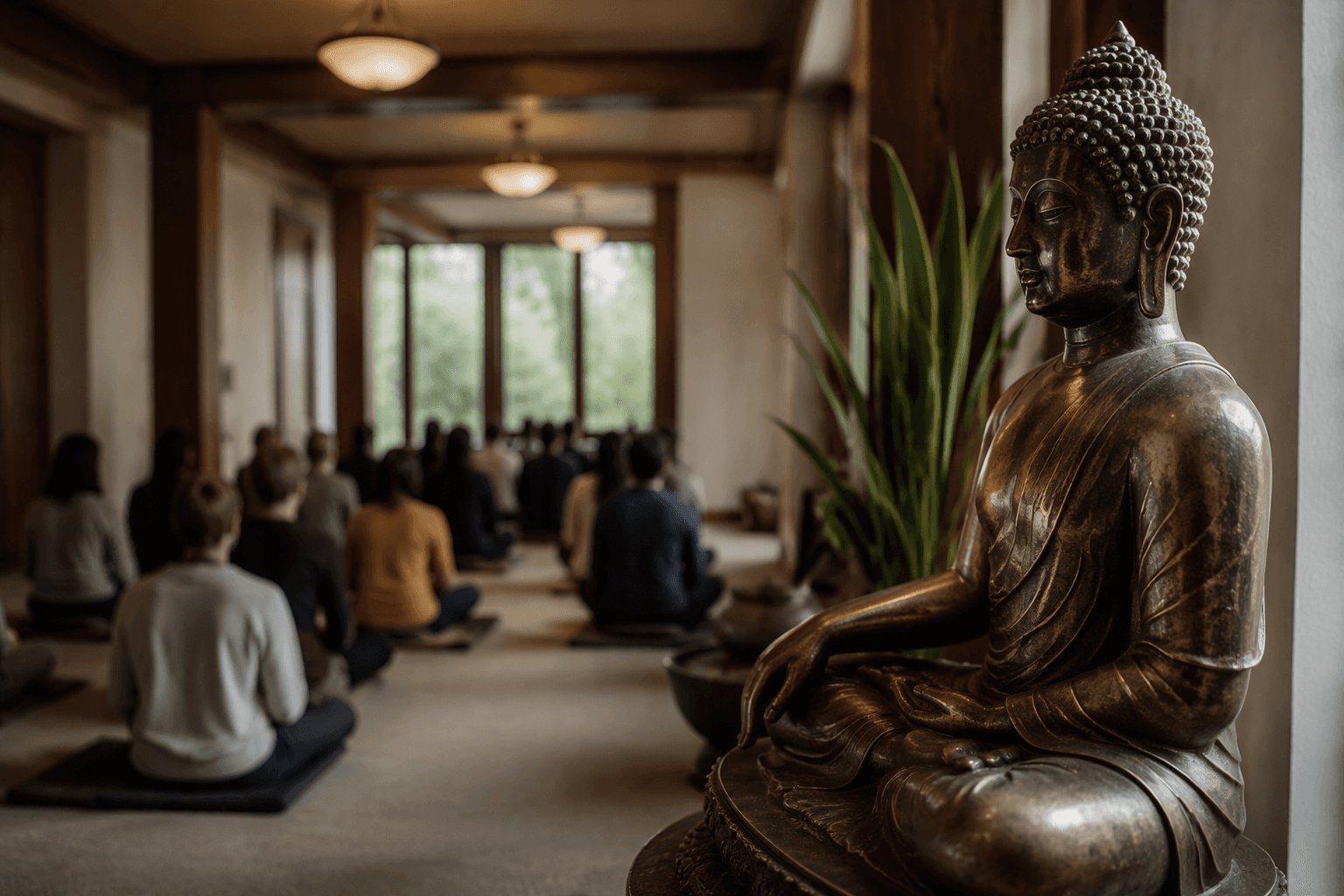
Thanissaro Bhikkhu offers basic breath meditation guidance for beginners
Thanissaro Bhikkhu makes breath meditation usable for beginners, showing how to meet wandering thoughts and pain without turning the sit into a fight.

For plenty of meditators, the phrase "follow the breath" is where practice gets hard, not where it gets easy. Thanissaro Bhikkhu's basic breath guidance answers that problem with a plain, workable method, treating wandering attention, pain, and beginner frustration as part of the practice instead of signs you missed it. The instruction appears in *With Each & Every Breath: A Guide to Meditation*, published on 2013-01-18, and the title page identifies the author as hānissaro Bhikkhu, whose lay name is Geoffrey DeGraff.
Why this small guide feels bigger than it looks
The guide is built as an instructional tool, not a doctrinal essay, which is exactly why it lands for people who need to sit down and start. Thanissaro's book organizes the material into "Basic Instructions," "Common Problems," "Meditation in Daily Life," and "Advanced Practice," so the first page is already part of a path rather than a one-off technique. That matters in insight meditation, where the breath is often the first stable object for building mindfulness, concentration, and calm.
The method is also unusually easy to place inside ordinary life. The notes on the guide point to practice on a chair, on a cushion, or in a quiet corner at home, which means the sit can fit into a busy day instead of waiting for the perfect retreat schedule. That practical framing helps explain why the page remains useful for beginners who want stress reduction without having to decode a lot of theory first.
The obstacles it names are the ones you actually meet
Thanissaro does not pretend meditation is smooth from the start. In the book's *Common Problems* section, he says everyone runs into difficulties and names pain and wandering thoughts as two of the most common ones, which is a better starting point than pretending those interruptions are unusual. If your attention keeps jumping, or your body complains halfway through a sit, the guide treats that as normal training material.
That tone also lines up with the book's introduction, which describes meditation as training for the mind, meant to solve the mind's basic problem of the stress and suffering it brings on itself. The result is a practice that asks for steadiness without turning steadiness into a performance test. The breath stays central, but not as a prop for forcing calm at any cost.
A practical reading of that advice looks like this:
- Sit in a posture you can maintain, whether that is a chair or a cushion.
- Put the breath in the foreground and keep returning to it.
- When pain or a wandering thought pulls you away, notice it and come back without turning the interruption into a verdict.
- Let the session be a training session, not a scorecard.
How it fits into Thanissaro's wider path
The basic guide sits inside a much larger teaching sequence. Dhammatalks.org describes its "Basics" evening talks as "a graduated series of 50 Dhamma talks for meditators, starting with breath meditation and leading through issues of discernment," which shows how deliberately the breath comes first. The same graduated design appears in *With Each & Every Breath*, whose table of contents moves from basic instructions into common problems, daily life, and advanced practice.
Thanissaro has returned to this theme for years. In a transcript dated November 2002, *The Steps of Breath Meditation* says the Buddha's breath meditation instructions are the most detailed meditation instructions in the Canon, and that the breath is a place where the mind can settle down, gain concentration, and analyze experience for insight. A talk dated January 5, 2008 says the Buddha's sixteen-step breath instructions are his most detailed meditation instructions and that he recommends breath meditation most highly and most frequently. He came back to the same material again in *Gather ’Round the Breath*, whose book page was published on 2020-05-02.
That long arc matters because the breath is not being treated as a stripped-down wellness trick. Dhammatalks.org's *The Structure of Breath Meditation* says MN 118 is the central focus for the sixteen steps of mindfulness of breathing and calls them the most precise meditation instructions in the discourses. In other words, the simplest version of the practice is also sitting on top of one of the Canon's most developed meditation frameworks.
A simple way to use the guide in one sit
The easiest way to work with this instruction is to keep the method small enough that you can actually do it. Start with posture, give the breath your attention, and treat every distraction as a chance to notice how attention moves. If the mind wanders a dozen times in ten minutes, that is not proof the practice failed; it is proof the practice is showing you what the mind does.
This is where Thanissaro's emphasis becomes especially useful for beginners. The breath becomes a steady object you can return to, pain and wandering thoughts stop feeling like exceptions, and insight starts with ordinary experience instead of with a dramatic state of calm. That is the quiet strength of the page: it makes the first sit feel possible, and it leaves the door open to the deeper sixteen-step structure that follows.
This article was produced by Prism’s automated news system from verified source data, official records, and press releases, then run through automated quality and moderation checks before publishing. The system is built and supervised by the people who set the standards it runs under. Read our full AI policy.
Did this article answer your question?