Warzone MK.78 build boosts recoil control and long-range damage
The MK.78 only matters when you need a lane-holder, not a rush gun. Built for recoil control, it stays dangerous past 50 meters while stronger ARs start to wobble.
When the MK.78 is the smarter long-range pick
If your squad keeps losing the same fights, the ones across rooftops, alley mouths, and dusty sightlines that stretch past 50 meters, the MK.78 starts making more sense than the usual AR or sniper answer. It is not trying to be quick, and it is not trying to be cute. It is trying to keep rounds on target long enough to crack armor, pin a lane, and let your team move first.
That is the real appeal here. A lot of Warzone weapons can win a highlight reel duel. Far fewer can sit on a head-glitch, dump sustained fire, and keep the other team from ever crossing. The MK.78 build solves that problem by leaning into stability, bullet velocity, and enough range to make long sightlines feel manageable instead of messy.
Why the MK.78 works in the first place
Activision’s own weapon guidance frames the MK.78 as a full-auto light machine gun with strong damage and a deep ammo reserve, but slower mobility and handling. That is the tradeoff, and it is a real one. Left alone, the gun has the kind of power that makes you want to keep firing, but the recoil and handling can punish sloppy tracking fast.
That is why the MK.78 is better understood as a squad anchor than a solo ego weapon. When you are holding a lane, covering a revive, or forcing a team to duck behind cover, raw uptime matters more than sprint speed. The MK.78 gives you that uptime, as long as you build around the parts of the gun that need help most: recoil, range, and bullet speed.
The build that steadies the gun
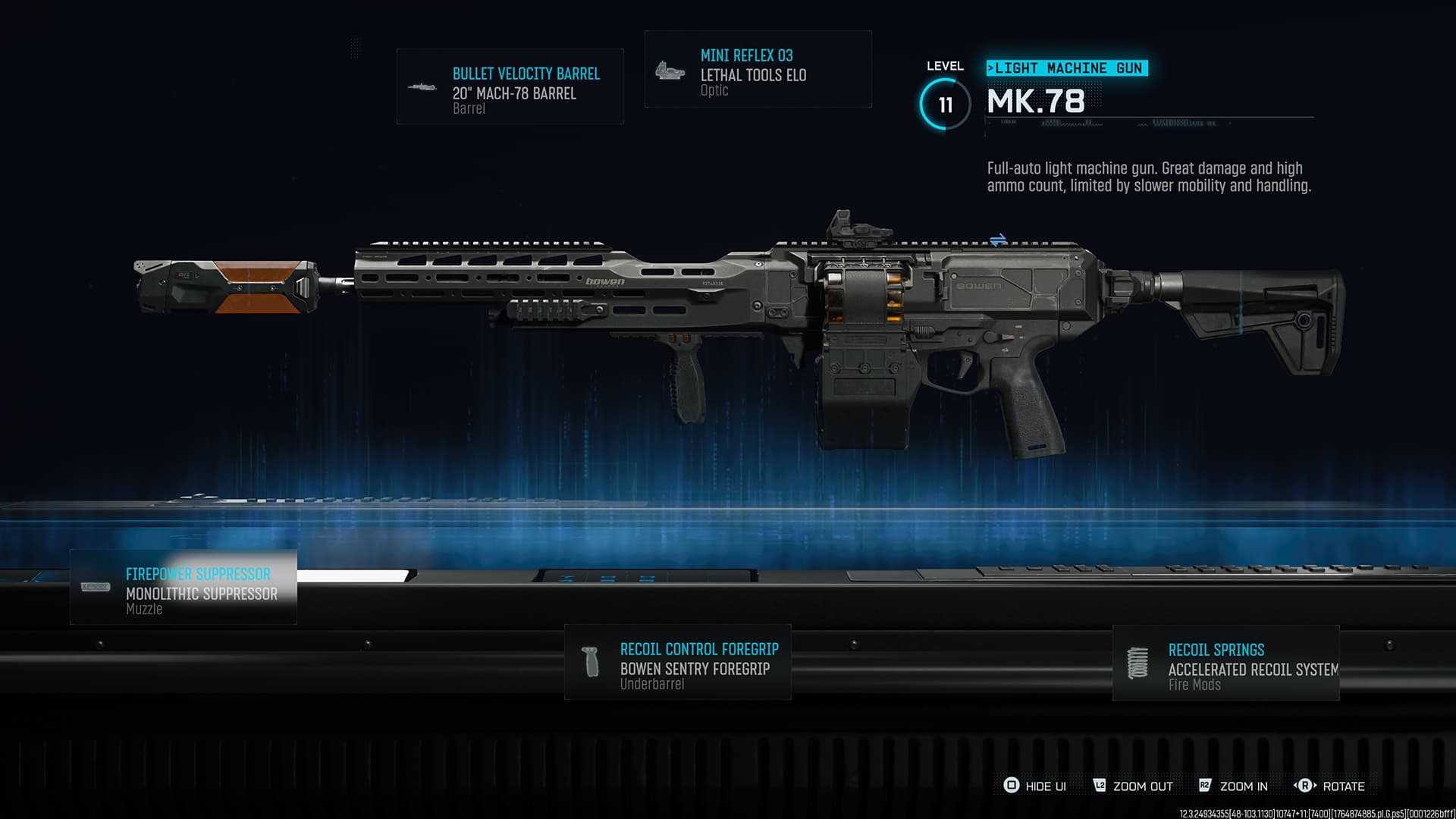
The current long-range setup goes hard on control and reach, and it does not waste slots trying to make the MK.78 into something it is not. The core package is the FANG Hoverpoint ELO optic, Monolithic Suppressor, 22-inch Impulse HB-762 Barrel, VAS Convergence Foregrip, and Shock Shield Stock.
Here is what that combination is doing:
- FANG Hoverpoint ELO gives you a clean sight picture for disciplined burst control at distance.
- Monolithic Suppressor keeps you quieter while supporting the long-range role instead of advertising your position.
- 22-inch Impulse HB-762 Barrel pushes the gun toward the kind of bullet velocity and effective range you need for distant fights.
- VAS Convergence Foregrip is there for recoil control, plain and simple.
- Shock Shield Stock helps the weapon settle into sustained fire instead of bouncing around when you hold the trigger.
That mix is why the build feels so much better once you settle into longer engagements. It is especially strong beyond 50 meters, where a lot of players start losing precision with more mobile guns. A current third-party loadout tracker like WZStats and MetaRadar lists the same attachment core for MK.78 long-range builds, which tells you this is not just a theorycrafting exercise. The same parts keep showing up because they solve the same problem.
How to run the class around it
The MK.78 should be the primary weapon in this class, not the thing you swap to after your real gun runs dry. The rest of the setup is there to cover the one weakness every heavy LMG has: when someone gets inside your space, you need an answer fast.
The recommended pairing is a mobility-friendly close-range option like the Kogot-7 or VST. That gives you a clean split in responsibilities. The MK.78 handles lanes, rooftops, and mid-long pressure; the secondary handles panic fights, building clears, and fast repositions.
The rest of the class keeps you aggressive without making you feel glued to the floor:
- Smoke or Stim Shot helps you cross dangerous ground or reset after a trade.
- Semtex adds a quick way to flush cover or finish a cracked player.
- Drill Instructor, Momentum, and Adaptive support pressure and keep the class from feeling overly sluggish.
That loadout structure matters because an LMG class lives or dies by tempo. If you can move once, stop, and immediately start winning a lane, the MK.78 pays off. If you keep trying to play it like an AR, you will hate it.
Why this beats the usual AR or sniper pick
This is the part people miss when they call every heavy gun niche. The MK.78 is not a replacement for an AR because it is faster, and it is not replacing a sniper because it one-taps from nowhere. It earns a slot because it is more forgiving in drawn-out lane fights than most ARs, and more reliable than a sniper when you need to keep pressure on multiple enemies instead of waiting on bolt cycles and perfect shots.
In live Warzone, that difference is huge. A team trying to rotate across open ground feels the MK.78 immediately. A few seconds of accurate sustained fire can stall a push, drain plates, and force a bad route. That is the kind of value that wins squads games even when nobody clips it for social media.
The tradeoff is just as important. You give up mobility and handling, and if you want to sprint around buildings or challenge tight corners, this is the wrong tool. The MK.78 is for players who want to own a sightline, not chase every fight on the map.
Why the timing matters right now
Warzone’s current balance cycle makes this build more interesting than it would be in a frozen meta. Season 03 Reloaded added the MK.78 Lightframe PDW Conversion, and that attachment pushes the gun toward a more mobile, aggressive style at the cost of extra recoil and reduced damage range. That is useful if you want a different flavor of the weapon, but it also proves the same point: the MK.78 only stays special when you decide what job it is supposed to do.
Recent patch notes have also shown that long-range attachment power is being tuned more aggressively across the sandbox. The Monolithic Suppressor has already taken hits to its bullet velocity and damage-range benefits on other weapons, which means you cannot rely on one attachment to carry the entire class anymore. Long-range dominance now comes from stacking several small advantages at once, and this build does exactly that.
That is why the MK.78 feels relevant in the current game instead of just experimental. It fills a real role for squads that need a dependable long-range anchor, and it does so with a setup that respects how Warzone is being balanced right now. If you need a gun that keeps lanes closed and lets your team move first, this is not overhyped at all. It is the kind of LMG that earns its place by doing one job better than most of the flashy options around it.
This article was produced by Prism’s automated news system from verified source data, official records, and press releases, then run through automated quality and moderation checks before publishing. The system is built and supervised by the people who set the standards it runs under. Read our full AI policy.
Did this article answer your question?