Baltic Yachts builds 33-metre catamaran Zeteo, pushing into multihulls
Baltic's first catamaran is more than a debut: Zeteo shows how a monohull carbon specialist is solving weight, structure and flow for bluewater multihulls.
Baltic’s first catamaran is a real shift, not a styling exercise
Baltic Yachts is not easing into multihulls with a token dayboat. Zeteo is a 32.90-metre carbon catamaran that asks a yard famous for advanced monohulls to rethink structure, sequencing and onboard flow from the keel up. In Jakobstad, the deck modules are already in lamination while hull outfitting is underway, which tells you this is a serious build, not a presentation model.
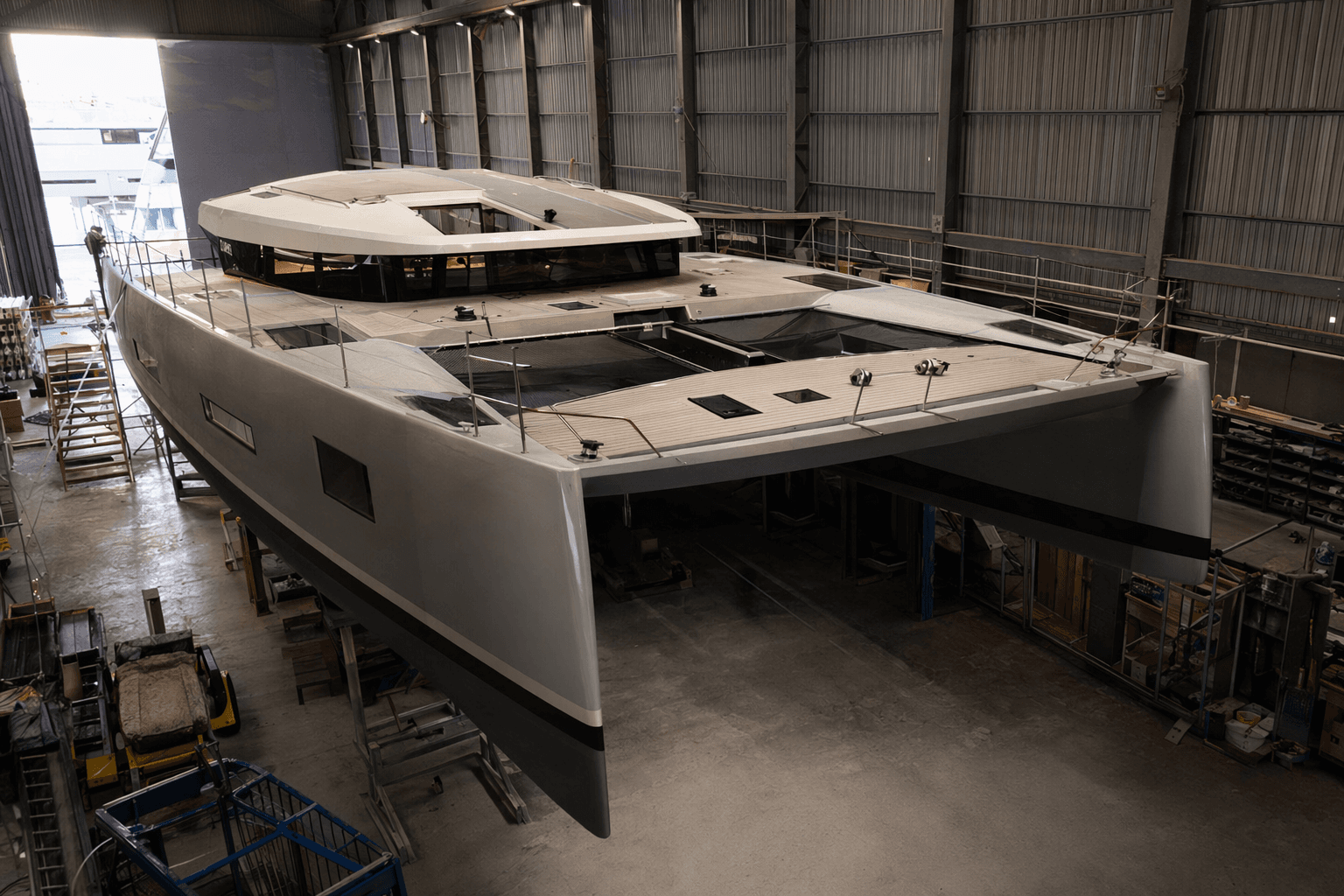
What makes the project so interesting is that Baltic is bringing its carbon know-how into a platform that obeys different rules. A catamaran spreads loads differently, carries its weight differently, and forces every plan decision to work harder than it does on a single-hull yacht. That is exactly why Zeteo matters to anyone watching the premium cat market.
Why the Baltic 107 is a genuine multihull milestone
This is Baltic Yachts’ first-ever multihull after more than 50 years of monohull production, and the yard is treating it as a major milestone. The contract was signed in June 2024, the yacht was publicly unveiled on 23 September 2024, and delivery is scheduled for summer 2027. For a builder with a reputation built on high-performance composite monohulls, that timeline signals commitment rather than experimentation.
The numbers reinforce the point. Zeteo, also identified as the Baltic 107 catamaran, measures 32.90 metres overall, has a 31.50-metre waterline, a 13-metre beam, draft of 1.7 metres raised and 5.0 metres lowered, and a light displacement target of 85 tons. Those figures place it firmly in the serious bluewater superyacht category, but with the volume and stability advantage that only a catamaran can bring.
That broad beam and shallow draft are not just spec-sheet theatre. They shape how the yacht will live at anchor, how it will settle under sail, and how much usable interior volume Baltic can carve out without making the boat feel bloated. In a market full of oversized “floating penthouses,” Zeteo is being positioned as something more disciplined.
The real challenge is structural, not cosmetic
The hard part of moving from monohulls to multihulls is not drawing two hulls instead of one. It is learning a different structural language. Load paths, stiffness targets, bridging structure, and the sequence of assembly all change, and Baltic is having to absorb those differences while maintaining the finish quality the yard is known for.
That is where the bridge-deck becomes a pressure point. On a catamaran, the bridge-deck has to do more than connect the hulls. It has to manage stiffness, control weight, reduce noise and keep the boat from feeling compromised when the sea state starts loading the platform. A lightweight structure that is too flexible becomes noisy and tiring; a structure that is too heavy erodes the very advantage that drew the owner to a cat in the first place.
Baltic’s own presentation makes clear that this yacht is about more than shallow draught and volume. The build is intended to deliver a quality of finish that the yard says has not yet been seen on a multihull. That matters because premium catamaran buyers increasingly expect monohull-level detailing without sacrificing the performance and autonomy that make a catamaran compelling.
A cruising brief with a real purpose
Zeteo is not being framed as a floating lounge with a pair of hulls attached. The owner brief calls for a long-range explorer yacht that can go almost anywhere, with especially strong light-wind performance and high autonomy from shoreside support. That gives the project a practical edge and pushes it into the part of the market where comfort has to coexist with serious passage-making.
Baltic says the yacht is meant to combine stylish looks with strong sailing performance, sustainability-minded construction and sustainable operation. Kenneth Nyfelt has described the goal as exceptionally high comfort, beauty and reliability, plus “groundbreaking developments in efficiency.” That is the right lens for a multihull like this: the yacht has to work hard, but it also has to make long-distance cruising feel easy.
- pivoting centreboards for better upwind performance and draft control
- low interior noise, especially in owner and guest spaces
- 360-degree saloon views that make the volume of a catamaran feel open rather than cavernous
- propeller-based energy regeneration while sailing, adding to onboard self-sufficiency
The boat’s features point in that direction:
Those are not decorative add-ons. They are the sort of details that separate a premium cruising cat from a stretched-out entertainment platform.
What the team says about where multihulls are going
The design group behind Zeteo is as telling as the hull form itself. Naval architecture is led by Berret-Racoupeau Yacht Design, with interior design by Jamie Bush & Co, structural engineering by Rivoyre Ingenierie, design consultancy by Andrea Chiari-Gaggia and Patrick Sassier acting as owner’s representative. That lineup says Baltic is not treating this as a side project. It is assembling the kind of specialist team you would expect around a custom superyacht of this size.
Olivier Racoupeau has framed the project as a natural step for a team with multihull experience, with the idea being to combine volume and global cruising comfort with an elegant, performance-oriented catamaran. That description fits the market shift underway. Premium buyers no longer want to choose between efficient sailing and high-end living spaces. They want both, and they want the engineering to disappear behind the experience.
By June 2025, reporting said the hulls were already well advanced and the twin hulls were out of the mould, with Baltic describing the boat as an Explorer while keeping the usual yard themes of comfort, performance and minimum weight. That matters because it shows the program is moving through the difficult part of the build, where theory meets real composite structure.
Why Zeteo points to the next phase of luxury cat design
The deeper lesson in Zeteo is that multihull luxury is becoming less about volume for its own sake and more about how intelligently that volume is used. Baltic’s move into cats shows where the top end of the market is heading: more carbon, more hybrid thinking, more self-sufficiency, and more attention to how the boat actually feels when you move through it underway.
That is why the project feels bigger than Baltic’s first catamaran badge. A monohull specialist is being forced to think like a multihull builder, and that shift is visible in the structure, the weight target, the saloon layout, and the cruising brief. Zeteo is not just Baltic’s first multihull. It is the yard’s proof that the future of high-end catamarans will belong to builders willing to relearn the basics and get the bridge-deck, the load paths and the onboard flow right from the start.
This article was produced by Prism’s automated news system from verified source data, official records, and press releases, then run through automated quality and moderation checks before publishing. The system is built and supervised by the people who set the standards it runs under. Read our full AI policy.
Did this article answer your question?