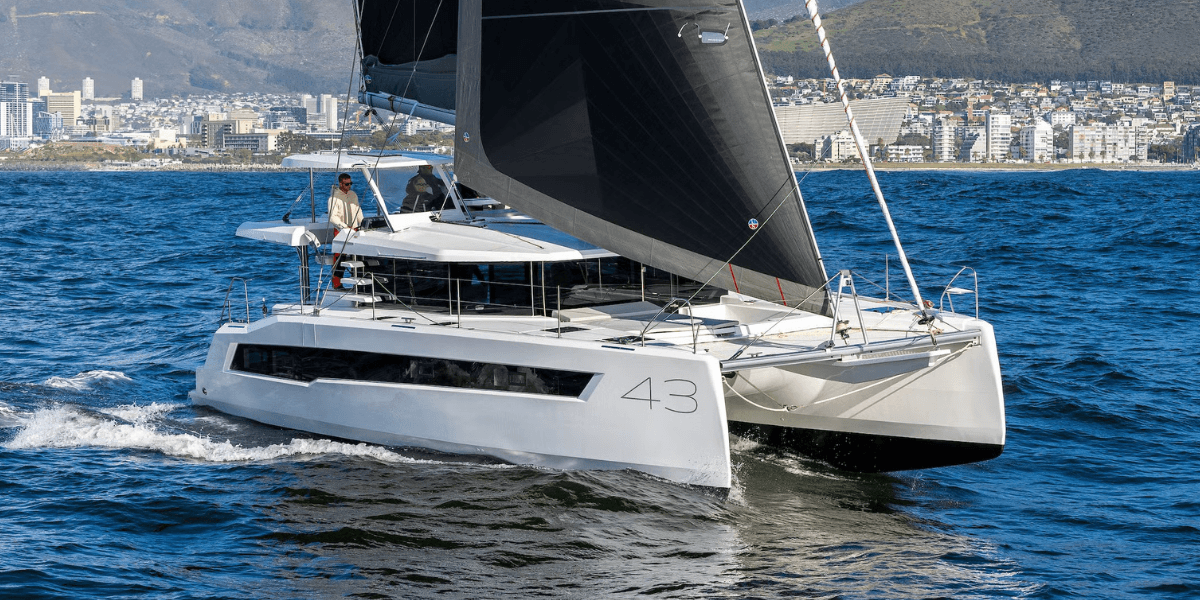
How to control catamaran sails as wind builds quickly
A catamaran can stay level while the rig is already overloaded, so the safest move is to reef early and trim with the traveler, vang, and cunningham before the wind spikes.
When a catamaran stays flat, the rig may already be asking for help
A cruising cat can look composed right up until the moment the sail plan starts driving too hard. That is the trap for monohull sailors moving aboard a multihull: the boat gives fewer heel clues, but the big mainsail is still the primary engine, and it can load up fast when wind builds or a downwind run turns active.
That is why cat handling is less about waiting for drama and more about reading the rig early. The wide beam, low center of gravity, and powerful roach mainsail that help a catamaran carry speed also mean the controls have to stay organized, smooth, and ready to depower before the sail plan becomes hard to tame.
The first mistake: waiting for heel to tell you it is time
On a monohull, heel is an obvious warning sign. On a catamaran, the warning is muted because the boat heels much less, which means the sailor gets fewer visual clues that the boat is becoming overpowered. By the time the deck starts feeling busy, the sail plan may already be carrying more load than is comfortable for cruising.
That is why reefing on a multihull is tied to wind speed and anticipation, not heel angle alone. The practical habit is simple: shorten sail before the boat feels pressed, not after it starts telling you so. On a cat, that often means reefing earlier than you would on a monohull of similar length, especially when a forecast front, gust line, or building sea state is part of the picture.
The second mistake: treating the mainsheet as the only throttle
A catamaran’s mainsail is not just another sail. Industry guidance treats it as the prime source of drive and power, which means mainsail control has to be more deliberate than a casual sheet-in, sheet-out routine. If you try to manage all the power with one line, the boat can feel abrupt instead of balanced.
The real control package is broader: traveler, mainsheet, boom vang, backstay tension, outhaul, and cunningham all work together to shape the sail and keep the load where you want it. The traveler is often the cleanest first adjustment because it changes the boom’s angle without immediately choking the leech. The mainsheet then fine-tunes power, while the vang, backstay, outhaul, and cunningham help flatten, tension, and stabilize the sail as the wind builds.
The third mistake: waiting until the reef is a rescue operation
Cruising cats reward early reefing because the main is such a large part of the drive. Letting the rig stay overpowered too long makes every later adjustment harder, and it can turn a routine reduction of sail into a clumsy, high-load job. Once friction builds in the system, even the right correction feels laborious.
The better habit is to reef while the controls still feel clean. If you are still making smooth traveler and mainsheet adjustments, that is the moment to shorten sail. Reefing should be normal seamanship, not a sign that things have already gone wrong.
The fourth mistake: ignoring friction and clutter in the control system
A catamaran’s handling gets messy fast when the controls are not organized. The updated Cruising World guide emphasizes managing friction so adjustments stay smooth and predictable, and that point matters because a loaded multihull sail plan does not forgive sticky hardware or tangled priorities.
- Lead and stow lines so the reefing sequence is obvious.
- Check that the traveler, mainsheet, and vang can move without hesitation.
- Make sure the outhaul and cunningham are ready to flatten the sail before the load peaks.
- Use backstay tension intentionally, not as an afterthought.
Before the wind builds, make the system easy to use:
The goal is not just speed. It is reducing the chance that a crowded cockpit and a loaded main turn a simple trim change into a scramble.
Why catamaran sail control feels different from monohull sailing
The transition from monohull to cat is really a transition from heel management to balance management. On a monohull, a sailor often reads comfort through angle. On a catamaran, you have to read power through speed, helm feel, sail shape, and how quickly the boat responds to small changes. That is a big shift, and it is why experienced multihull sailors talk about anticipation more than reaction.
It also explains why catamaran rigs are built the way they are. Rolly Tasker Sails describes the multihull mainsail as the prime source of drive and power, and notes that cruising cat rigs are designed with a fairly low center of gravity to withstand enormous loads while countering excessive heeling forces. In practice, that means the boat can carry power efficiently, but only if the sail plan is kept under control before the loads stack up.
Training standards reflect how serious the learning curve is
US Sailing’s Cruising Catamaran Endorsement puts structure around that learning curve. The course and examination are conducted on a catamaran of at least 34 feet, with wheel steering, twin engine auxiliary power, and an adequate equipment inventory. Those requirements reflect the reality that multihull handling is not just about sail trim, but about handling a larger, more system-heavy platform with real consequences if the sail plan gets away from you.
That is also why a good multihull training mindset starts with the basics and repeats them under pressure. You do not wait for the breeze to become difficult before deciding whether the sail plan is set up correctly. You prepare the boat so that the first gusts can be handled cleanly.
The four traps to avoid when the breeze comes up
When wind builds quickly, most catamaran mistakes fall into a few familiar traps:
- You wait for heel that never really arrives, so the rig stays loaded too long.
- You try to solve everything with the mainsheet instead of using the traveler and sail-shaping controls.
- You put off reefing until the sail plan is already hard to manage.
- You let friction, clutter, and hesitation make every adjustment slower than it should be.
Each of those errors is more costly on a cat than on a monohull because the boat gives fewer visual warnings and more immediate power once the main is fully engaged.
Save this before the next windy passage
Use this quick conditions-based check before you leave the dock or before the next squall line arrives:
- If the forecast shows building wind, reef early rather than waiting for heel.
- If the boat feels quick but the controls are getting heavy, reduce load before the sail plan becomes hard to tame.
- If the downwind run starts to feel lively, organize the traveler, mainsheet, and vang first, then shorten sail if needed.
- If the sail is deep and driving too hard, flatten it with outhaul and cunningham before reaching for heroic sheet adjustments.
- If the controls feel sticky or crowded, clear friction and reset the deck layout before the gusts arrive.
- If you are still comfortable making small, smooth changes, that is the best time to reef, not the last.
A catamaran can look calm while the rig is already working hard, and that is exactly why the smartest sailors act before the boat starts asking louder questions. The flat ride is not the warning sign, the loaded main is.
This article was produced by Prism’s automated news system from verified source data, official records, and press releases, then run through automated quality and moderation checks before publishing. The system is built and supervised by the people who set the standards it runs under. Read our full AI policy.
Did this article answer your question?