Leopard 53 Powercat shows how fuel efficiency expands cruising freedom
The Leopard 53’s real win is not headline speed, but fewer fuel stops and more routing freedom on Florida and Bahamas passages.
Fuel efficiency is the difference between a trip and a plan
The Leopard 53 Powercat makes a simple point that a lot of brochure talk misses: efficiency matters most when you are drawing actual lines on a chart. A boat that burns less fuel does more than save money at the dock. It changes whether Fort Lauderdale to Key West feels easy, whether Miami to Bimini is just a quick hop, and whether Miami to Nassau still leaves you with a comfortable margin instead of a white-knuckle fuel calculation.
That is why the Leopard 53 is worth talking about in practical terms, not just as a spec sheet. Leopard says the boat is up to 50% more fuel efficient than monohull motor yacht counterparts, and in this market that kind of claim only matters if it translates into real cruising freedom. Here, it does.
Why the Leopard 53 stands out in the Leopard line
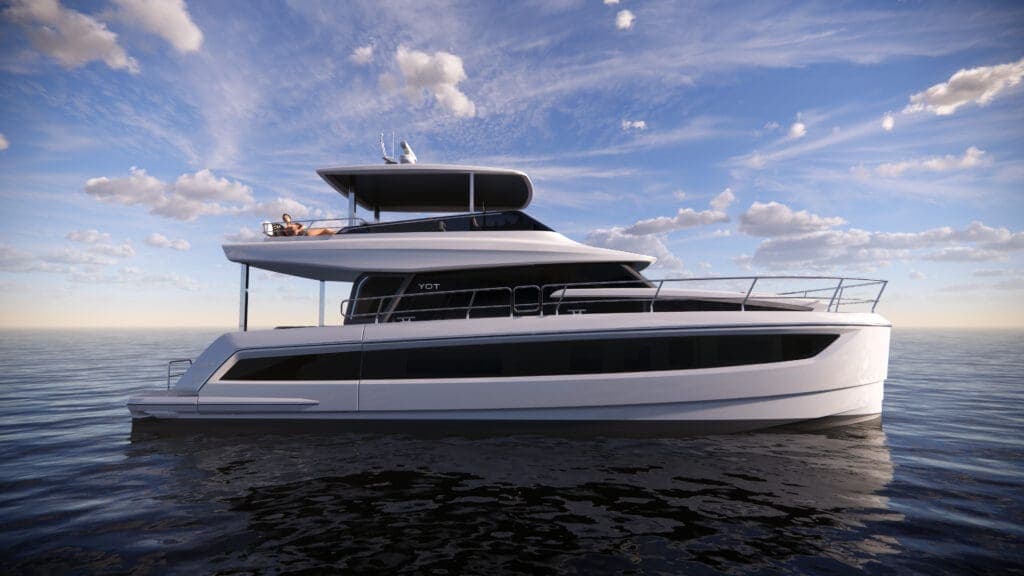
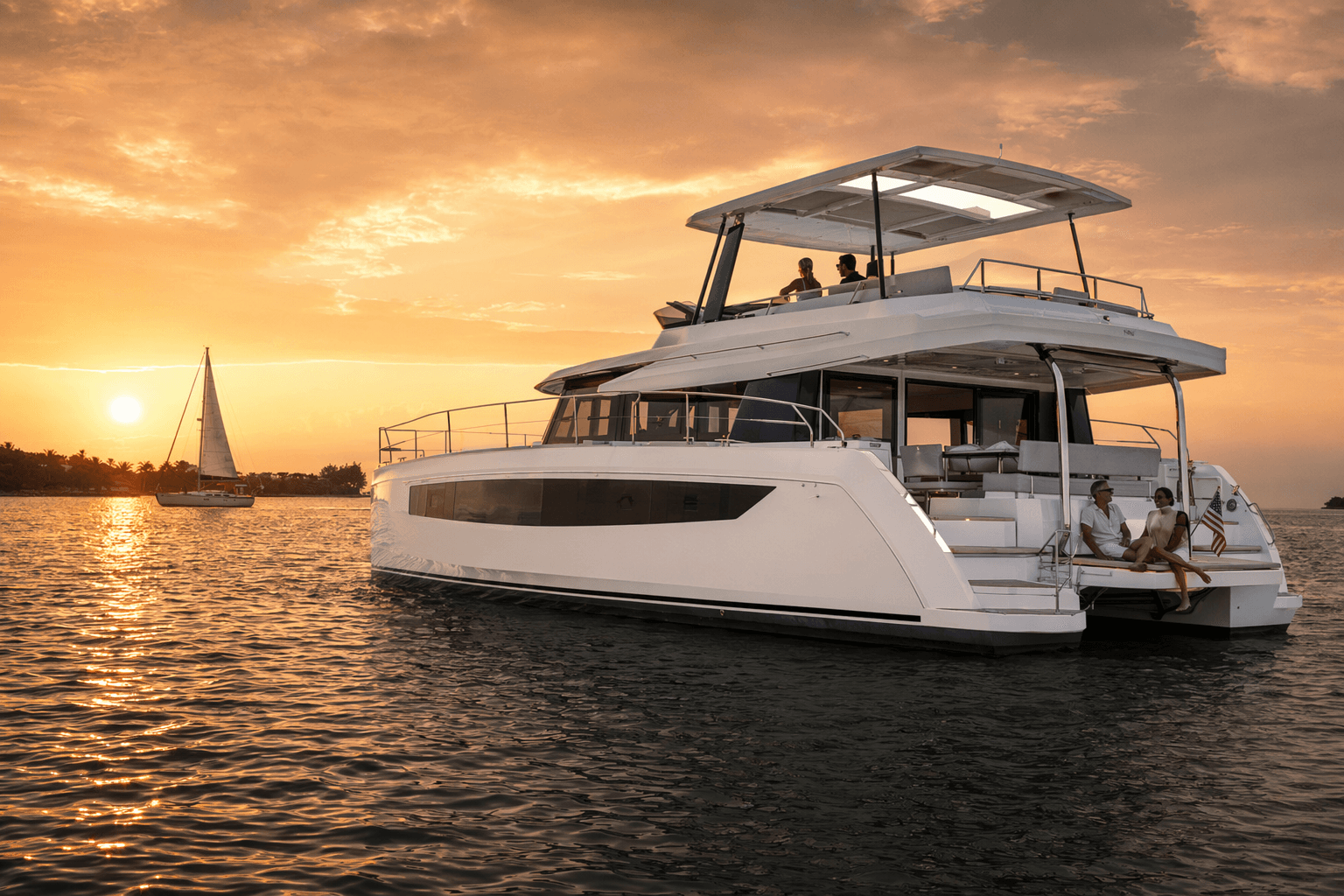
The 53 Powercat is Leopard’s largest power model, and it arrived with a lot of significance attached to it. Leopard named it the 2020 Multihull of the Year winner, and the model made its world debut at the Miami International Boat Show in February 2020. It succeeded the Leopard 51 Powercat, which Leopard describes as the most popular powercat of all time, so the 53 was never just a replacement. It had to carry the line forward.
That pedigree matters because the boat was conceived as a pure motoryacht from the start, not as a sail-cat conversion. Leopard and Robertson & Caine build it in Cape Town, South Africa, and that design approach shows in the way the platform is discussed: as a cruising machine built around usable range, comfortable passage making, and enough pace to keep a plan flexible. Leopard says 141 units had been delivered to date on its current product page, which tells you this is not a niche experiment. It is a proven production boat with a real owner base.
What fuel efficiency actually means offshore
The biggest trap buyers fall into is thinking fuel burn is only about cost per gallon. On a power cat like the Leopard 53, fuel efficiency is really a routing tool. It changes how many stops you need, how much weather slop you can tolerate, and how confident you feel when the next fuel dock is not exactly where you want it to be.
That difference is especially clear in the Florida and Bahamas examples Leopard likes to use. Miami to Bimini is a short crossing, and on a boat like this it barely dents the overall fuel picture. Miami to Nassau is longer, and that is where a fuel-efficient platform earns its keep. You are not forced to organize the whole trip around refueling; you can build the passage around comfort, sea state, and the kind of day you actually want to have.
How to read the performance curves without kidding yourself
Leopard’s performance-curve material is the part serious owners should pay attention to. It includes trial data for trial, half-load, and full-load conditions, and it charts both speed in knots and fuel consumption in nautical miles per liter and miles per gallon. That matters because a catamaran never lives in brochure conditions. Tanks are full one day, provisions are heavier the next, and a family cruise out of South Florida will not load the boat the same way as a charter-style delivery run.
The curves are not just technical decoration. They are the closest thing you get to a trip-planning map. If you know how the boat behaves at a realistic cruising speed, you can choose a route and still preserve a margin. That margin is the whole game offshore. It is the difference between arriving with confidence and arriving with a fuel guess.
Miami to Key West: a leg that rewards margin, not bravado
Fort Lauderdale to Key West is the kind of passage that makes range meaningful in a very ordinary way. You are not trying to prove anything, but you are making a real day of it, and the boat has to handle that without turning every tank calculation into a chore. On the Leopard 53, the point is not to run flat out just because the twin Yanmar 8LV370 diesels can push the boat past 23 knots.
The smart move is to pick a cruising speed that suits the sea state and your schedule, then let the efficiency curve do the work. A boat that preserves fuel at sensible speeds leaves you room for detours, weather changes, and the occasional long lunch without making the return trip feel like a gamble.
Miami to Bimini: the short hop that proves the point
Miami to Bimini is the easy example, but easy does not mean irrelevant. Short crossings are where people often get lazy with planning, assuming any modern powercat will do the job. The Leopard 53 makes that leg feel almost trivial, which is precisely why its efficiency story matters. A boat that handles a quick crossing without drama gives you more options on the far side, not just a smoother ride getting there.
That kind of freedom is especially valuable for owners who split their time between private use and charter-style thinking. The Moorings association matters here because charter operators care about exactly this problem: keeping itineraries flexible without burning through fuel and schedule at the same time. Efficiency is not a luxury in that world. It is operating margin.
Miami to Nassau: where range becomes confidence
Miami to Nassau is the better stress test because it stretches the same logic over a longer run. A less efficient power yacht can still make the passage, but it often does so with less room for error and more pressure to plan around fuel. The Leopard 53’s argument is that you should not have to organize the entire trip around the fuel dock.
That is where the boat’s claimed 50% efficiency advantage over monohull motor yacht counterparts becomes more than marketing. It means more realistic route options, fewer compromises, and a better chance of arriving with enough reserve to enjoy the destination instead of immediately calculating the next fuel stop. For owners who like the Bahamas but dislike anxiety, that is a real selling point.
The 2026 update adds comfort to the efficiency story
The revised 53 Powercat, launched in December 2025 and shown publicly for the first time at the Miami International Boat Show in February 2026, pushes the same idea in a more refined direction. The update emphasizes larger social spaces and reduced noise and vibration, which is exactly where a modern powercat should be improving. Efficiency gets you the range, but comfort is what makes you use it.
That combination matters because most owners do not run maximum speed for its own sake. They want a boat that can cover water cleanly, keep the ride civilized, and still leave them with enough fuel confidence to take advantage of a weather window. The 53 does that while still offering a maximum speed in excess of 23 knots with twin 370 hp Yanmar engines.
Why this model has stayed relevant
The reason the Leopard 53 remains such a useful benchmark is that it ties together scale, real-world range, and a proven ownership base. It is the brand’s largest power model, the successor to a beloved predecessor, and a boat with enough production history to matter beyond launch-day hype. Add the Cape Town build quality, the Multihull of the Year recognition, and the updated 2026 comfort tweaks, and you get a platform that is still evolving without losing its core purpose.
For buyers comparing motor yachts and power catamarans, the lesson is straightforward. Do not stop at headline speed. Look at the performance curves, think about your actual legs, and ask whether the boat gives you more choices when you are offshore. On the Leopard 53 Powercat, that is where fuel efficiency pays off: fewer compromises, fewer fuel stops, and a lot more confidence when the horizon gets longer.
This article was produced by Prism’s automated news system from verified source data, official records, and press releases, then run through automated quality and moderation checks before publishing. The system is built and supervised by the people who set the standards it runs under. Read our full AI policy.
Did this article answer your question?