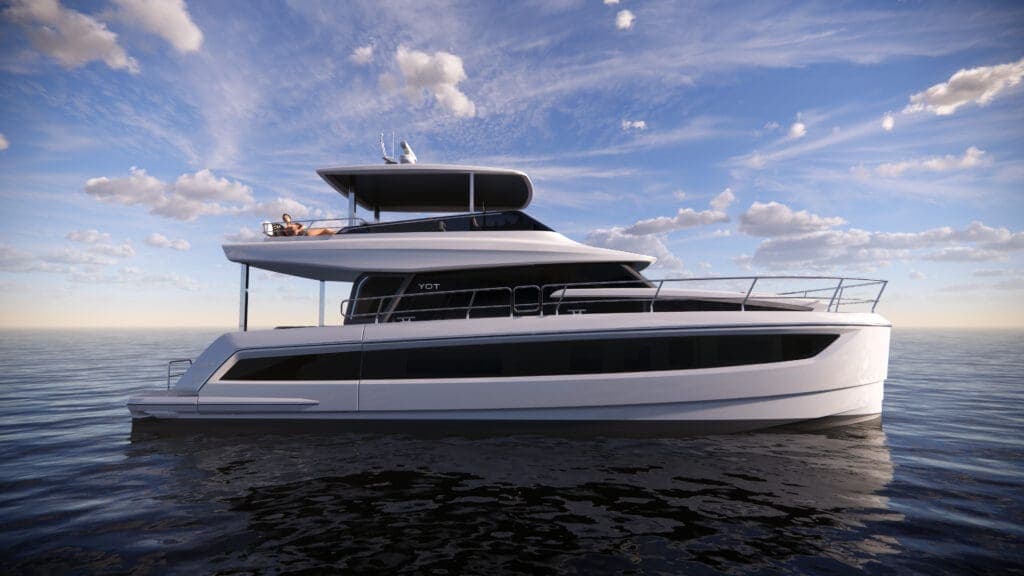
Prestige M7 review spotlights a 59-foot powercat with yacht-like comfort
Prestige’s M7 is trying to normalize the big powercat for monohull buyers. The real story is not speed, but how much livable space and shallow-water freedom a 59-footer can package.
Prestige’s new powercat pitch is not about bragging rights
The Prestige M7 is not trying to win the powercat arms race on sheer speed. It is trying to make a 59-foot multihull feel like the sensible upgrade for owners who want more room, more stability, and more usable cruising life without jumping into a much larger motor yacht.
That is the part of this boat that matters most. Prestige, a brand that built its reputation around approachable cruising yachts, is using the M7 to say the multihull market has matured enough to be a mainstream move, not a niche detour. And because the boat sits between the M48 and M8 in the M-Line, it reads less like a one-off experiment and more like a deliberate attempt to build a real family of powercats.
What the M7 says about where powercats are headed
For years, the big objection to powercats from conventional yacht buyers has been simple: they look broad, feel different, and can seem like a compromise if you are coming from a monohull. Prestige is clearly attacking that hesitation head-on. The M7’s pitch is that you get the catamaran advantages that matter in real cruising, then package them in a layout that still feels familiar enough for monohull owners to cross over.
That is why the review framing around this boat is so revealing. The M7 is not being sold as a floating novelty. It is being presented as a serious answer to a market question: how do you give owners more volume, better shallow-water access, and easier social living without making the boat feel overly technical or overly compromised? Prestige’s answer is to lean into comfort, serenity, and a layout that feels more like a private residence than a stripped-out performance multihull.
Space is the M7’s strongest card, and it uses every inch
The numbers tell the story fast. Prestige says the M7 offers about 200 square meters of living space, and the 24-plus-foot beam is doing a lot of that heavy lifting. Inside, nearly 7 feet of salon headroom keeps the main deck from feeling tunneled or enclosed, which is one of the easiest ways for a cat to feel bigger than its length.
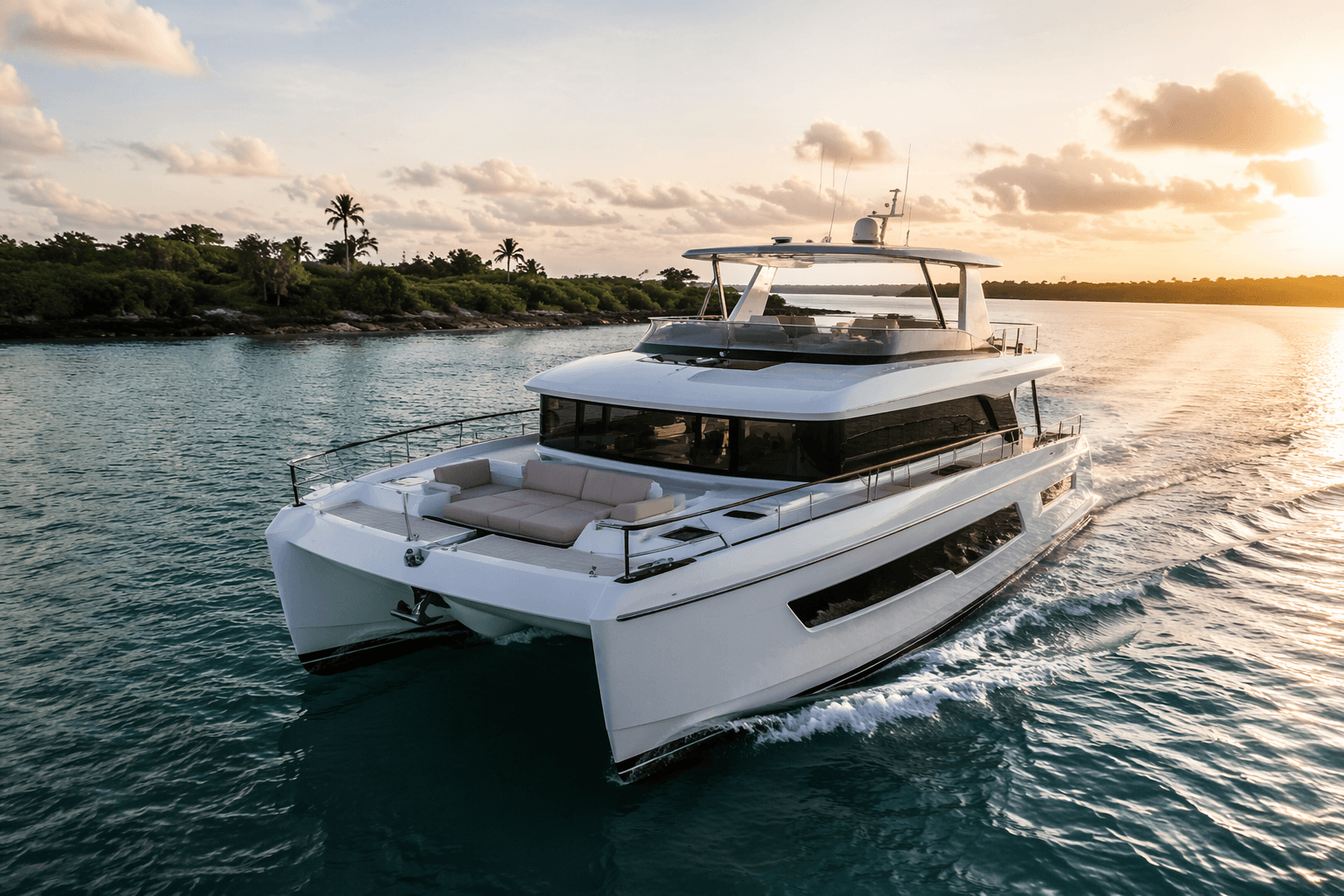
The layout details matter just as much as the raw measurements. The 88-inch sliding doors and the near-continuous sightline from the cockpit forward to the salon windows create one long social zone instead of three separate compartments. When the aft doors slide back, the boat opens up like a beach house, and that is exactly the right metaphor for the way this design works at anchor or on a slow evening cruise.
The owner’s suite is a major part of that argument too. Set forward on the main deck, it is about 20 square meters and includes an ensuite, storage, and a desk area. That is not just generous for a catamaran. It is a direct statement that Prestige wants the M7 to deliver apartment-like comfort without giving up the structural advantages that make a multihull appealing in the first place.
This is still a cruising boat, not a spec-sheet stunt
Prestige and the early sea-going impressions both make a point of avoiding the pure speed story. Twin Volvo Penta D8-550s push the M7 to about 22 knots, which is plenty for a boat in this category, but the bigger headline is how quietly and efficiently it is supposed to cruise. That is the right emphasis for a yacht like this. Buyers shopping at this level want usable range, civilized noise levels, and a boat that feels relaxed rather than strained when running.
The fuel-burn claims sharpen that message. Prestige says the M7 should burn 40 percent less fuel at 22 knots and 25 percent less at 17 knots than a comparable 58-foot monohull. Whether you are looking at marina legs, island hops, or longer coastal runs, that is the kind of efficiency story that can move a buyer who is comparing operating costs as carefully as interior finishes.
Shallow-water access is another catamaran advantage the M7 clearly knows how to use. The ability to anchor in just 5 feet of water changes where this boat can comfortably live, especially in cruising grounds where monohulls of similar overall presence would be forced to stay farther off the beach or deeper in the channel.
Prestige is leaning into usability, not just luxury theater
One of the smartest details in the M7 story is the crew setup. Prestige says the boat is arranged for three staff members, which keeps operational requirements more reasonable than on larger yachts. That matters because it tells you who this boat is really for: owners who want a serious cruising platform without the staffing burden that often comes with a much bigger motor yacht.
Prestige also frames the M7 through its Art de Vivre positioning, describing it as a multihull built for serene cruising and refined comfort. That is not just marketing language. It shows up in the way the boat is presented as a private retreat, with a lifestyle-oriented layout and a fit-and-finish level meant to feel elevated rather than merely spacious. The brand’s own line about “the sound of serenity” fits the boat’s actual message better than any performance headline could.
There is also a strong manufacturing story behind the pitch. Prestige traces its roots to Jeanneau, launched its first yacht in 1989, introduced its first PRESTIGE flybridge in 2000, and marked its 5,000th yacht delivered in 2024. That history matters because it places the M7 inside an established production culture, not a startup trying to invent a market from scratch. The fact that the M7 is built in the Monfalcone factory alongside the M8 reinforces that this is a serious platform, not a speculative concept.
The launch trail shows Prestige wanted this boat seen everywhere
The M7 did not arrive through a single reveal, and that matters. Other coverage placed an early unveiling at boot Düsseldorf in January 2025, while Prestige’s own rollout pointed to private Mediterranean viewings in summer 2025, an exclusive preview at PRESTIGE Exclusive Days in Beaulieu-sur-Mer in August 2025, and the official world premiere at the Cannes Yachting Festival in September 2025. Later, Prestige said the boat had its U.S. premiere in Miami Beach and picked up a nomination for Multihull of the Year.
That broad rollout makes sense for a boat with this much ambition. Prestige was not just launching a model, it was trying to normalize the power multihull in every major yacht conversation. The momentum got an extra boost when the M7 won Best Interior Design in the Catamaran category at the 2025 World Yachts Trophies in Cannes, which confirmed that the boat’s appeal was not limited to layout talk and spec-sheet math.
The Prestige M7 ends up saying something clear about the powercat market right now: buyers are no longer being asked to choose between catamaran space and yacht-like polish. This boat argues that the best new powercats can give you both, and for a lot of owners coming out of conventional cruising yachts, that is the first multihull case strong enough to feel like an upgrade rather than a trade-off.
This article was produced by Prism’s automated news system from verified source data, official records, and press releases, then run through automated quality and moderation checks before publishing. The system is built and supervised by the people who set the standards it runs under. Read our full AI policy.
Did this article answer your question?