Sunreef says owner expectations are reshaping luxury catamaran design
Nicolas Lapp’s message is blunt: luxury catamaran buyers now want quieter, cleaner boats shaped around how they actually travel.
Owner expectations are now the design brief
Nicolas Lapp’s interview lands on a simple but loaded question: what exactly are owners demanding now that is visibly changing Sunreef’s boats? The answer is bigger than styling. Sunreef is talking about propulsion choices, sustainability, privacy, autonomy, and the overall onboard experience as if they all belong in the same design conversation, because for today’s buyers, they do.
That shift matters because Sunreef is not describing a niche experiment. The Poland-based builder presents itself as a company that designs, builds, and charters luxury yachts from 60 to 200 feet, and it has spent years translating changing buyer expectations into actual platforms. In practice, that means the brief is no longer just “make it larger” or “make it sleeker.” It is now about how quietly the boat moves, how long it can stay self-sufficient, and how the layout supports life on board rather than just movement between destinations.
Propulsion has become part of the lifestyle story
Sunreef’s ULTIMA range shows how directly the yard is responding to this new mindset. The line was unveiled on March 16, 2023 as a family of hi-tech hybrid-powered catamarans, and Sunreef explicitly described it as a response to “new market demand.” That framing is important: propulsion is not being sold as a hidden technical upgrade, but as part of the experience owners want to have.
The ULTIMA lineup is offered in two propulsion variants. Buyers can choose twin thermic engines of 600 or 800 horsepower, or a hybrid diesel-electric system supported by rooftop solar panels and an integrated battery bank. That is a clear sign that Sunreef sees flexibility as part of the value proposition. The same platform can answer two different owner profiles: one that still wants traditional power, and another that wants cleaner running and a quieter onboard rhythm.
Sunreef’s own wording around the ULTIMA range makes the design intent even clearer. The company says, “We now have the ultimate hull shape for all those who are looking to enjoy quick getaways in speed, comfort, and style.” In other words, the hull, powertrain, and lifestyle promise are being packaged together as one decision.
Quiet cruising is no longer an extra, it is the point
The older Sunreef Eco story helps explain how the yard arrived here. The Sunreef 60 E was first unveiled at the Cannes Yachting Festival 2019, and it was already being positioned as part of a sustainable catamaran lineup. Sunreef has kept pushing the same idea, but now with more technical specificity and a much broader market message.
For Sunreef, electric catamarans are powered by lithium-ion batteries that can be replenished by solar panels, wind turbines, hydrogenerators, or a combination of those systems. That gives the company a practical way to talk about extended range, not just green branding. The Eco range is built around three benefits that Sunreef says were central from the start: noiseless cruising, vibration-free cruising, and zero-emission cruising.
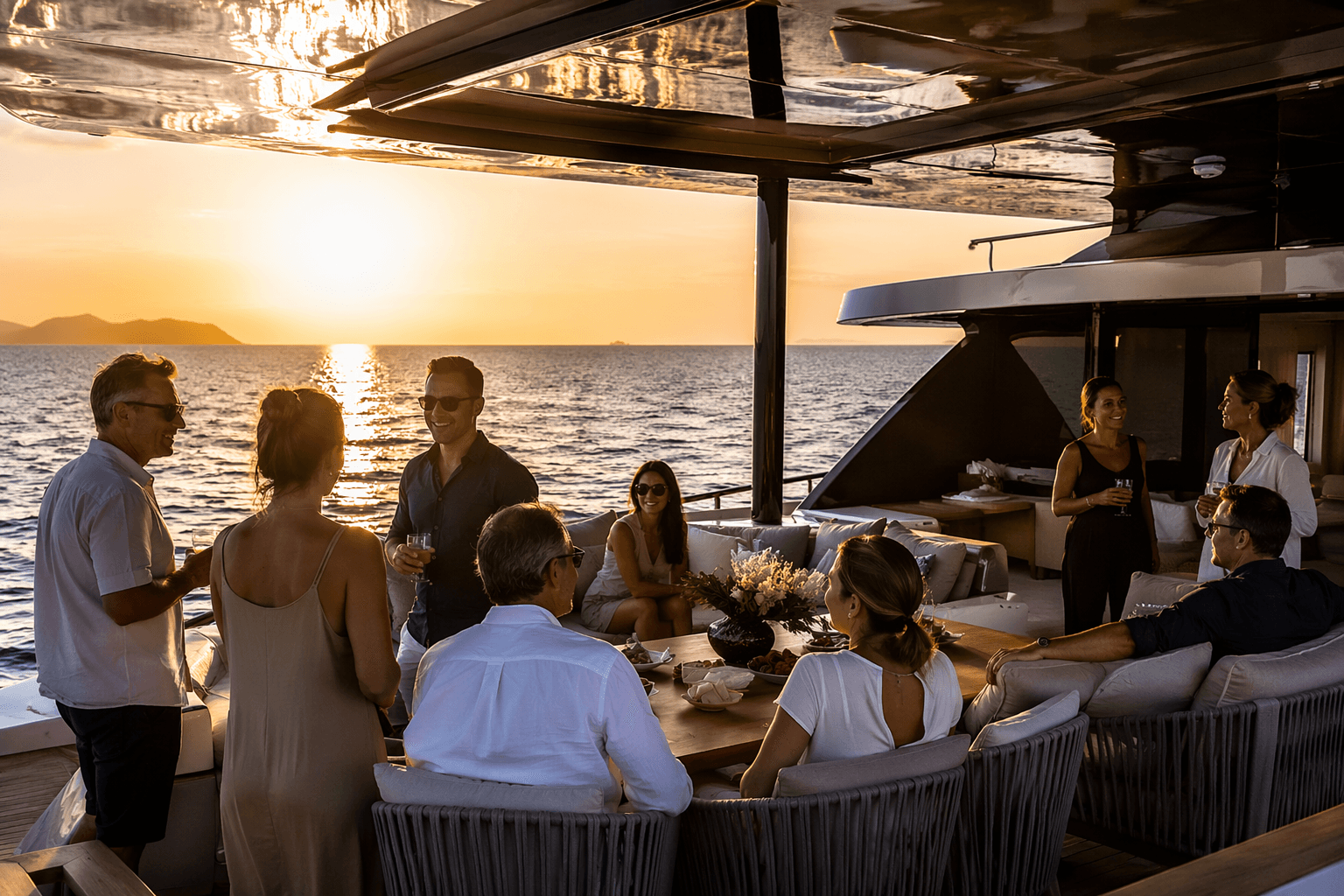
Those three promises matter because they change the way a yacht feels at anchor and underway. A quieter boat is not just easier on the environment, it is easier to live on. Less vibration means less fatigue, more comfort, and a more residential onboard atmosphere. Zero-emission cruising, meanwhile, becomes part of how owners justify using the boat more often and for longer stretches.
The clearest buyer profile is already on the water
Sunreef is not only speaking to a theoretical future buyer. The company says the Sunreef 80 Power Eco Sol was commissioned by an experienced family of yacht owners who were deeply engaged in sustainability and looking for the perfect eco-responsible motor yacht. That detail is revealing because it shows these boats are being ordered by people who already know what they want from cleaner marine technology.
That kind of owner is shaping the product in a very direct way. They are not asking Sunreef to bolt sustainability onto a standard yacht later. They are asking for a boat whose power system, energy generation, and daily use all support a lower-impact way of cruising from the start. That is where owner expectations stop being abstract and start changing deck plans, machinery choices, and the way the yacht is meant to be enjoyed.
A bigger growth strategy sits behind the design shift
The design story also sits inside a much larger commercial plan. SuperYacht Times’ company profile describes Sunreef as a major yacht designer providing exterior design, interior design, naval architecture, and new-building services, with strong recent output. The same broader corporate picture is even more ambitious: Sunreef has set a €1 billion revenue goal for 2030 as part of a Beyond 2030 roadmap focused on industrial expansion, new yacht designs, premiumisation, sustainable yachting technologies, and geographic diversification.
That matters because it explains why these owner-led design shifts are showing up so clearly now. Sunreef is not just reacting to the market in real time. It is building a brand identity around the idea that luxury multihulls can be faster, cleaner, and more customizable at the same time. The result is a product line that treats sustainability as a selling point, not a compromise.
For catamaran buyers, the new Sunreef message is easy to read. The boats are being asked to do more than look luxurious. They have to cruise quietly, support longer autonomous time afloat, reduce reliance on noise and vibration, and give owners a layout and propulsion package that reflects how they actually want to live. That is the real change Nicolas Lapp is pointing to, and it is already visible in the hulls, the power options, and the way Sunreef is defining the next generation of luxury catamarans.
This article was produced by Prism’s automated news system from verified source data, official records, and press releases, then run through automated quality and moderation checks before publishing. The system is built and supervised by the people who set the standards it runs under. Read our full AI policy.
Know something we missed? Have a correction or additional information?
Submit a Tip