Power catamarans gain appeal for stability, efficiency and family cruising
Power cats are winning buyers with stability, range and family volume, but the trade is real: more beam, higher berth costs and tighter dock planning.
The ownership decision is really about beam, volume, and how you cruise
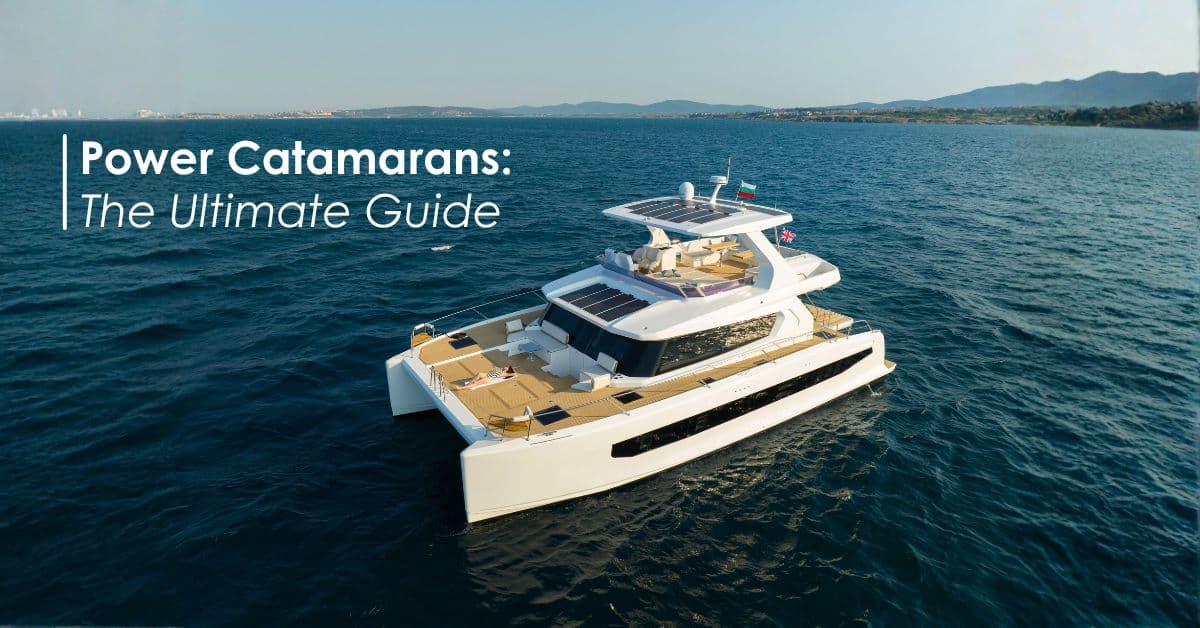
A power catamaran makes sense when you want a boat that stays level, carries its load easily, and does not punish you every time the water gets skinny. That is the basic bargain: two hulls, two engines, more usable space, and a ride that feels calmer than many comparable monohulls, with the price being a wider footprint and a little more planning at the dock.
That trade has been drawing steady attention. The design itself is ancient, traced by Britannica to twin-log craft used in the Indonesian archipelago and across Polynesia and Micronesia, but the modern market is very much current, with one industry report valuing the power catamaran segment at about $1.85 billion in 2026 and projecting growth to $3.23 billion by 2035. In other words, this is not a novelty category. It is a mature, expanding part of the market that keeps pulling in family buyers, charter operators, and owners who want comfort without giving up range.
Why powercats feel easier to live with
The first thing most people notice is stability. A twin-hulled powercat sits flatter at rest and tends to feel less fussy underway, which is exactly why families and groups keep gravitating toward them. The second draw is efficiency, especially when the platform is matched to the right engines, because the hulls can deliver better fuel economy than a comparable monohull in many real-world cruising setups.
There is also the safety-and-convenience angle that experienced owners care about most: redundancy. Two hulls and two independent engines do not make a boat invincible, but they do give real peace of mind on long runs, remote itineraries, and in less forgiving conditions. Add the shallower draft, and a powercat opens up anchorages and island-hopping routes that can be awkward or off-limits for deeper boats.
The size bands are where the ownership math changes
The smaller end of the market is where you see the easiest entry into the class. Aquila’s current range starts with the 28 Molokai, then moves through the 32 Sport and 36 Sport, which tells you how broad the category has become. Those boats are about getting the catamaran advantages, stability, shallow draft, and efficient running, without immediately jumping into the full complexity of a large yacht.
Once you move into the 42/46 Coupe and the 45/46/47/50/54 Yacht range, the conversation changes from “nice cruising platform” to “serious family or charter boat.” MarineMax’s 54-foot power catamaran, for example, is set up with five cabins so family and friends can spread out without feeling on top of one another. At the top end, Aquila’s 70 Luxury and Fountaine Pajot’s Power 67 and Power 80 are squarely in the premium space, where the goal is maximum comfort, more entertaining volume, and long-range cruising with a strong liveaboard feel.
Fountaine Pajot has also kept the lineup moving. The company lists motor yachts including the MY4.S, MY5, MY6, Power 67, and Power 80, and it announced the FP41 in September 2025 and the FP44 in January 2026. Aquila, meanwhile, says its 45 Sail is arriving in 2026, which is a useful reminder that buyers are not just comparing hull lengths anymore, they are comparing whole platform philosophies from one builder to the next.
What charter operators know that private owners should pay attention to
The charter side of the market is one of the strongest signals for where powercats fit best. The Moorings markets its power boat charters for groups of up to 12 and leans hard into island-hopping in the Caribbean, Mediterranean, and Seychelles. That tells you exactly how these boats are being used: as social platforms with enough space to keep people comfortable over multiple days, not just as floating transportation.

MarineMax’s 54-foot example points in the same direction. Five cabins make the boat useful for families and friends without forcing everyone to compromise on sleeping space, and that cabin count is part of why powercats keep winning over buyers who would otherwise default to a conventional motoryacht. If you cruise with a crowd, the extra beam stops feeling like a stylistic choice and starts feeling like the whole reason the boat works.
The dockside penalty is real, and it is mostly about beam
A wide stance is one of the category’s biggest strengths and one of its biggest ownership costs. Aquila’s 46 Coupe specification sheet lists an overall beam of 17 feet 11 inches, and that kind of width is exactly why these boats feel so roomy inside and so planted underway. It is also why marina planning matters more than it does on a narrower monohull.
One ownership-cost guide says catamaran berths can run 20% to 50% more than comparable monohull slips because of beam. That is not a small line item, especially if you keep the boat in a high-demand marina or move between popular cruising grounds. The handling side follows the same logic: a powercat is stable, but the wide footprint means you need to think ahead in tight slips, narrow fairways, and crosswind situations where the boat simply occupies more space.
How to think about engine choice and operating costs
Aquila describes the 46 Coupe as offering fuel-efficiency and range benefits with both inboard and outboard power options, and that is the sort of detail buyers should focus on. The propulsion choice affects everything from cockpit layout to service access to how you plan long passages. It also shapes operating costs, because powercats can still carry the usual ownership bills, marina fees, maintenance, insurance, fuel, and crew if you run a larger boat or use it intensively.
That is the part of the story people sometimes gloss over when they fall in love with the deck space. A powercat is not a magic cost saver, and it is not always the cheapest route into a given length class. What it does offer is a strong value proposition for owners who actually use the volume, the shallow draft, and the steadier platform.
Who should buy one, and who should think twice
If your boating life is built around family cruising, island-hopping, charter-style entertaining, or liveaboard comfort, the case for a powercat gets stronger the longer you look at it. The category is especially persuasive in shallow-water regions and places where your itinerary is defined by anchorages, beaches, and quick hops between islands. That is why the market keeps stretching from compact Aquila models to premium offerings from Aquila and Fountaine Pajot, and why the charter fleets keep loading them up with cabins.
If your priority is slipping into the tightest marina berth with the least fuss, a narrower monohull will still be easier to place. But if the opening scene in your boating life is a flat, spacious deck, family aboard, and a route that rewards shallow draft and redundancy, the powercat is hard to beat. It asks you to pay for beam, but it gives back the one thing most buyers are chasing: a boat that feels bigger, steadier, and more usable every time you leave the dock.
This article was produced by Prism’s automated news system from verified source data, official records, and press releases, then run through automated quality and moderation checks before publishing. The system is built and supervised by the people who set the standards it runs under. Read our full AI policy.
Know something we missed? Have a correction or additional information?
Submit a Tip