Sweden's Järudd and Jonsson Claim Nacra 17 Title at Trofeo Princesa Sofía
Racing sick and grieving, Emil Järudd and Hanna Jonsson mastered Nacra 17's new two-race final to win Trofeo Princesa Sofía, signalling a shift in how foiling multihull titles will be won at LA 2028.
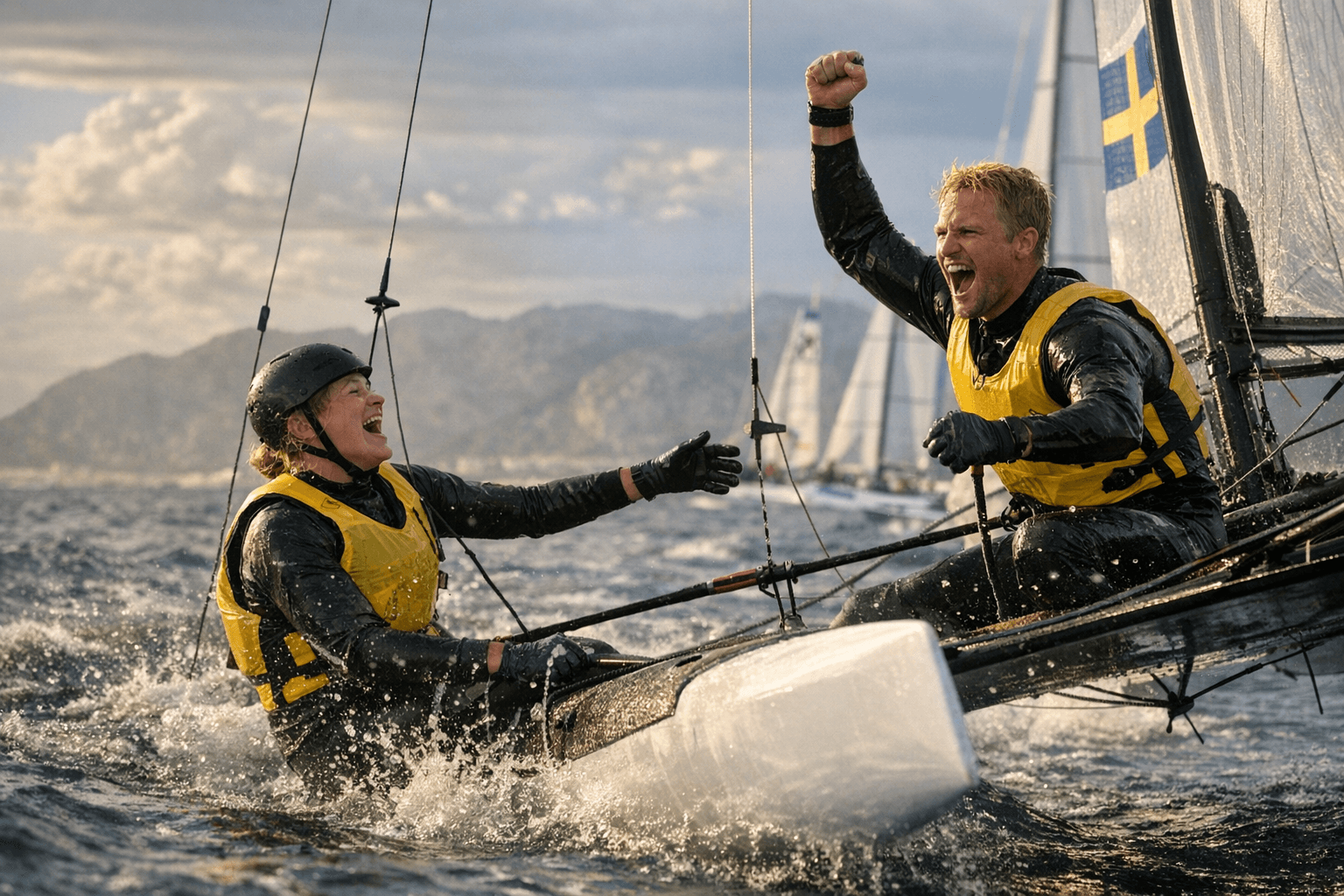
Emil Järudd and Hanna Jonsson spent most of the 55th Trofeo Princesa Sofía Mallorca fighting a flu virus. They also carried fresh family bereavements into the Bay of Palma. What they brought onto the water on Saturday's final day was precisely the kind of composure the new two-race format demands and most of the fleet had not yet figured out how to manufacture.
The Swedish pair sealed the Nacra 17 title with finishes of 5th and 2nd across the two-race decider, finishing on 20 points overall. Argentina's Mateo Majdalani and Eugenia Bosco, the 2024 Olympic silver medallists, took second overall despite a boom-breaking collision before one start that cost them a DNC. Britain's John Gimson and Anna Burnet charged from fifth place entering the final to claim bronze.
The result matters beyond the podium because of what it reveals about a format shift that will define Olympic multihull racing through the LA 2028 cycle. World Sailing replaced the single double-points medal race in the Nacra 17 with a two-race final series. Palma functioned as one of the early season tests of that revised format, and the tactical difference proved immediate. In a single winner-takes-all medal race, a team leading going in might push aggressively, gambling on a port flier or forcing a starboard cover at the first mark. Two races change the maths entirely: a 5th and 2nd does not win in isolation, but calibrated against a pre-built points cushion, it is unbeatable. Järudd and Jonsson understood that distinction from day one.
The 2023 World Championship bronze medallists delivered four race wins from six starts in qualifying, building a 12-point lead over winter training partners Mateo Majdalani and Eugenia Bosco by the time the Gold fleet phase began. Even then, with Jonsson ill, Järudd kept the approach deliberate. "We are still sailing smart and fast," he said mid-week. "Hanna is working through some sickness but I think is feeling a bit better today. Our course was very shifty but we found ourselves in phase with the shifts quite well."
"We feel so good, we have kept it simple all week, not least because we have both been sick, we are really happy," Järudd said going into the final. Keeping it simple in Palma's northerly shifts, which compressed the margins across the Gold fleet all week, is harder than it sounds. Day 4 of the Gold fleet phase produced a real mix of results for all the top teams, with shifty conditions making consistency hard to find. Majdalani and Bosco's boom-breaking pre-start collision on the final day illustrated exactly how punishing the compressed environment can be when aggression misfires.
For foiling multihull crews building toward LA 2028, Palma signals a clear training priority. A two-race final demands you can peak twice inside a morning and still execute tactical discipline on the second race when your body and your boat have already absorbed one full-intensity fight. Back-to-back high-pressure sessions, not single medal-race simulations, should anchor final-week preparation. Communication under accumulated fatigue is not a secondary skill in this format; it is the one that determines whether a 5th-and-2nd holds or collapses into a 5th-and-8th.
Järudd and Jonsson's first major regatta win together raises Sweden's profile in the mixed multihull LA 2028 campaign and gives every national federation watching from Palma a concrete data point: the format rewards long-game sailors, and the training programmes that reflect that shift earliest will have a meaningful head start.
This article was produced by Prism’s automated news system from verified source data, official records, and press releases, then run through automated quality and moderation checks before publishing. The system is built and supervised by the people who set the standards it runs under. Read our full AI policy.
Did this article answer your question?