Coffee Insurance Emerges as Vital Defense Against Climate Risk
Coffee prices jumped 38.8% in 2024 as weather hit harvests, and insurers are now becoming part of the fix, not just a backup plan.
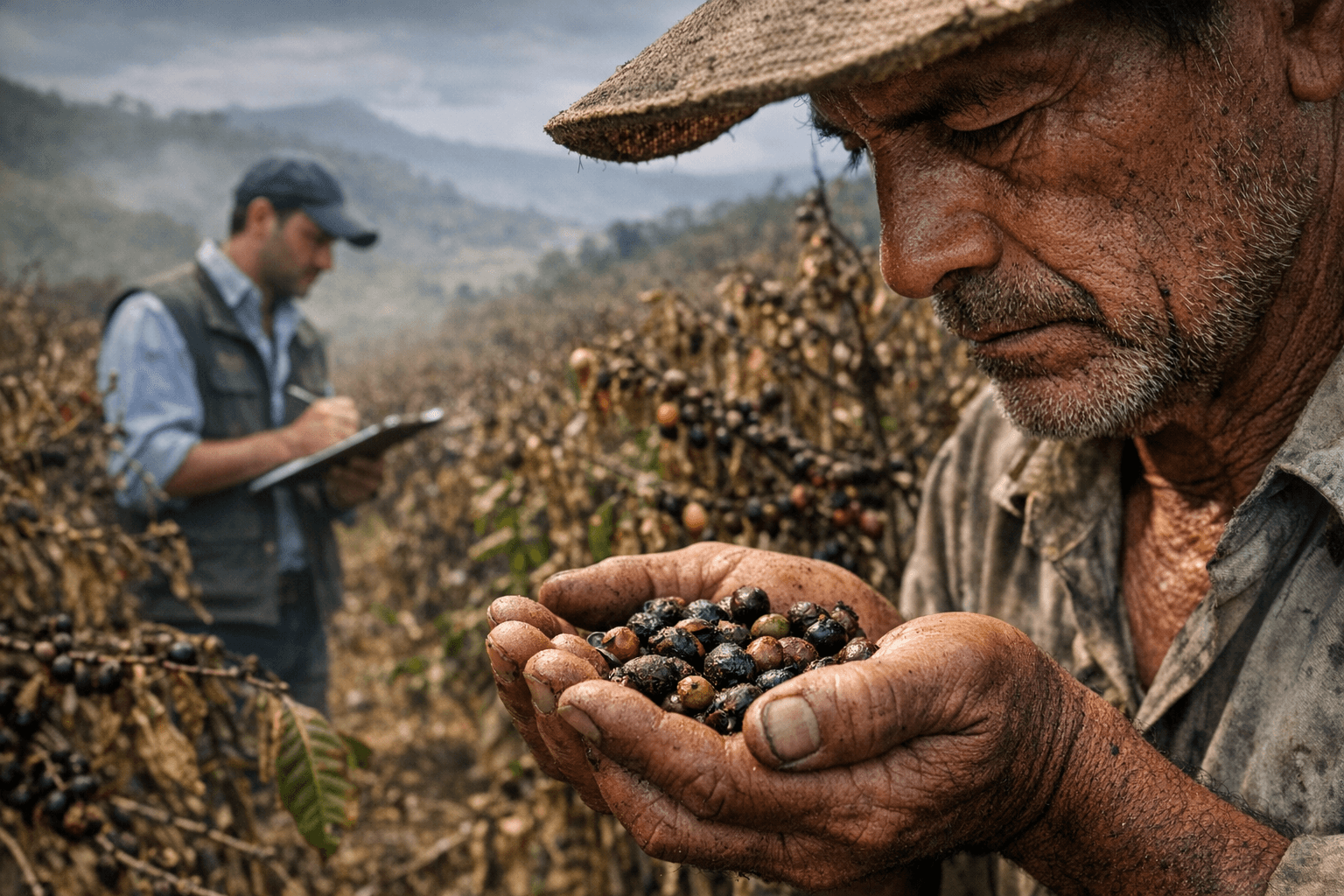
Why coffee insurance is moving to center stage
Coffee is no longer just managing climate risk in theory. It is now being forced to price it, insure it, and build around it. The biggest shift is practical: when adverse weather pushes up costs and cuts yields, insurance can be the difference between a smallholder staying in production and dropping out of the market entirely.
That matters because coffee is deeply exposed. More than 95% of the world’s coffee is grown in tropical regions, where weather variation can quickly turn into crop loss. The Food and Agriculture Organization said world coffee prices rose 38.8% in 2024 compared with the previous year’s average, mainly because of unfavorable weather, and it also says smallholder farmers account for 80% of global coffee production.
Why the sector is so exposed
Coffee’s climate problem is structural, not occasional. ENSO swings, especially El Niño and La Niña, can disrupt rainfall and temperature patterns, trigger crop failures, and amplify volatility in both supply and prices. When that happens, the pain does not stay on the farm. It moves through exporters, roasters, retailers, lenders, and eventually consumers.
The scale of dependence makes the shock harder to absorb. The FAO says coffee is produced by up to 25 million farming households globally, which means a weather event in one region can ripple across an enormous network of producers. For buyers, that translates into less predictable supply. For lenders, it means more uncertainty around repayment and farm income. For farmers, it means the difference between a manageable bad season and a lasting exit from the crop.
Why insurance is becoming a serious tool
Sustainability programs and data systems often get the spotlight, but insurance is one of the most practical tools available for resilience. It can protect income after a shock, help stabilize supply chains, and make it easier for farmers to plan the next season instead of absorbing every loss alone. In a market where weather losses are becoming more frequent and more expensive, that kind of stability is not a side benefit. It is core infrastructure.
The problem is that insurance is disappearing in the places that need it most. High-risk areas, especially in developing countries, are becoming harder to underwrite as climate exposure rises and insurers see less attractive economics. That creates a dangerous gap: the parts of the coffee world most exposed to weather shock are also the least likely to get private cover without support.
How climate insurance works in coffee
The clearest path forward is not traditional loss assessment after the fact, but parametric insurance that pays out when measurable conditions are met. In coffee, that often means satellite and weather-index data instead of waiting for a full field-by-field damage claim. The appeal is speed: automatic triggers can get money moving quickly, which matters when farmers need to protect cash flow, replant, or cover operating costs.
Blue Marble and Nespresso have been running coffee weather-insurance programs in Colombia since 2018, and the model has become a reference point for the sector. Nespresso says the scheme uses satellite and weather-index data to trigger automatic payouts, and one Nespresso Colombia page says more than 4,700 farmers and 15,000 hectares in Aguadas and Norte Caldas are already protected. Marsh says the broader Blue Marble and Nespresso collaboration has expanded rainfall-indexed parametric drought cover to more than 13,000 smallholder coffee farmers in Colombia, Indonesia, Kenya and Zimbabwe.
That expansion matters because it shows insurance can move beyond one pilot plot or one country office. It can become repeatable infrastructure across origins if the data, pricing, and partnerships line up.
What the Mexico pilot adds
Latin America offers another useful test case. UNDP says its tripartite insurance pilot in Mexico covered over 10,000 smallholder farmers against floods and droughts, was triggered twice, and delivered direct payments to more than 1,400 producers. That is a meaningful proof point because it shows the product did not just sit on paper. It paid out.
UNDP’s Mexico factsheet goes even further into coffee-specific design. It says a coffee-focused pilot covered 165 coffee farmers against drought, excessive rainfall and earthquakes, and it was tailored to coffee phenological phases. That detail matters. Coffee insurance works better when it matches the crop’s actual growth stages, not just broad climate averages. The more closely the trigger reflects farm reality, the more useful the cover becomes for producers and buyers alike.
Why this is now a value-chain issue, not just a farm issue
The sector’s resilience challenge is no longer being discussed only at farm level. UNIDO and the International Coffee Organization published their June 13, 2024 report on sustainability and resilience in the coffee global value chain, which is a sign that this issue has moved into industry policy. The message is clear: the cost of climate risk cannot be left to individual producers alone.
That is why the article’s framing around collective investment makes sense. Exporters, roasters, retailers, insurers, development agencies, and governments all have a stake in whether climate insurance becomes normal infrastructure. If smallholders fail after repeated weather shocks, green coffee supply becomes more volatile and more expensive, and every actor downstream absorbs the shock.
What has to change for insurance to scale
Insurance will not solve climate exposure on its own. Premiums may rise steeply by 2030, which means the industry cannot simply buy its way out of risk without structural changes. Public policy support will be essential, along with consumer-protection regulation, stronger local understanding of climate risk, and better capacity to manage insurance programs.
That is also where the broader development finance conversation comes in. UNDP and Generali have said the global insurance protection gap is about US$1.8 trillion, which gives a sense of how much risk remains uncovered across countries and communities. In that context, coffee insurance is part of a much bigger disaster-risk finance challenge, especially in markets where climate shocks are rising fastest and private underwriting alone is not enough.
Boubaker Ben-Belhassen, Alba Maria Alba and Yannick Glemarec sit within this wider conversation as industry and development voices pushing resilience higher on the agenda. The direction of travel is unmistakable: climate insurance is shifting from an abstract safeguard to a commercial necessity for coffee.
The bottom line for coffee
Coffee insurance is emerging as a vital defense because the economics of climate risk have changed. Weather shocks are already showing up in prices, yields, lending conditions, and supply continuity, and the impact is most severe for the smallholders who produce the bulk of the crop. If the sector wants stable green coffee flows, it has to treat insurance as part of the operating system, not an optional extra.
The next phase is not about proving whether climate risk exists. It is about deciding whether coffee has the institutions, policies, and partnerships to keep producers in business when the weather turns against them.
This article was produced by Prism’s automated news system from verified source data, official records, and press releases, then run through automated quality and moderation checks before publishing. The system is built and supervised by the people who set the standards it runs under. Read our full AI policy.
Did this article answer your question?