Fourteen Major Coffee Traders Endorse Shared Principles to Support Farmer Viability
A 2024 industry audit found value in coffee flows heavily to roasters, not farmers. Fourteen major traders including JDE Peet's and Volcafe just agreed on two principles to change that.
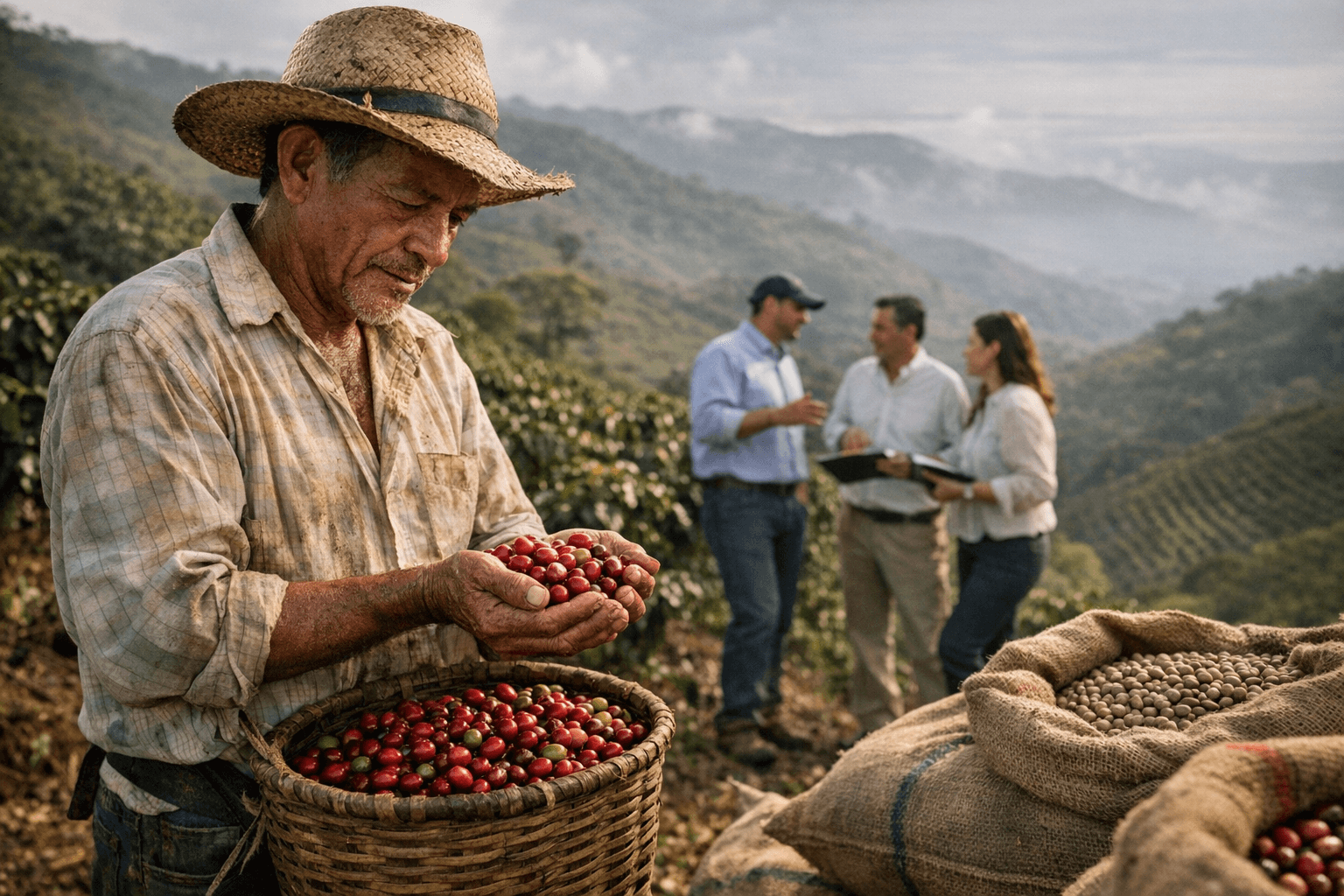
The fourteen companies that collectively move an enormous share of the world's green coffee had a problem put to them plainly in 2024: the sector generates sufficient value, but the distribution of that value heavily favors roasters and direct-to-consumer sellers, with farmers frequently earning below what it costs to grow the crop. That finding, published in a GCP-commissioned document called "The Grounds for Sharing," framed a nine-month conversation that ended on March 31 with a signed set of two shared procurement principles.
The signatories are Caravela, ECOM, Export Trading Company, illycaffè, JDE Peet's, Louis Dreyfus Company, Neumann Kaffee Gruppe, ofi, Sucafina, Sucden Coffee, Taylors of Harrogate, Touton, UCC, and Volcafe. The Global Coffee Platform convened the process alongside IDH and Solidaridad, who function here as the accountability infrastructure: civil-society organizations whose involvement makes it harder to quietly shelve the commitments.
The two principles, in plain terms: first, Strategic Partnerships, which commits participating companies to move away from spot buying and toward longer-term, trust-based relationships that share risk and allow coordinated investment in productivity and quality. Second, Sustainable Coffee Production, which commits them to purchase coffee in ways that allow farmers to cover what it actually costs to produce it, and to support system-level improvements including agroforestry, better processing infrastructure, and climate resilience. The accompanying guidance adds specifics: faster payment windows, price mechanisms that reflect production costs rather than just commodity market swings, and co-financing for sustainability compliance.
GCP Executive Director Annette Pensel framed the stakes without softening them: "Ensuring the long-term economic viability of sustainable coffee farming, and overall farmer prosperity is essential for a resilient supply and a competitive coffee sector. This requires shared responsibility and a more coordinated approach across the industry."
These principles are voluntary. No signatory is contractually obligated to rewrite a single purchase order based on the March 31 document, and the gap between endorsed guidance and changed contracts is where most industry initiatives quietly dissolve. The test is specific: watch whether companies like JDE Peet's, Volcafe, and Louis Dreyfus cite these commitments in their 2026 sustainability reporting, whether new supplier contracts include the longer tenors and cost-reflective pricing the principles describe, and whether GCP and its partners publish measurable adoption metrics rather than signatory counts.
For the roaster on your regular rotation, the signal list is concrete. Ask whether they source through forward contracts with named origin partners rather than spot. Ask whether their pricing model references cost-of-production data. Ask if their green buyer receives payment within 30 days of delivery. A roaster whose sourcing genuinely reflects the spirit of these principles can answer those questions; one running a PR-aligned version of sustainability cannot. The fourteen signatories have now put their names to a standard, which makes those questions worth asking of every company on the list.
This article was produced by Prism’s automated news system from verified source data, official records, and press releases, then run through automated quality and moderation checks before publishing. The system is built and supervised by the people who set the standards it runs under. Read our full AI policy.
Did this article answer your question?