Kenyan Governor Backs Ruto After Billion-Shilling Coffee Debt Write-Off Promise
Kirinyaga Governor Anne Waiguru told coffee farmers to back Ruto if he clears Ksh1 billion in local debt, days after Ruto promised a Ksh6.9 billion national write-off for 600,000+ farmers.
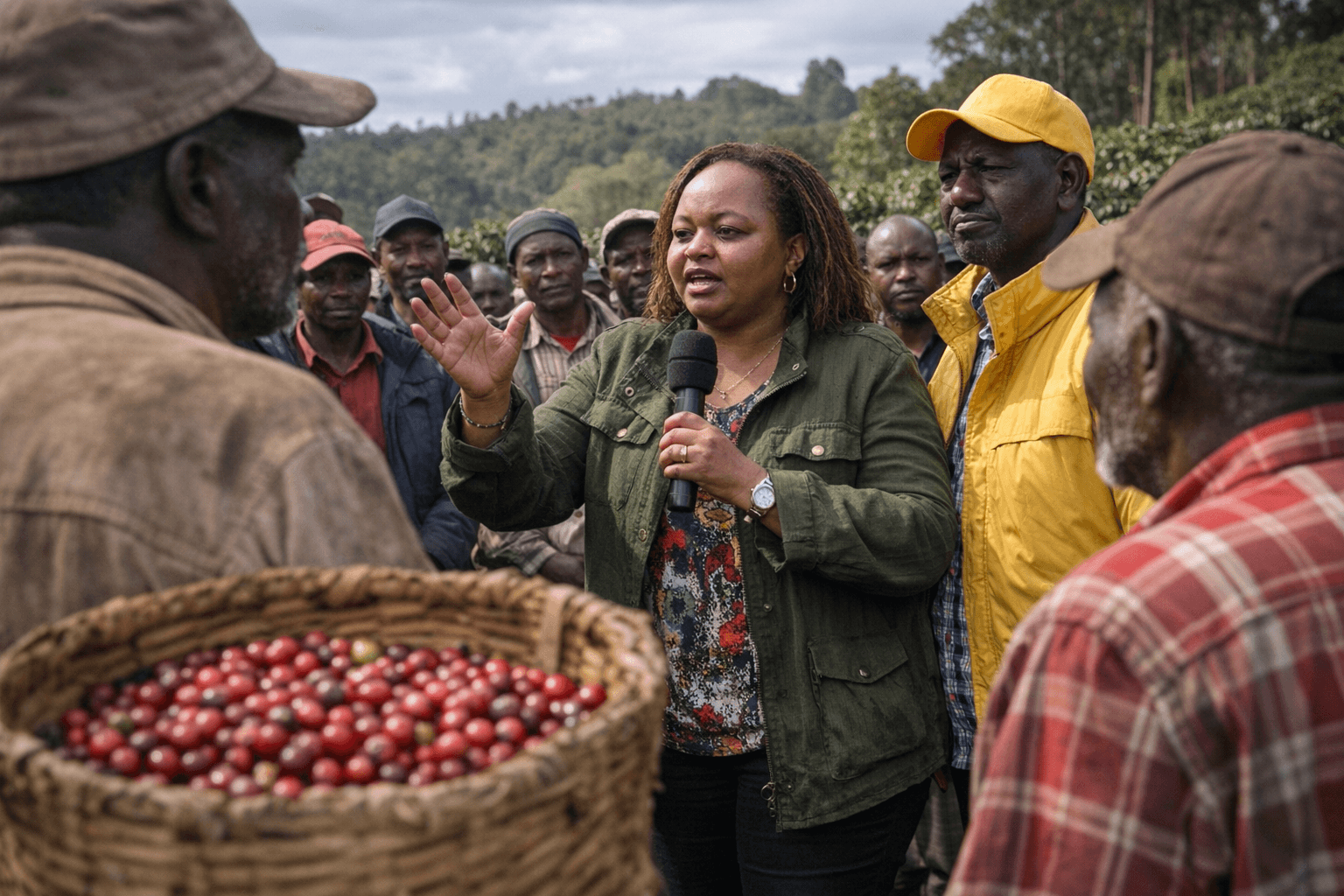
Kirinyaga County Governor Anne Waiguru delivered a politically charged ultimatum to coffee farmers in her county in June 2024: back President William Ruto electorally if he delivers on his promise to settle their Ksh1 billion cooperative debt. The conditional endorsement came days after Ruto, speaking to Kenyans in the United States on May 27, 2024, pledged to write off Ksh6.9 billion owed by coffee farmers nationally, a commitment he called "a shot in the arm" for the more than 600,000 farmers who stand to benefit.
Waiguru has since appealed to the national government to fast-track the waiver of Sh1.06 billion in debts owed by 14 coffee cooperatives in the county, saying the burden continues to slow the revival of the sector. The cooperatives carrying that debt are not abstractions on a balance sheet: they include Karithathi, Rung'eto, Thirikwa, Ngiriambu, Rwama, Kanjuu, Mirichi, Inoi, Kibirigwi, Mwirua, Mutira, New Ngariama, Baragwi, and Kirinyaga Cooperative Union. For farmers inside those societies, debt is not a macro-policy question. It shapes what a cooperative can afford to advance at cherry intake, what rate it can offer per kilogram, and whether it invests in the wet-mill infrastructure that separates specialty-grade lots from commodity-grade ones.
Waiguru made the production arithmetic explicit. "The Ksh6.9b debt write-off for coffee cooperatives and allocation of Ksh4 billion Cherry fund by the President will positively impact the county's production, doubling coffee yields from 50,000-102,000 metric tonnes per year," she said on June 4, 2024. Waiguru noted that Kirinyaga's coffee sector is steadily recovering, with production rising from 28,000 metric tonnes in 2017 to 48,000 metric tonnes, and that annual farmer earnings have grown to about Sh7.4 billion, supported by reforms and investments in production, processing, storage, marketing, and value addition. Doubling output from that base would be one of Kenya's most significant coffee-sector gains in decades. Kenya's highest national coffee production was 128,862 metric tonnes during the 1987/1988 season, a figure the country has never come close to replicating, and debt-laden cooperatives are a core reason why.
The connection between debt and quality incentives runs directly through the cherry payment. The government had enhanced the Cherry Advance Revolving Fund from Ksh2.7 billion to Ksh6.7 billion to enable increased payment to farmers from Ksh20 a kilo to Ksh80 per kilo. When cooperatives carry historical debts, those advances are clawed back before farmers see a final payout, compressing the income signal that determines whether a smallholder picks selectively or strips the branch. Ruto's package addresses both layers: the national debt write-off of Ksh6.9 billion and a separate Ksh2 billion fund to cushion cherry farmers while they wait for Nairobi Coffee Exchange auction settlements.
Kigumo MP Joseph Munyoro had asked the government to extend the same courtesy it had given to sugar farmers when it wrote off Sh117 billion debt to turn around the sector in 2023. Munyoro's ask was concrete: "Mt Kenya is a coffee growing zone but farmers are faced with many challenges. I am asking the government to set aside Sh6 billion for the purposes of bailing the sector." The sugar precedent matters because it established that cabinet-level write-offs are administratively executable once there is political will.
The administrative sequence, however, has repeatedly been the sticking point. Cooperatives CS Simon Chelugui announced a forensic audit of the debt that coffee farmers owe various value chain players, with the aim of verifying the exact amount overdue and identifying any debts previously waived. To facilitate settlement, coffee cooperatives, Saccos and other creditors were required to submit to the Ministry for Cooperatives, within seven days, the list of all farmers who owe them money along with all supporting documents for verification and processing of payment. Any fraudulent and fictitious claims, the Cabinet warned, will be dealt with in accordance with the law.
As of March 2026, the process remains active but incomplete. The Ministry has received verified debt waiver requests amounting to Ksh6.8 billion from coffee cooperative societies across the country, and out of this, the government has allocated Ksh2 billion to begin clearing part of the verified claims. The government is also working to increase national coffee production to at least 150,000 metric tonnes by 2028.
For specialty buyers sourcing Kenyan lots, the supply-chain math is straightforward. Debt-free cooperatives pay more per kilo at intake, which strengthens the incentive for farmers to pick ripe cherry and invest in agronomy. In the 2024/2025 season, 27 coffee factories out of Kirinyaga's 75 wet mills announced payouts of between Ksh100 and Ksh145 per kilogram for cherry, with Gacami Coffee Factory under Baragwi Farmers Cooperative Society making the highest payout of Ksh145.10 per kilogram. Those are the numbers that specialty roasters track. Whether they hold and improve in subsequent seasons depends on how quickly the remaining Ksh4.8 billion in verified claims moves from a ministerial allocation line to cooperative bank accounts.
Governor Waiguru's conditional endorsement of Ruto was politically blunt, but it named the mechanism that actually governs quality and availability in Kenya's coffee belt: payment certainty at the farm level. Without it, even the country's best-regarded growing regions produce below their ceiling.
This article was produced by Prism’s automated news system from verified source data, official records, and press releases, then run through automated quality and moderation checks before publishing. The system is built and supervised by the people who set the standards it runs under. Read our full AI policy.
Did this article answer your question?