Keurig Dr Pepper Secures 96% of JDE Peet's in $16 Billion Takeover
Keurig Dr Pepper secured 96% of JDE Peet's in a €14.9B deal, folding Jacobs, Senseo, and Peet's Coffee into the Keurig ecosystem.
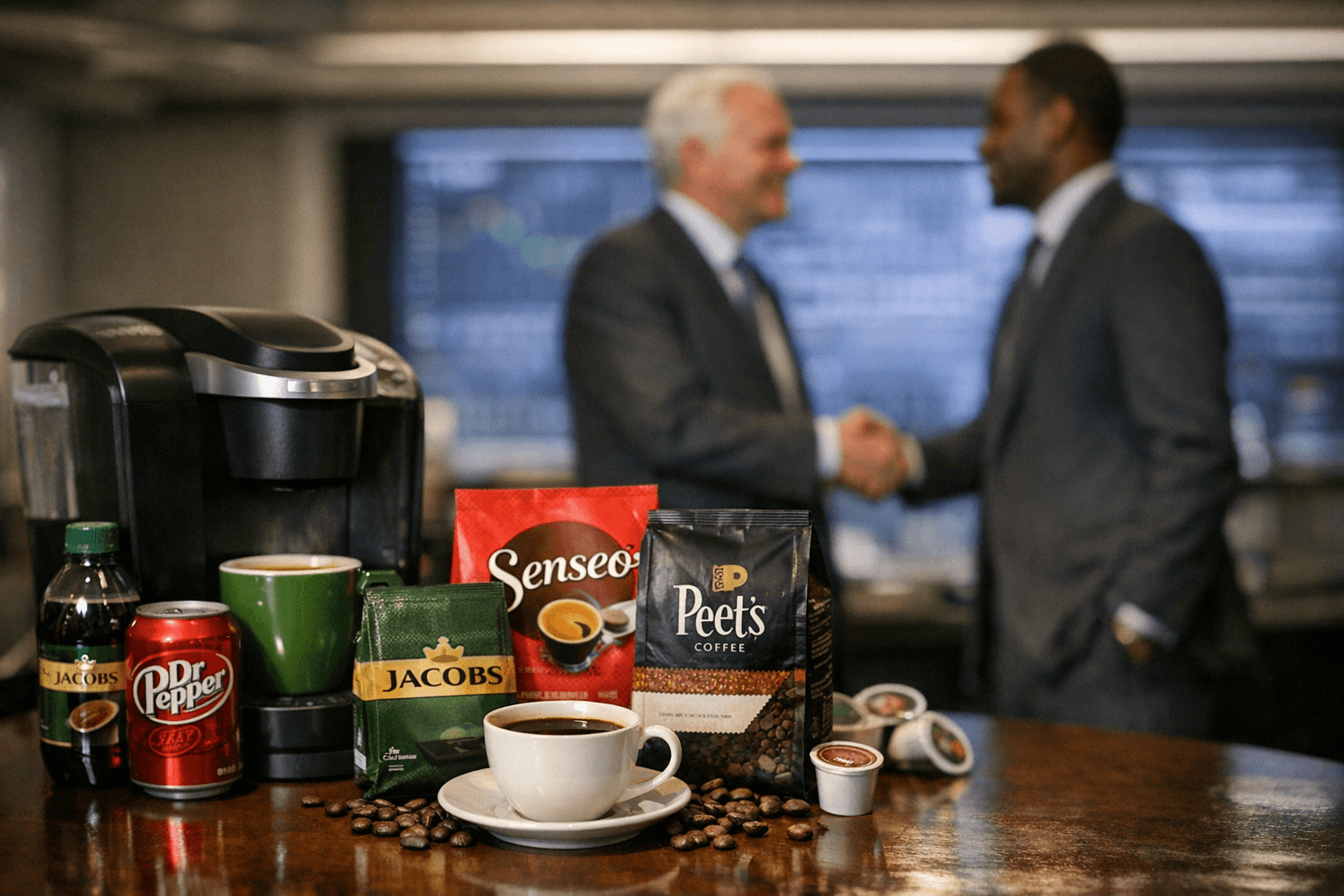
Keurig Dr Pepper declared its cash offer for JDE Peet's N.V. unconditional on March 27, after 96.22% of the Dutch coffee giant's shareholders tendered their shares, collapsing the world's largest pure-play coffee group into the KDP ecosystem in one of 2026's biggest beverage consolidation moves. At €31.85 per share across 466,712,270 tendered shares, the aggregate value lands at roughly €14.865 billion, with settlement scheduled for April 1 and a post-closing acceptance window open through April 13 for any holdout shareholders.
The deal routes Jacobs, Senseo, and Peet's Coffee directly into the same corporate structure as the Keurig single-serve platform, giving KDP command over pod-format coffee in North America while inheriting JDE Peet's distribution infrastructure across Europe, Latin America, and Asia-Pacific. That breadth is the point: KDP's dominance in U.S. single-serve has always bumped against geographic limits, and JDE Peet's carried the international footprint that fills in the map.
For anyone who runs through a bag of Jacobs on the stovetop and a box of K-Cups at the office, that convergence is now a corporate reality rather than a coincidence. When two brands that previously competed for the same supermarket shelf share a supply chain and a board, retail buyers lose a negotiating alternative, and pricing pressure typically moves in one direction. The variety of single-serve options at retail, already thinned by years of consolidation, bears watching as KDP determines which SKUs justify the shelf space in a combined portfolio of this scale.
Workers across JDE Peet's manufacturing and distribution network enter a period of integration uncertainty effective April 1. Board changes approved at an extraordinary general meeting on March 2, 2026 take effect upon settlement, and JDE Peet's will begin the process of delisting from Euronext Amsterdam, ending its run as an independent publicly traded company. KDP's formal acquisition vehicle, Kodiak BidCo B.V., was the legal buyer, with the offer governed by documentation approved by the Dutch Authority for the Financial Markets.
The winners and losers sort out fairly quickly at this scale. KDP acquires global roasted and instant coffee credibility it could not build organically in the timeframe the category demands. Nestlé, which has long held the dominant position in European grocery coffee, now faces a rival with significantly more firepower at retail. Independent roasters competing for premium positioning will find the combined entity's distribution leverage harder to displace from supermarket planograms. Packaging and green coffee suppliers, though, may find themselves negotiating with a buyer whose consolidated volume commands steeper discounts.
The offer was originally agreed in late 2025 and framed as creating a global "coffee champion." At 96.22% shareholder acceptance, the market rendered its verdict on that framing clearly enough. How KDP chooses to deploy the Peet's café brand, whether Senseo survives as a distinct platform or folds into Keurig's single-serve identity, and what integration looks like for the roasting facilities and distribution hubs across EMEA will define whether this deal delivers on its ambitions or simply reshuffles the same cups into a bigger cabinet.
This article was produced by Prism’s automated news system from verified source data, official records, and press releases, then run through automated quality and moderation checks before publishing. The system is built and supervised by the people who set the standards it runs under. Read our full AI policy.
Did this article answer your question?