Specialty Coffee Remains a Small Fraction of Brazil's Massive Total Crop
Brazil sits on 1.9 million coffee hectares, yet only 38,000 are certified specialty, with over 80% of that concentrated in a single state.

Brazil harvests coffee across nearly 1.9 million hectares, but a peer-reviewed study published in Scientific Reports has put a precise number on how little of that land produces certified specialty arabica: 38,000 hectares, roughly 2 percent of the country's total coffee footprint. The analysis, authored by Gustavo Hiroshi Sera and colleagues and drawing data from 175 farms affiliated with the Brazilian Specialty Coffee Association (BSCA), puts hard figures on a gap the trade has long sensed but rarely quantified with this level of granularity.
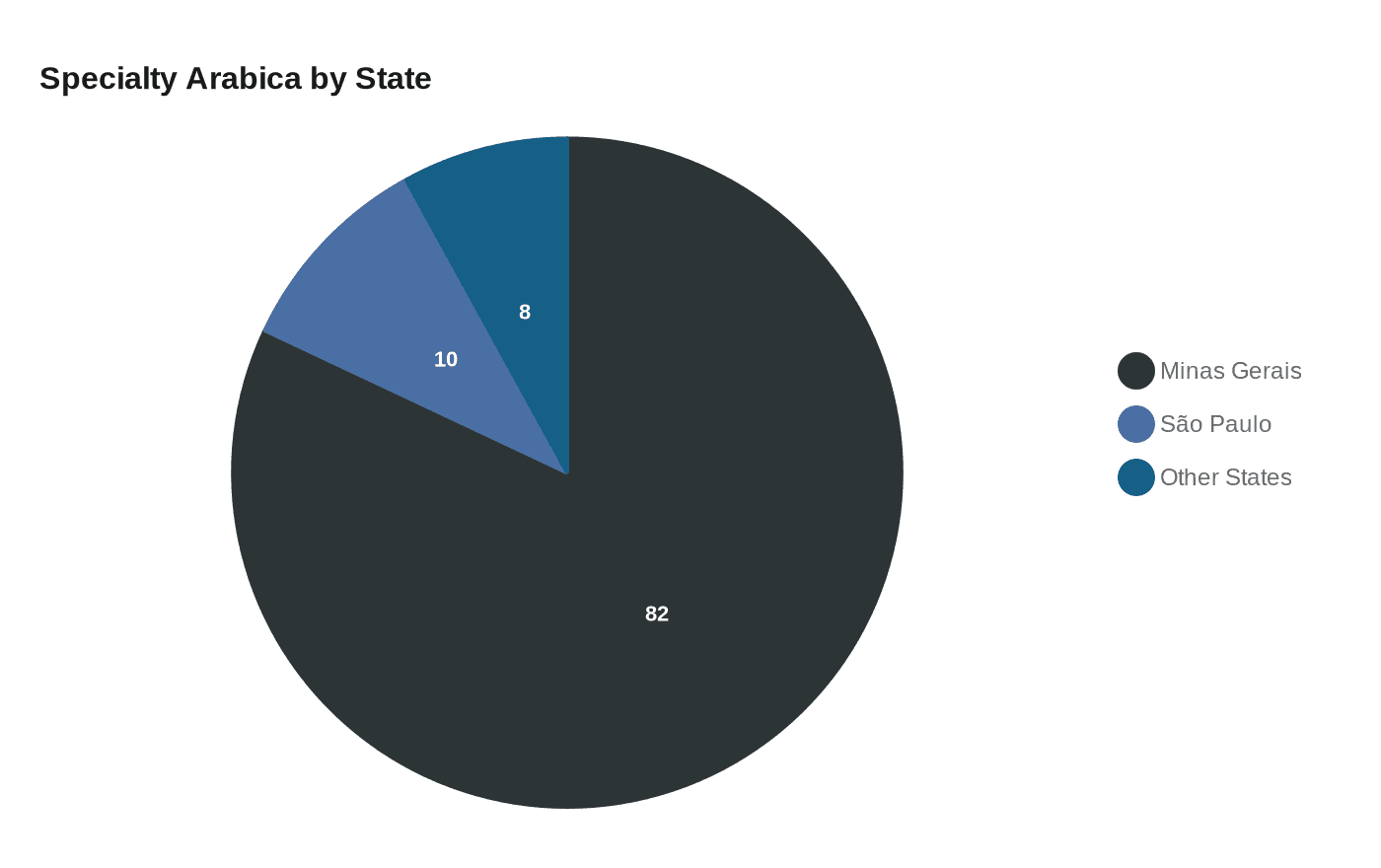
Of those 38,000 certified specialty hectares, Minas Gerais accounts for approximately 82 percent. São Paulo came in a distant second at around 4,000 hectares, or about 10 percent. Beyond those two states, only Paraná, Mato Grosso do Sul, Goiás, Rio de Janeiro, and Espírito Santo had certified producers at all. The study argues that Minas Gerais' dominance is not purely a story of elevation and microclimate; it is equally a story of market structure. The state has a well-developed supply chain, with established buyers, warehouses, and exporters geared toward specialty lots, that most other Brazilian growing regions simply do not have. Outside Minas Gerais, the paper found, specialty expansion can stall at the most basic level: no nearby buyers, no warehouses capable of handling small lots, no export infrastructure designed for the channel.
That finding matters because it reframes the challenge. Telling a farmer in Bahia or Espírito Santo to produce specialty-grade arabica is incomplete advice if the market infrastructure to reward that investment does not exist at origin. Add the capital cost of specialty-grade post-harvest processing equipment, the investment required to pursue certifications, and the need for smaller-lot handling, and the economic case for conversion becomes difficult even where the terroir would otherwise permit it.

For roasters, the picture is equally constrained. Brazil accounted for roughly one-third of global coffee production in 2022, and projections for the 2026/27 harvest are tracking toward a record 75 million bags or more total. Against that backdrop, the 38,000-hectare certified specialty footprint is genuinely small, and the concentration in one state means international buyers seeking traceable, high-scoring Brazilian arabica have little choice but to cultivate focused, ongoing relationships with a narrow pool of producers and exporters. Supply from outside Minas Gerais will remain scarce until infrastructure catches up, a timeline no study can set.
The researchers also found that most Brazilian specialty producers have adopted the semidry, or pulped natural, processing method, either alone or in combination with other approaches. That processing choice reflects both the quality goals of the segment and another layer of capital commitment, requiring drying infrastructure and careful quality management at the farm level.
The paper points to capital access, technical assistance, and clearer market pathways as the levers needed to make specialty conversion viable beyond the Minas Gerais core. Without those, the 38,000-hectare certified specialty footprint will remain a thin sliver of a crop that keeps breaking volume records, rewarding scale while leaving quality premiums locked inside a small, concentrated geography.
This article was produced by Prism’s automated news system from verified source data, official records, and press releases, then run through automated quality and moderation checks before publishing. The system is built and supervised by the people who set the standards it runs under. Read our full AI policy.
Did this article answer your question?