Sweeping New Analysis Links Coffee to Just 1% of Agriculture-Driven Deforestation
A Nature Food study spanning 184 commodities found coffee accounts for just 1% of agriculture-driven deforestation globally — yet in Brazil, over 1,200 square miles of forest have been directly cleared for coffee since 2001.
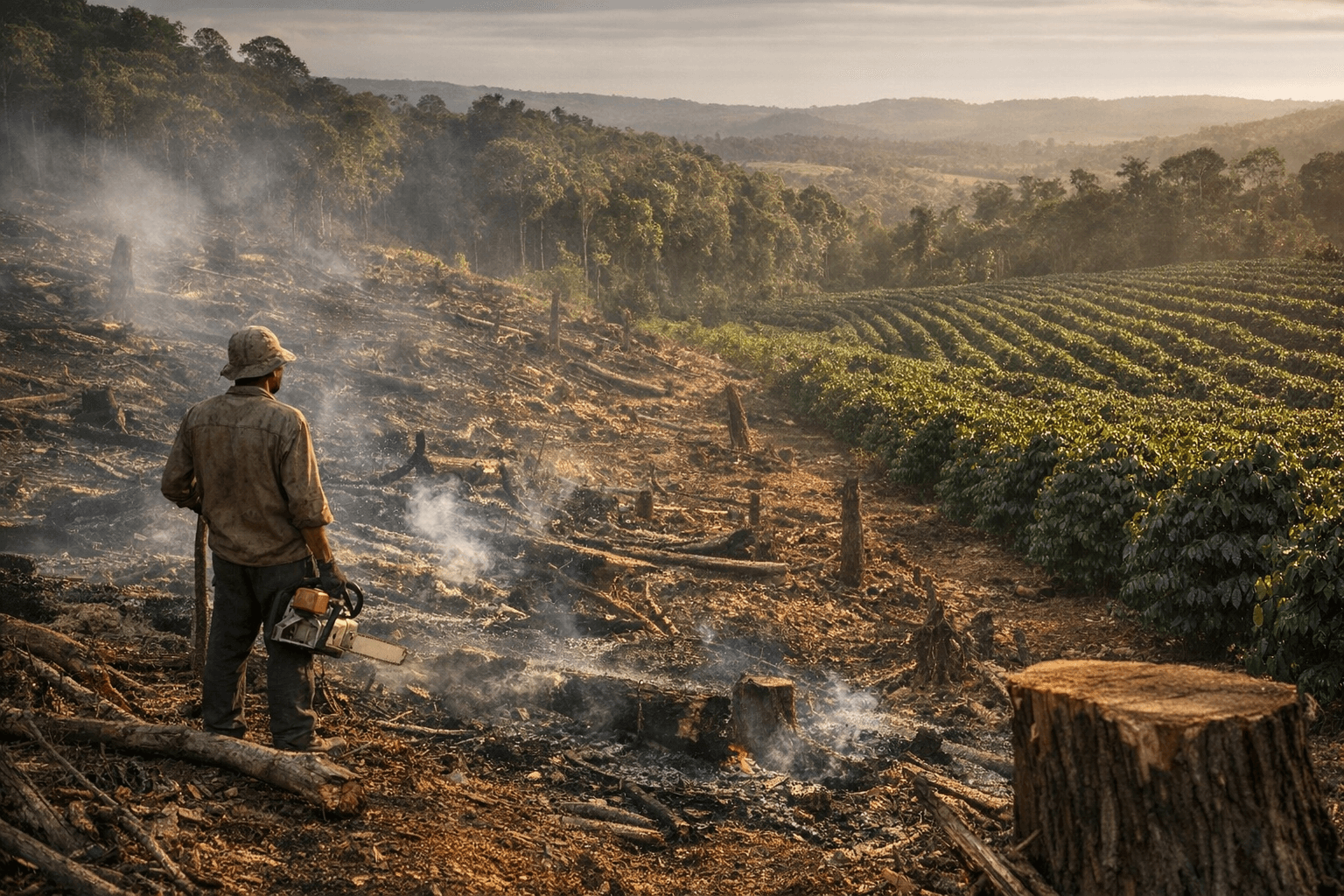
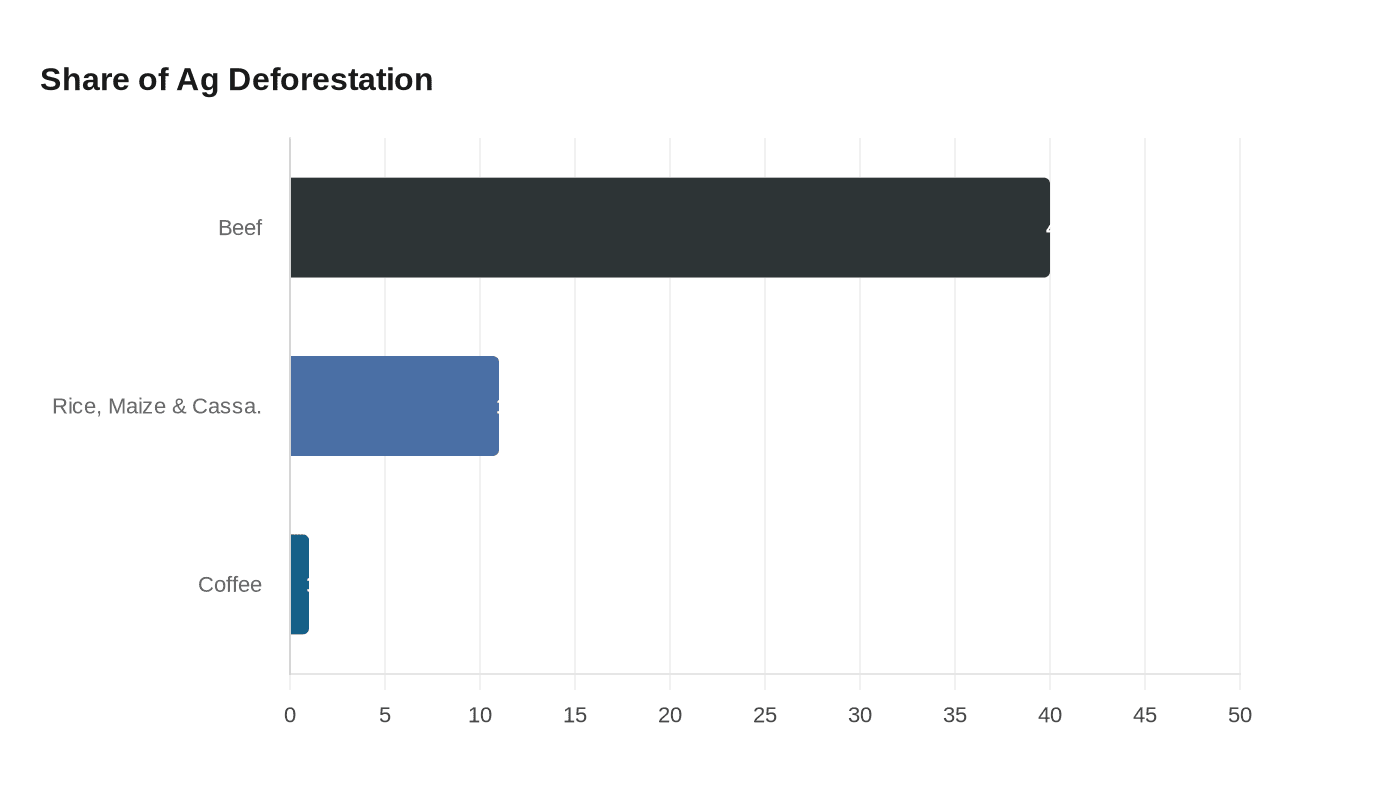
The numbers look reassuring at first glance: a new analysis published in Nature Food, built on the Deforestation Driver and Carbon Emissions (DeDuCE) model developed by Chandrakant Singh and Martin Persson at Chalmers University of Technology in Sweden, covers 184 commodities across 179 countries and tracks annual deforestation from 2001 to 2022. Its headline finding for coffee? Just 1% of global agriculture-driven deforestation. Put next to beef, which the same model attributes with 40% of the global total, coffee barely registers. Rice, maize, and cassava cumulatively account for approximately 11% of total global deforestation — exceeding that of cocoa, coffee, and rubber combined.
Singh and Persson describe DeDuCE as the most comprehensive global survey of its kind to track commodity-driven deforestation. The breadth is genuinely notable: prior research has often focused on well-known culprits like beef, soybeans and palm oil, and tended to concentrate on specific countries. Singh says their study combined extensive satellite land-use data with agriculture statistics "in a way that gives us the most comprehensive and accurate picture yet of what is driving deforestation worldwide." The researchers said they hope their modeling can help provide support for government agencies, private-sector actors and others seeking to reduce deforestation. Singh put it plainly: "Our data shows where the risks are and where initiatives are needed most. The goal is for the model to connect researchers, decision-makers, companies and civil society."
Martin Persson's commentary adds an important wrinkle. "The debate on deforestation has circulated a lot around how people in rich countries like ours cause deforestation with our commodities imports, and this is absolutely important to get to grips with. But we mustn't forget that a large proportion of deforestation is driven by agricultural production for domestic markets. So to really reduce deforestation, we must also take action in the producer countries."
That country-level view is exactly where the coffee community's alarm gets louder. In Brazil, the world's biggest coffee producer, coffee farming is driving deforestation — and that, in turn, makes coffee harder to grow. More than 1,200 square miles of forest were cleared for coffee cultivation in Brazil's coffee-growing areas between 2001 and 2023, according to Coffee Watch, which used satellite images, government land-use data and a forest-loss alert system in its analysis. In areas with a high concentration of coffee-growing operations, a total of more than 42,000 square miles of forest are now gone — including forest loss caused directly by coffee farming, as well as indirectly from nearby road and infrastructure projects.
Etelle Higonnet, Coffee Watch's founder and director, says "Coffee essentially punched a Honduras-sized hole in Brazilian forests." To be clear, coffee is not the leading cause of deforestation in Brazil — cattle ranching is responsible for a far larger share — but Higonnet says coffee's role has not been talked about enough. The self-defeating logic of that clearing is what makes her data so uncomfortable for the industry. "When you kill the forest, you're actually also killing the rains, which is exactly what your crop needs to thrive in the long run," Higonnet says. "Even for people who don't much care about climate change and mass extinction, if they drink coffee and care about having coffee in the long run, this should be very scary for them."
Most years of the past decade have seen rainfall deficits in Brazil's major coffee-growing areas, the Coffee Watch report says. Farmers are expanding to respond to the world's "insatiable demand for coffee," says Aaron Davis, a senior research leader of crops and global change at the Royal Botanic Gardens, Kew, England. "And to produce that coffee, you need land. Simple as that."
The global 1% figure and Brazil's 42,000 square miles are not contradictory — they measure different things at different scales. DeDuCE reports coffee's share of all agriculture-driven deforestation globally; Coffee Watch reports absolute forest area lost in a specific country tied to a specific crop. Both can be true simultaneously. The gap between them illustrates a persistent problem in how supply-chain risk gets assessed.
Commodity monitoring firm Satelligence adds another layer of complexity. The DeDuCE authors suggested that their data could help fill gaps in EUDR implementation by providing commodity-specific, country-level deforestation estimates for risk benchmarking. The EUDR covers coffee, cocoa, cattle, palm oil, soy, rubber, wood and certain derived products, and has faced repeated delays and political pushback since adoption — the European Parliament voted in late 2025 to delay enforcement dates to December 30, 2026 for large and medium operators and June 30, 2027 for many micro and small operators.
Landmark droughts in 2016-17, 2019-20 and 2023 slashed yields and contributed to over 40% price rises in 2023-24. Modeling indicates up to two-thirds of Brazil's suitable Arabica area could be lost by 2050. For anyone pulling shots or sourcing green coffee, the DeDuCE study's global reassurance doesn't change what's happening on the ground in Minas Gerais.
This article was produced by Prism’s automated news system from verified source data, official records, and press releases, then run through automated quality and moderation checks before publishing. The system is built and supervised by the people who set the standards it runs under. Read our full AI policy.
Did this article answer your question?