Bluey and Rusty Granny Squares Bring Beloved Characters to Kids' Crochet Projects
Two free 6-inch granny squares capture Bluey and Rusty's color palettes with ears and face details, making them the cheerful pocket accent any kids' cardigan needs.
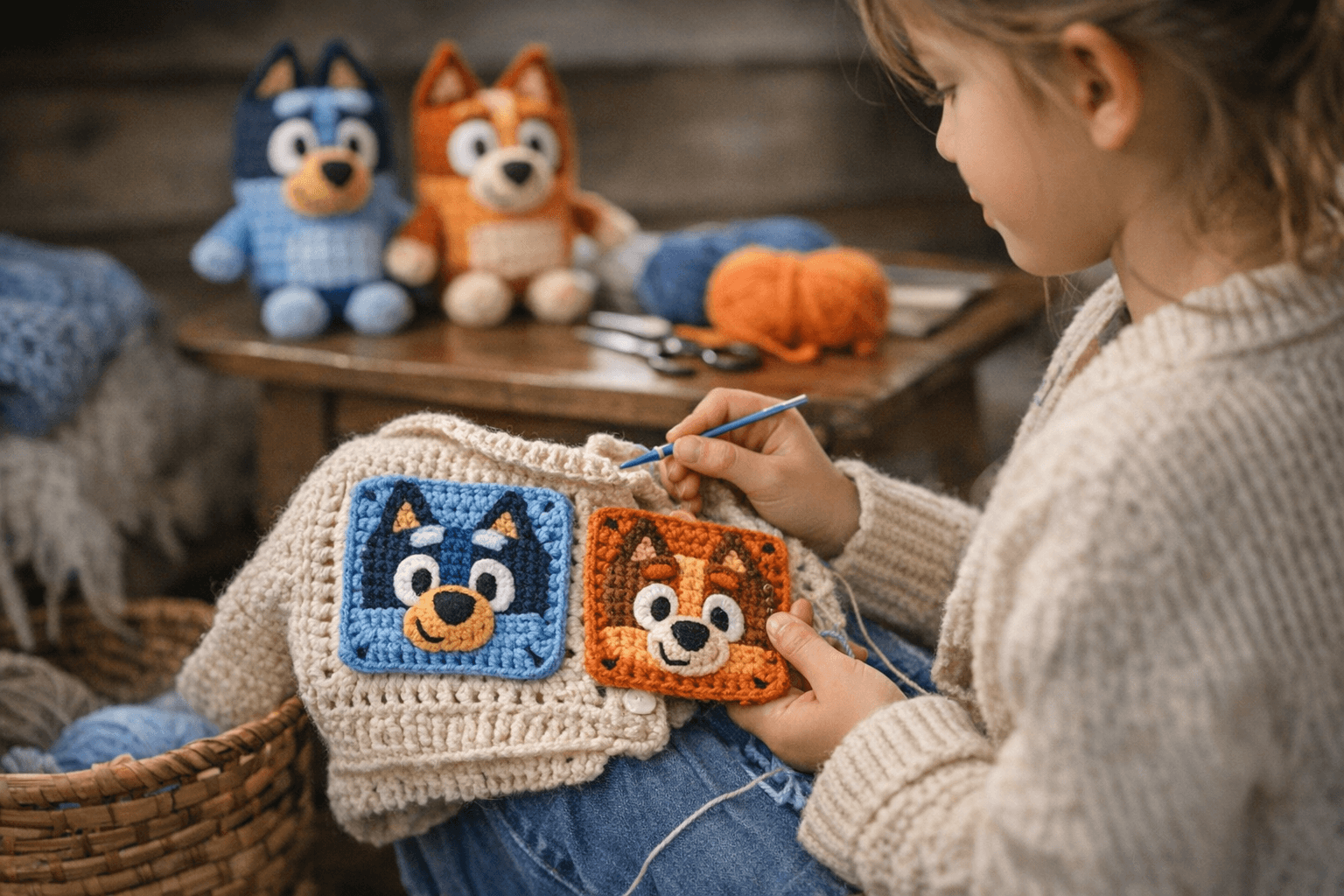
The kind of pattern that makes you want to drop whatever you're doing and pick up a hook, Shellie Wilson's free "Bluey and Rusty Inspired Granny Square" design turns two beloved animated characters into a pair of charming 6-inch crochet squares, complete with little ears, bold color blocking, and simple facial details. Published on Crochet, a CraftGossip site, the pattern is free to access and delivers exactly what kids' project season calls for: something "equal parts practical and ridiculously cute."
What You're Making
Each finished square measures approximately 6 x 6 inches and is designed in a classic granny square format with character-specific features layered in. One square works up in Bluey-inspired blues, capturing the unmistakable palette of the blue heeler pup who has become a fixture in households worldwide. The second square shifts into Rusty-inspired orange tones, bringing his best mate to life with the same structure and construction. Both squares feature the same character-style details: ears worked into the design and simple facial features added at the finishing stage. The result is a pair of squares that read as immediately recognizable to any child who's spent time with the show.
Why This Pattern Works for Busy Makers
The real appeal here is the construction logic. As Wilson describes it: "This is the sort of pattern that feels cheerful from the very first round. You start with a simple square, build in the color sections, then add the ears and face details at the end. It's one of those projects that looks clever without being overly complicated, which is always nice when your yarn pile is already giving you side-eye from across the room."
That sequencing matters practically. You build the granny square foundation first, integrate the color blocking as the rounds progress, then tackle the ears and face at the very end once the base is solid. The construction stays identical for both squares, which means the second one comes together considerably faster than the first. If you've crocheted one granny square in your life, the structure here will feel familiar, with the character elements added as a final flourish rather than woven through every round in a way that requires constant chart-checking.
The Color System
Wilson keeps the color-switching as straightforward as possible. The Bluey square uses light blues and navy blue tones to capture the character's distinctive coat. For Rusty, the substitution system is explicit and elegant: replace every light blue section with orange and every navy blue section with dark brown. That's the entire color translation. Work both squares exactly the same way and simply swap those two color values to get from one character to the other. Separate color guides for the Bluey Square and Rusty Square appear in the full pattern, with specific yarn shades listed there.
Both color schemes begin from the same starting point: Round 1 opens in tan, which forms the face center of the square before the character colors take over in the outer rounds.
A Look at the Pattern Construction
The pattern opens with a magic ring (MR) worked in tan, establishing the face center of the square. Round 1 reads:
*Starting in tan, make a MR. Ch 3, 2 dc. Ch 2, 3 dc 3 times. Ch 2 and sl st to the top of the beginning ch-3. Sl st in the next 2 stitches and into the corner space.*
This is a standard granny square opening, giving you a compact center cluster with defined corner spaces. Round 2 expands outward with the familiar double-crochet cluster and corner construction:
*Ch 2, 1 dc, ch 2, 2 dc all in the corner space. Dc in next 3. 2 dc, ch 2, 2 dc in corner space. Dc in next 3. 2 dc, ch 2, 2 dc in corner space. Dc in next 3. 2 dc, ch 2, 2 dc in corner space. 3 dc. Sl st to the top of ch-3 and into the next stitch.*
Round 2 establishes the granny square's classic layered structure, with clusters in the corners and straight double crochets along the sides. The pattern continues for additional rounds where the character color sections build out, before the ears and face details are added in the finishing stage. The full pattern, including all rounds beyond the first two, the complete materials list, abbreviations, and finishing instructions for the ears and facial details, is available on the Crochet CraftGossip site.
What to Make With Them
Wilson is direct about her favorite application: "These squares are especially sweet as pockets for a cardigan or hoodie, and that's exactly how I'd use them." It's a genuinely clever use. A pair of character-face pockets on a kids' cardigan transforms a basic knit into something a child will actually want to wear, and at 6 x 6 inches the squares sit at a practical pocket size rather than a purely decorative one.
Beyond cardigans, the pattern lends itself to a range of project types. Wilson notes they work equally well as bag panels, kids' room decor, or playful crochet accessories. A single square sewn to a tote bag, a pair used as appliqués on a pillow, or a set stitched into a small coin purse all make sense at this size. Because the squares are self-contained and finished individually, you can scale up or combine them without needing to rework any construction.
Getting Started
The pattern is free on the Crochet CraftGossip site, where Shellie Wilson's full post includes the complete materials list, abbreviations, color guides for both the Bluey and Rusty versions, and all remaining pattern rounds including the finishing steps for the character ears and facial details. If you're new to granny squares, the construction here is a solid entry point: the base rounds follow familiar double-crochet cluster logic, and the character elements come in only at the finishing stage, keeping the main body of the work accessible.
For anyone building a kids' wardrobe project or looking for a fast, high-impact make to work into an existing WIP, two 6-inch squares worked in the same construction with a single color swap is about as efficient a character project as you'll find in the current free pattern landscape.
This article was produced by Prism’s automated news system from verified source data, official records, and press releases, then run through automated quality and moderation checks before publishing. The system is built and supervised by the people who set the standards it runs under. Read our full AI policy.
Did this article answer your question?