Why 1970s crochet still fits modern wardrobes and homes
Granny squares, ponchos, and slouchy crochet work now because the best 1970s shapes still solve a real style job: they add texture without looking dressed up.
Why 1970s crochet still reads as current
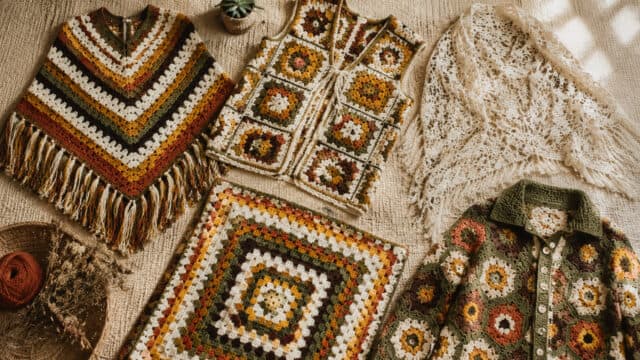
The easiest way to make 1970s crochet feel modern is to treat it like construction, not nostalgia. A poncho with square geometry, a vest built from granny squares, or a jacket that hangs cleanly over jeans does more for a wardrobe than a costume-like blast of fringe ever will. The same logic works in the home, where a small crochet accent adds handmade texture without turning the room into a period set.
The decade gave crochet a real reason to last
The reason this look keeps coming back is that the 1970s were never only about one mood. In the early part of the decade, designers pulled handmade materials and decorations such as patchwork, crochet, knitting, and embroidery into high fashion. Fashion History Timeline describes the period as one of bold colors and patterns, sometimes called the Polyester Decade, while also noting that early 1970s fashion looked back to hippie style and moved toward ready-to-wear and other new market forms.
That mix matters because crochet sits right at the intersection of the handmade and the commercial. Research from the Fashion Institute of Technology says crochet garments appealed because the craft was portable, cheap, easy to learn, and deeply personal since the stitch cannot be duplicated by machine. The same research points to mass-market success through coverage in women’s magazines and the rise of craft encyclopedias, which helped push crochet far beyond the counterculture.
What makes the best 70s pieces wearable now
The strongest modern versions of 1970s crochet are the ones that keep the silhouette readable. A boho 70s crochet poncho works because its relaxed drape and square construction give it an obvious job: throw it over jeans, layer it over a dress, or use it as a travel piece when the temperature drops. That is the difference between something useful and something that only looks convincing in a photograph.

The same is true of a men’s crochet jacket or shirt pattern. Treated as a unisex retro garment, it can read casual or polished depending on the yarn choice, which is exactly why it makes a strong gift pick. A made-to-measure crochet top is even more adaptable because it can be worn strapless, with straps, or with lace sleeves, proving that the era’s shapes still bend to contemporary preferences instead of freezing them in place.
If you want the vintage flavor without tipping into costume, keep the design language disciplined:
- Let one feature lead, such as square construction, a relaxed drape, or a clear shoulder line.
- Use earthy stripes or a restrained palette when the stitch pattern is already busy.
- Keep fringe controlled. A little movement adds energy; too much turns the piece into a theme.
- Choose slouchy silhouettes that skim the body instead of clinging to every era-specific detail at once.
That last point is the one that saves most projects. Granny squares, fringed shawls, ponchos, dresses, and jackets all still work, but only when the garment has a clear role in a modern wardrobe.

The style range was wider than the boho cliché
It is easy to flatten 1970s crochet into one image, usually all tassels and festival styling. The more useful read is broader. The category could be shaggy and free-spirited, tailored and wearable, or homey and decorative. That range is why the revival keeps finding new entry points: a layered piece for cooler evenings, a wardrobe staple with texture, or a handmade accent for a sofa or wall.
The Metropolitan Museum of Art’s Costume Institute collection, which holds more than 33,000 objects spanning seven centuries, is a good reminder that crochet never stayed in one lane. Among its holdings is a 1970s crocheted bikini by Barbara Baumann, a rust-colored string bikini made almost entirely from cotton yarn. That piece matters because it shows crochet as body-conscious fashion, not just boho covering or home craft. The same stitch language that makes a relaxed poncho also works in something fitted, revealing, and deliberately modern-looking.
The craft has a much longer memory than the 1970s
The current revival also makes more sense when you look farther back. Britannica traces crochet to the 19th century and says it was introduced into Ireland in the late 1840s as a famine relief measure. That history is part of why crochet keeps shifting between necessity, ornament, and fashion. It has always been a practical textile technique first, then a visual language people keep reusing when they want something that feels handmade but still functional.
That long arc is exactly why the 1970s version still lands today. The best pieces are not trying to cosplay a decade; they are using old grammar to build clothes and objects that still have a job. A square poncho over jeans, a tailored crochet shirt, a made-to-measure top, or a simple home accent all work for the same reason the stitch worked then: the shape is useful before it is decorative.
This article was produced by Prism’s automated news system from verified source data, official records, and press releases, then run through automated quality and moderation checks before publishing. The system is built and supervised by the people who set the standards it runs under. Read our full AI policy.
Did this article answer your question?