Crochet This Charming Mushroom Pincushion, Cute and Functional for Any Craft Room
Built on a magic ring and done in under two hours, this free mushroom pincushion is the crossover project crochet-and-sewing makers have been waiting for.
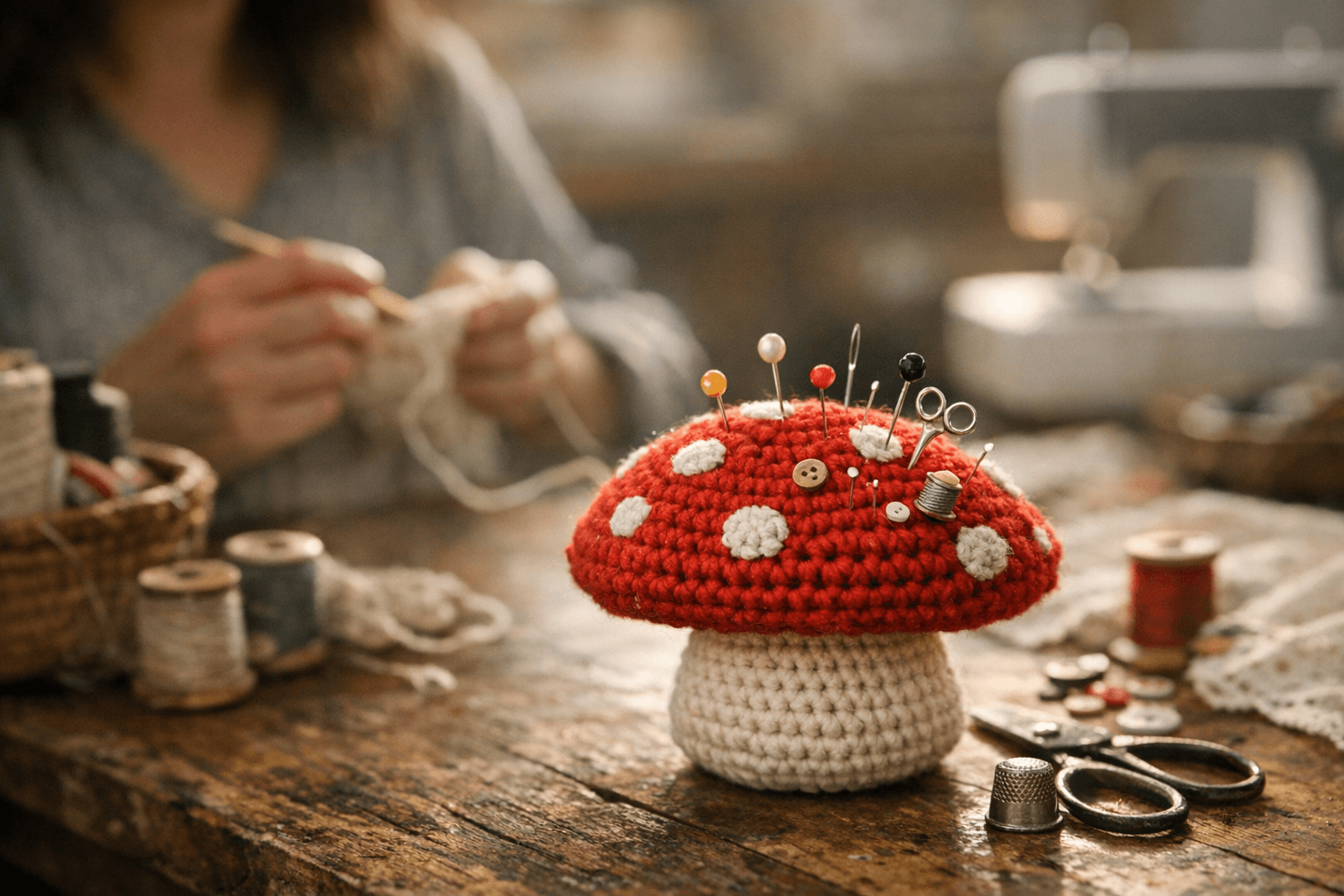
There's a specific kind of maker who keeps two project baskets going at once: one for crochet, one for hand embroidery or garment sewing. For that maker, the mushroom pincushion is having a genuine moment. Handmade accessories are surging in visibility, with Etsy's Spring 2026 Seller Trend Report noting that "crochet, embroidery, and stitched textures are stepping into the spotlight" as buyers and crafters alike push back against mass-produced sameness. A crocheted pincushion sits squarely at that intersection: it's a fiber project that produces a sewing tool, and when the design is as visually satisfying as a spotted mushroom cap, it doubles as desk decor. DIYsCraftsy's recently released free pattern is a well-timed entry into that conversation.
Why the Mushroom Shape Works So Well
At a small scale, mushrooms are almost uniquely forgiving as a crochet subject. The domed cap naturally suits the increase-then-decrease shaping that crocheted rounds produce, and the contrast between a richly colored cap and a pale stem gives makers an immediate, clear color blocking challenge without requiring colorwork complexity. The spotted cap is iconic enough to read from across a room, which matters when the finished object sits on a craft desk or vendor table. It's also a shape that spans aesthetics: the same pattern can swing woodland-cottage with muted terracotta and cream, or tip into bold kawaii territory with a vivid red and stark white spots. That flexibility is rare in a pattern this small.
Materials: Getting the Gauge Right
The pattern recommends mercerized cotton or fine wool for the cap, with old rose cited as the suggested cap color, though any favorite shade works. The stem calls for lighter tones, beige or white, and the decorative spots are worked in white. Hook size matters here more than it does on a forgiving afghan: the 2.5 to 3 mm range is specified precisely because a dense, tight fabric is load-bearing in a pincushion. Loose gauge means pins push through the stitches and snag the yarn rather than sitting cleanly in the stuffing. Mercerized cotton is particularly well-suited because it's smooth, color-stable, and resists the micro-abrasion that repeated pin insertion and removal creates over time.
The yarn investment is genuinely minimal. A project this size pulls from scraps rather than full skeins, which makes it an ideal stash-buster and a natural candidate for those odd lengths of quality cotton left over from larger garment projects.
The Build Plan: A Realistic Time Estimate
For an intermediate maker comfortable with reading round-by-round instructions, this is a confident two-hour finish, including seaming and stuffing. The construction sequence runs as follows:
1. Start the cap with a magic ring, then work increases across the first several rounds to build the dome shape.
2. Introduce decreases to shape the underside of the cap and close the opening, leaving space for stuffing.
3. Work the stem separately as a short tube, stuff it lightly for structure, then join it to the cap.
4. Add the white spot embellishments as surface details using slip stitch or duplicate stitch depending on your preference.
5. Finish with stuffing, insert the weighted base, and close.
For makers who haven't yet conquered the magic ring, the pattern includes a two-chain alternative that achieves the same tight center start without the hand tension adjustment the ring requires. That inclusion bumps the pattern's accessibility considerably.
Stuffing, Structure, and the Weighted Base
A pincushion that tips over is just a small sculpture. Stability is functional, not decorative. The pattern flags an optional flat stone or recycled plastic disk placed in the base before closing, which lowers the center of gravity and keeps the mushroom upright through daily use. Both options are genuinely free: a smooth river stone from a garden or a circle of rigid plastic cut from packaging both work. The disk approach is particularly tidy because it can be cut to fit the exact diameter of the stem base.
For stuffing material, firm is better than fluffy. Polyester fiberfill packed tightly, or a combination of fiberfill topped with a small amount of heavy material like dry rice or sand near the base, gives the pincushion the resistance that holds pins at the angle you place them. A pincushion that compresses too easily lets pins lean and cluster, which defeats the organizational purpose.
The One Tip Most Makers Miss
Here's the finishing detail that separates a pretty pincushion from a truly functional one: line the inside with a small piece of wool felt before closing. Cut a rough dome shape from wool felt, slightly smaller than the interior of the cap, and nestle it against the stuffing before you seam shut. Wool felt acts as a buffer layer between the pins and the crochet fabric, meaning pins push into the felt rather than the yarn loops. Without it, repeated use gradually catches the stitches on pin shafts, distorting the fabric and eventually snagging visible loops on the outside of the cap. The felt layer adds maybe five minutes to the build and meaningfully extends the life of the finished piece.
Skill Level and What You'll Actually Practice
The pattern is labeled intermediate, and that rating reflects the precision required rather than the complexity of individual stitches. Magic ring starts, clean increases that maintain a smooth dome curve, and symmetrical decreases that close the cap without puckering all demand stitch-count attention. The pattern provides counts at the end of each round, which gives makers a checkpoint system to catch errors before they compound. Worked small and in-the-round, this project is genuinely useful as a teaching piece for anyone ready to move beyond flat squares. The shaping logic here, increasing to widen and decreasing to close, is the same logic behind amigurumi heads, hat crowns, and granny square circles, so the skills transfer directly.
From Craft Room to Craft Fair
Beyond personal use, mushroom pincushions scale well as gifts and small-batch vendor items. They're compact enough to ship flat-rate, visually strong in a flat-lay photograph, and sit at a handmade gift price point that requires no justification. Craft fair shoppers respond to functional whimsy, and a basket of mushroom pincushions in varied colorways draws attention without requiring elaborate display infrastructure. For designers building a social following, the format also rewards process content: the magic ring start, the dome taking shape round by round, and the final spot placement are all naturally photogenic moments.
The toadstool silhouette may be the classic read, but the same construction opens into woodland variations: deeper burgundy caps for autumn, pale lavender for a more fantastical feel, or earthy brown-and-tan for a porcini-inspired version that leans naturalistic rather than whimsical. The pattern's color recommendations are a starting point, not a ceiling, and makers who swap old rose for something from their own stash are likely to produce the most interesting results.
This article was produced by Prism’s automated news system from verified source data, official records, and press releases, then run through automated quality and moderation checks before publishing. The system is built and supervised by the people who set the standards it runs under. Read our full AI policy.
Did this article answer your question?