Disabled Crafter Turns Rock Bottom Into Community Giving Through Crochet
When Michele became disabled, she built a donation group producing chemo caps, kennel blankets, and preemie items for four causes at once.
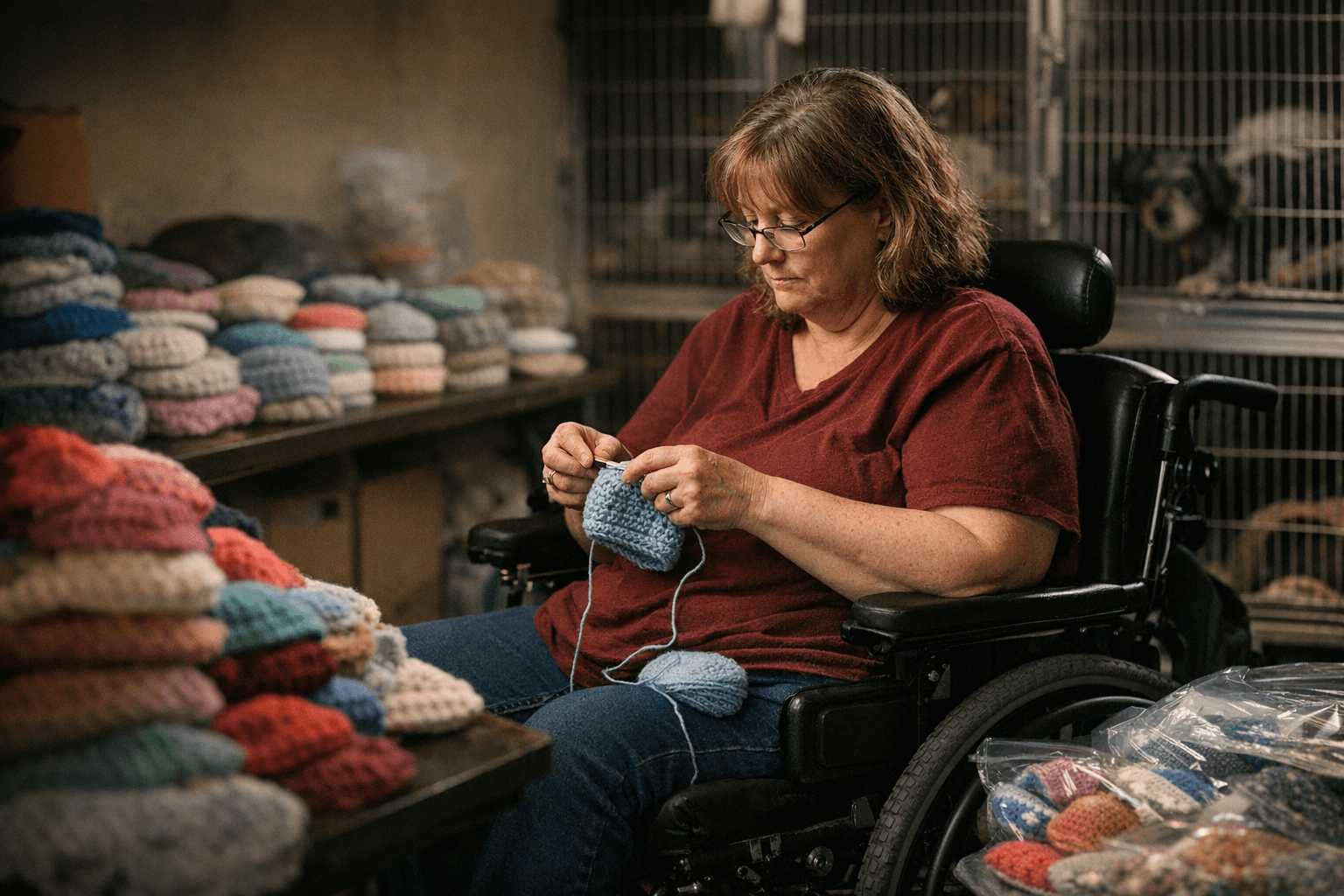
Rock bottom turns out to be a surprisingly productive place to start a charity. When Michele became disabled, she responded not by withdrawing but by founding a knitting and crocheting group that now channels handmade goods to cancer centers, animal shelters, homeless services, and families of stillborn babies. The items her group produces, lap robes, chemo caps, kennel blankets, hats, scarves, and preemie pieces, are among the most consistently requested donations in charity crochet, which means her model is ready for any group willing to pick up a hook.
Chemo caps are the logical entry point. Knots of Love has distributed over half a million handmade caps and NICU blankets to more than 580 locations since 2007, and the organization offers free downloadable patterns that reduce the barrier to zero for a beginner. The critical yarn rule: soft cotton, acrylic, silk, or fleece blends are best; avoid wool and alpaca, which can irritate the scalp of a patient undergoing chemotherapy. If you need to wash the item, use detergents labeled "allergen free," "unscented," or as a "clear" liquid. Pack finished caps in a sealed bag, smoke-free, before sending.
Kennel blankets for animal shelters operate on different logistics. Comfort for Critters donates handmade pet blankets to more than 400 animal shelters across the United States. Most facilities want machine-washable, hole-free fabric sized to fit a standard kennel floor, which makes dense stitches like the half double crochet more practical than any lacy openwork. All blankets must be soft and machine washable, made from a yarn that can be dried at a high temperature, since most shelters and hospitals will machine dry them. A quick call ahead to confirm a shelter's current needs prevents duplication and ensures your work goes exactly where it's wanted.
Preemie items and memorial pieces for families of stillborn babies carry the most specific requirements. The Still Remembered Project, which creates items for families who have lost a baby, accepts only cotton and synthetic yarns, with no wool or alpaca, and asks that washing instructions accompany each donation. Pastels and light shades are preferred; fluorescent or neon colors are not accepted. NICU hats follow similar logic: non-irritating fibers and a snug fit, typically 9 to 12 inches in circumference for premature newborns.
Lap blankets destined for cancer centers or nursing homes run roughly 36 by 40 inches, large enough to cover a seated patient from waist to knee. A granny square panel or simple C2C construction works quickly and clears out stash yarn efficiently. Items must be smoke-free and cannot include religious messaging. Scarves and hats for homeless shelters are accepted nearly universally, though calling ahead to check current inventory levels is always worth the two-minute effort.
The through-line in everything Michele built is that the skill threshold stays deliberately low. Chemo caps, kennel blankets, and preemie hats are all beginner-level projects, the yarn costs are modest (especially with stash or donated fiber), and the range of recipients, four distinct community needs served by one committed group, means that almost any crafter, at almost any point in their own life, can find a place to plug in.
This article was produced by Prism’s automated news system from verified source data, official records, and press releases, then run through automated quality and moderation checks before publishing. The system is built and supervised by the people who set the standards it runs under. Read our full AI policy.
Did this article answer your question?