Free Lacy Crochet Summer Top Pattern Offers Beginners a Breezy Seasonal Project
Hira's free lacy summer top from YarnsPatterns uses granny-stitch rows and single-crochet panels — a beginner-friendly build with real fit flexibility for a season when crochet is everywhere.
Start With Your Body, Not the Hook
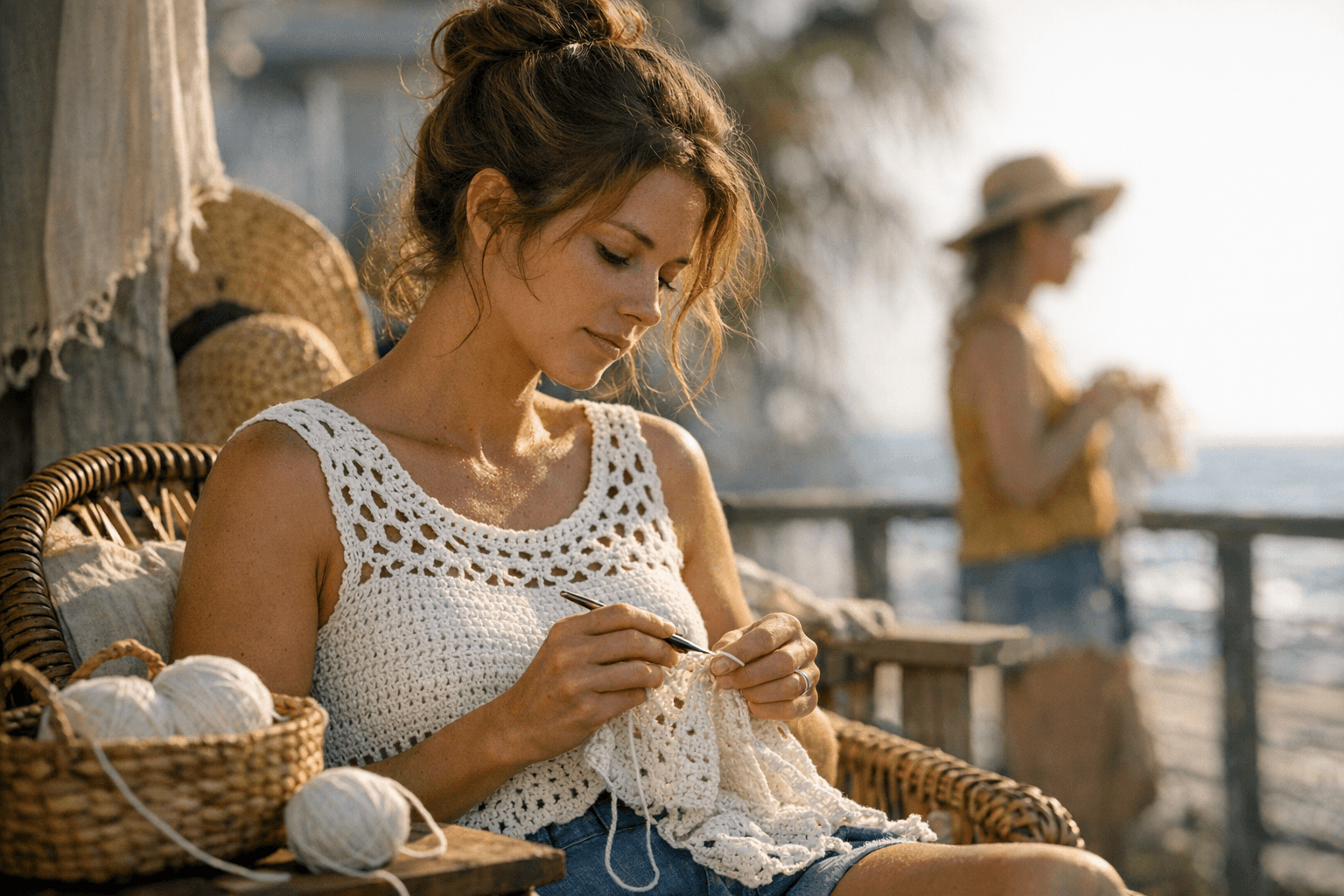
Before you wind a single yard of yarn, pull out a flexible measuring tape. The single biggest mistake first-time garment makers make is skipping this step, and with a fitted summer top, there is no hiding a bust that runs two inches too tight or a hem that hits at the wrong spot. Hira's pattern lists a small size with an approximate 32" finished bust, but the real power in the construction is that the initial chain count directly controls that measurement. Add or remove chains at the start, and the bust width follows proportionally, which means this pattern is essentially a framework you can dial in to your own body rather than a fixed size you have to squeeze into.
Take four measurements before you cast on: bust circumference, waist circumference, the length from shoulder to where you want the hem to fall, and your torso depth from shoulder to underarm. Write them down. Then pull a T-shirt or tank top you already love and lay it flat. Those real-life dimensions give you a sanity check against the pattern's finished measurements before you've committed a single stitch.
The Gauge Swatch Is Not Optional Here
With a lace-construction top, gauge matters more than it does in a blanket or a tote bag because every extra stitch per inch compresses across the entire width of the garment. Hira's pattern specifies a 3.5 mm hook, and that number assumes a particular yarn weight and tension. Crochet a 4" x 4" swatch in the pattern's primary stitch (single crochet for the initial block, then a test row or two of the granny stitch), block it flat, let it rest, and count your stitches per inch.
If your count runs higher than the pattern calls for (smaller, tighter stitches), go up half a hook size to a 4 mm. If it runs lower (looser fabric), try a 3 mm. This adjustment costs you maybe 20 minutes and saves you from finishing a top that gaps at the bust or pulls across the back. Critically, also check how the swatch drapes: hold it off the edge of a table and watch whether it falls softly or stands stiff. Summer tops need movement, and a swatch that stays rigid even before washing will only get stiffer on your body.
Choosing the Right Yarn for Heat and Drape
Hira's sample photos use acrylic yarn, which is a practical choice for color vibrancy and budget, but if you plan to actually wear this top in summer heat, a cotton-bamboo blend will serve you significantly better. The blend works because the two fibers solve each other's weaknesses: pure cotton can feel dense and heavy in finer weights, while 100% bamboo tends to stretch excessively over time and lose its shape at the bust. A 52% cotton / 48% bamboo sport-weight yarn offers breathability alongside a natural sheen and fluid drape that flatters lace openwork; a 40% cotton / 35% bamboo / 25% linen blend adds even more structure for makers who want the fabric to hold its shape without a lining underneath.
For a pattern built around granny-stitch rows, that drape quality amplifies the lacy texture beautifully. The open clusters in granny stitch catch light differently when the yarn has a slight sheen, making the finished top look considerably more elevated than its beginner construction level suggests. Stick to a sport or DK weight to keep the fabric light; anything bulkier than DK will make the granny clusters look chunky and turn a breezy summer top into a considerably heavier garment than intended.
One practical note: cotton-heavy yarns have very little stretch, which means the fit you measure in the swatch is almost exactly what you'll get in the finished garment. That is actually good news for beginners, because there are fewer surprises. Pick your yarn color early, since granny-stitch construction works beautifully in a single tonal color that lets the stitch texture carry the design, or try two alternating colors across the granny rows for a subtle stripe effect. Hira explicitly suggests varying colorways and adding optional flower embellishments, a philosophy that echoes Butterick Publishing's 1891 description of granny-square work: "no two blocks should be alike, and the colors may be combined to suit the fancy."
How the Top Is Actually Built
The construction follows a logical two-stage sequence that makes it an excellent first wearable.
1. Work a foundation of single-crochet rows (six rows in Hira's sample) to create the solid, stable top band of the garment. This dense block anchors the top of the bust and gives the structure that keeps the neckline in place.
2. Transition into granny-stitch rows for the body. The granny stitch (clusters of double crochets separated by chain spaces) creates the open, lacy texture that makes the fabric breathable and visually light. The pattern includes explicit stitch counts and step-by-step directions for this transition so you know exactly when to switch.
This two-stitch structure is actually one of the best teaching tools in beginner garment work because it demonstrates how to move between dense fabric and openwork within a single piece. The solid band at the top reads as a design detail rather than a technical transition, which means your first wearable already looks intentional.
Three Size-Adjustment Moves That Actually Work
Once you've swatched and confirmed gauge, there are three specific customizations worth knowing before you begin.
Bust width: The chain count at the foundation is your primary lever. Each additional stitch in the starting chain adds width across the bust; removing stitches narrows it. The pattern notes adjustments for medium and large, so use those increments as your guide for how many chains translate to how many inches at your specific gauge.
Length: This is the simplest adjustment in bottom-up construction. Simply add or remove granny-stitch rows between the underarm and the hem. Because the granny stitch repeats in a modular way, you can add two rows for a longer tunic silhouette or stop two rows early for a cropped fit without disrupting the stitch pattern or count. Try on the piece as you go by slipping it over your head and checking where the hem falls against your hip; with granny stitch, each row adds a consistent, predictable amount of length, so you can plan your stopping point precisely.
Straps and neckline: For this style of top, strap length is the difference between a comfortable, secure fit and something that slips off the shoulder with movement. Start by measuring from your shoulder down to where the solid band sits at your chest, then add about an inch of ease. If you are working in a low-stretch fiber like cotton, also account for the fact that the strap won't give at all during wear, so err slightly generous. You can always join at a higher point to shorten; lengthening means ripping back, which is a frustration worth avoiding. For a wider neckline, work your foundation chain across fewer stitches at center front and increase toward the sides.
Try-On Checkpoints
Crochet fabric is forgiving about mid-project adjustments in a way that woven fabric is not, and the key is checking in early rather than waiting until you've finished.
- After the single-crochet block: hold the piece against your chest and confirm the width feels right and the band sits where you want the top of the neckline.
- After the first four granny-stitch rows: put the piece down flat and measure the length so far; divide that by the number of rows to calculate how many more rows you need for your target length.
- At the halfway point of the granny-stitch body: if you can, pin the sides together and try it on. Check for pulling at the sides, gaping at the center, and whether the fabric drapes the way you want it to.
The 140-Year-Old Stitch at the Heart of This Top
The granny stitch powering Hira's lacy top is not a modern invention. The earliest documented granny square pattern appeared in an 1885 issue of Prairie Farmer Magazine, an Illinois publication, and Butterick Publishing's 1891 book "The Art of Crocheting" featured an engraving of a granny square alongside its now-famous customization note. Weldon's Practical Needlework expanded on the technique in 1897, cementing granny-stitch work as a genuine Victorian-era craft tradition. More than 130 years later, the same stitch construction forms the lacy body of a beginner summer top designed for a global digital audience. The continuity is remarkable: what made the granny stitch appealing in 1885 (its modularity, its adaptability, and its tolerance for color experimentation) is exactly what makes it work beautifully in a free pattern built for makers who want to customize.
The Broader Moment This Pattern Fits Into
This is not a random seasonal release. Hira has published at least three additional free crochet top patterns: the Crochet Textured Crop Top (May 26, 2025), the Crochet Mesh Top designed with a boxy cropped silhouette for layering over tanks or swimsuits (July 2, 2025), and the Crochet Off Shoulder Top (December 3, 2025). Together with this April lacy top, they represent a deliberate seasonal garment calendar rather than opportunistic one-off publishing.
The timing aligns with a documented market shift. Who What Wear declared crochet "the must-have texture of spring/summer 2025," with Zara, Mango, and H&M all producing crochet pieces across clothing, bags, shoes, and accessories. The global crochet market is currently valued at approximately $3 billion, driven by growing demand for handmade goods and sustainable materials, according to STATS N DATA. The knitting-and-crochet tools and accessories segment alone is projected to grow from roughly USD 0.216 billion in 2025 to USD 0.316 billion by 2034 at a 4% compound annual growth rate, per Business Research Insights, a trajectory that validates the long-term commercial logic behind free pattern publishing as a discovery engine.
If You Want to Sell What You Make
A finished top made from this pattern is a practical market item for seasonal craft fairs and online shops. Etsy remains the primary platform for handmade crochet pieces, with a $0.20 per-listing fee that keeps the entry barrier low for makers testing a single seasonal item. Ravelry functions as both a pattern marketplace and a community discovery platform, letting designers list patterns directly or cross-promote finished objects. Amazon Handmade, LoveCrafts, Instagram Shopping, and Facebook Marketplace round out the secondary options.
For a lacy summer top, photography matters enormously. Natural light, a simple background, and a flat-lay alongside the yarn you used will generate more interest than a styled shoot because buyers want to see the actual stitch texture. Hira's optional flower embellishments are a smart upsell for market tables: a plain version at one price, an embellished version at a slight premium, both made from the same base pattern.
The pattern's combination of a recognizable lace aesthetic, genuine beginner accessibility, and a market-driven release window makes it one of the more practical starting points for a crocheter ready to move from practice squares to a finished wearable that can hold its own on a warm-weather rack.
This article was produced by Prism’s automated news system from verified source data, official records, and press releases, then run through automated quality and moderation checks before publishing. The system is built and supervised by the people who set the standards it runs under. Read our full AI policy.
Did this article answer your question?