Free Mia Doll Amigurumi Pattern Offers Advanced, Customizable Crochet Design
A free Mia Doll amigurumi pattern packed with fully articulated fingers, poseable wire limbs, and endless customization options — rated advanced, and worth every round.
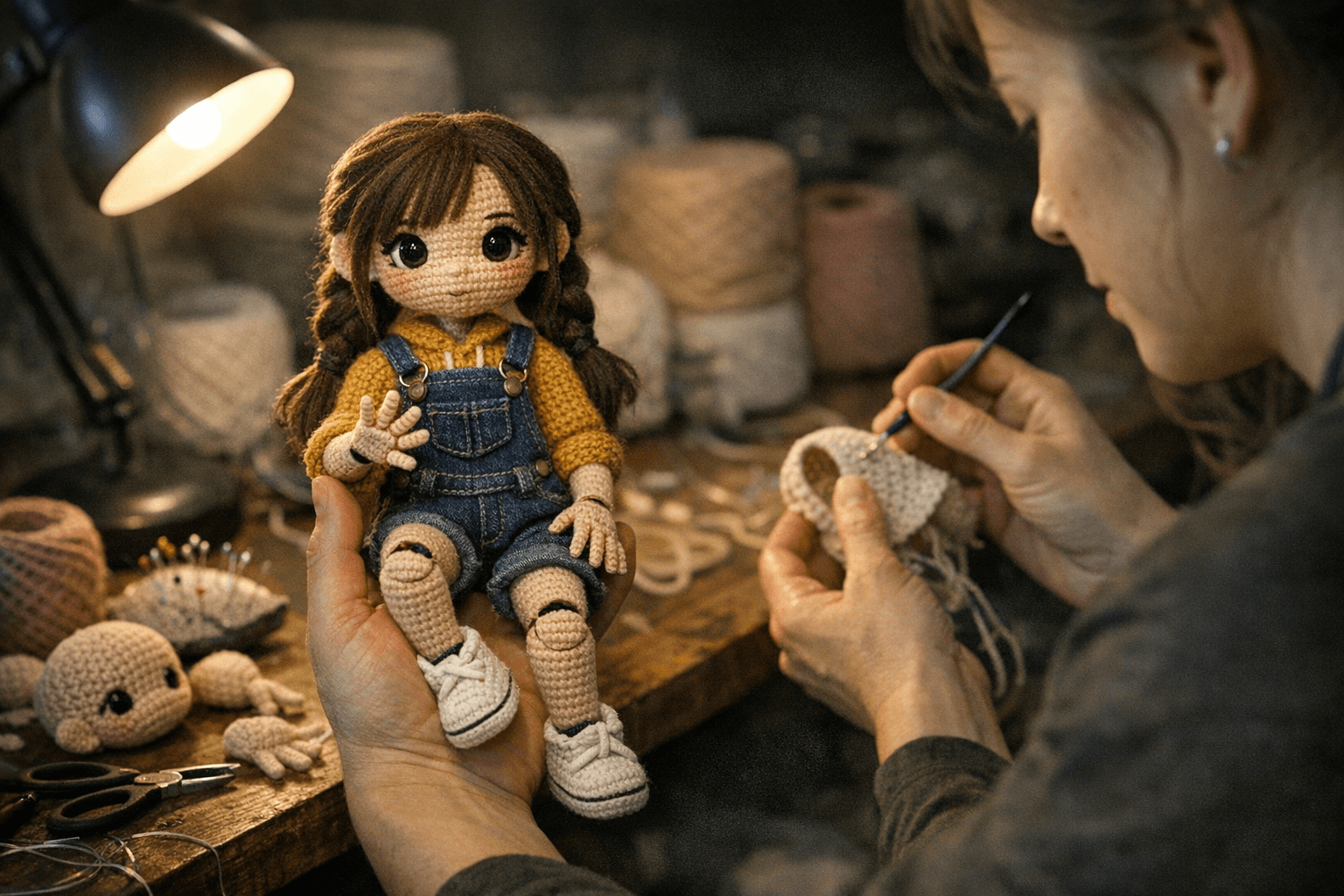
The kind of amigurumi doll that makes you set aside every other project on your hook, Mia arrives with articulated fingers, poseable wire-reinforced limbs, a crocheted wardrobe, and a hairstyle you can style to suit any personality. The pattern, posted on Amigurumi.Today and attributed by Carmencrochet to designer MyazinaDolls, is available free online and carries a clear skill-level warning: advanced. That rating is not decorative.
What Makes Mia Different
Most free amigurumi doll patterns ask you to crochet a round head, a tubular body, and four simple limbs. Mia asks considerably more. As Amigurumi.Today describes her, "Mia isn't just any amigurumi doll, she is full of charm and highly customizable!" The customization runs through every layer: hairstyle, clothing, and accessories can all be swapped out, and the pattern is designed so you can "easily personalize her to match any personality, season, or favorite color palette." The materials list alone signals the project's ambition, calling for insulated wire threaded through the limbs to make them poseable, separate shoe insoles cut from plastic or cardboard, decorative buttons in two sizes, beads for a headband, and a wig yarn distinct from the body yarn.
One maker who completed the project, writing on Eliserosecrochet, found the payoff entirely worth it: "I also adore her sweet face and her precious little dress, which I enjoyed crocheting so much." She also noted that the fox ears headband option transformed the doll's personality in one small addition: "The addition of the fox ears headband makes this amigurumi doll pattern so much fun too."
Materials and Tools
Amigurumi.Today specifies the full supply list, and it rewards careful preparation before you cast on a single chain.
The primary yarn is Yarnart Jeans, a fine-weight yarn (160 m per 50 g) blended from 55% cotton and 45% acrylic. That blend gives the finished fabric a light structure that holds stitch definition well at a tight gauge. For the wig, the pattern calls for a separate 100% acrylic yarn (50 g / 200 m), which gives you freedom to change hair color without committing your main yarn to it. The recommended hook is a 2.0 mm Tulip.
Beyond yarn and hook, you will need:
- 10 mm safety eyes
- Black embroidery floss (for facial details)
- Fiberfill
- 1.5 mm (0.06") insulated wire (for poseable limbs)
- Long tapestry needle
- Plastic or cardboard for shoe insoles
- Two 6 mm buttons for shoes
- Three 8 mm buttons for the dress
- Three beads for the headband
- Sewing needle and scissors
When those materials are used as specified and stitches kept firm, Amigurumi.Today states the completed doll should measure "about 26 cm (10")." However, Carmencrochet reports a finished height of 21 cm using the materials noted on that site. The gap between those two figures, roughly 5 cm, likely reflects differences in yarn weight, hook size, or tension, though neither source explicitly explains the discrepancy. If you are making Mia as a gift with a specific size in mind, it is worth crocheting a test piece before committing to the full project.
Accessing the Pattern
The free online version lives on Amigurumi.Today and requires a free account: sign in and scroll down on the pattern page to reach the full instructions. A PDF version is also available for purchase in the Amigurumi.Today store, which is worth considering if you prefer to print and annotate rather than tab between a screen and your hook. Carmencrochet hosts the pattern text on-page as well, including the full stitch-by-stitch instructions for the arms, and includes a linked video tutorial for the right arm construction, labeled "watch here" alongside that section.
Skill Level and Construction Conventions
Amigurumi.Today lists the skill level as advanced, and it appears twice in their materials block, which is as clear an emphasis as pattern text can give. The advanced rating reflects the density of construction details: the doll is worked in continuous rounds throughout (unless otherwise specified), with the beginning of each round marked with a stitch marker or yarn scrap to keep count accurate across dozens of sections. Carmencrochet adds the additional note that "the doll is crocheted only on the wrong side," which shapes how you orient your work from the first round.
The abbreviation set is standard for amigurumi: sc (single crochet), inc (2 sc in one stitch), dec (2 sc together), sl st, hdc, dc, tr, and ch. The bracket conventions follow the familiar pattern: parentheses indicate a repeat, square brackets indicate the total stitch count in a round.
A Closer Look at the Construction: Arms and Legs
The right arm section, hosted with full stitch counts on Carmencrochet, shows exactly why the advanced rating is earned. You begin by crocheting four individual fingers in chain and slip-stitch sequences before joining them: the little finger starts with 4 chains and 3 slip stitches for a total of 4 stitches; each of the ring, middle, and index fingers uses 5 chains and 4 slip stitches for a total of 5. After joining the fingers and working around them, you add a thumb in round 2, then shape the palm through a series of decreases across rounds 4 and 5 before settling into the longer arm tube.
The arm continues through 31 numbered rounds, narrowing and then steadying at 9 stitches before finishing with additional single crochets to reach armpit placement, a slip stitch, and a chain before cutting the yarn. Every stitch count is bracketed at the end of each line: (10), (12), (9), and so on, making it easy to verify your round before moving on.
The leg construction is no less detailed. The body-joining round alone reads: "11 sc, dec, 3 sc, 6 inc in BLO, sc, 2 sc in the chain, sc, 6 inc in BLO, 3 sc, dec, 11 sc, 2 sc in the chain" for a total of 60 stitches, and the pattern works through 10 rounds of shaping before arriving at the foot. Wire integration happens at round 8, when the two wires threaded through the legs are twisted around each other before continuing. The shoes are assembled separately, with the upper portion sewn to a cardboard or plastic sole; optional finishing touches include wrapping a furry yarn ball onto the shoe and shading with dry pastel pigment.
Dress Construction and Yarn Weight Considerations
The dress assembly introduces its own set of decisions. Theloopylamb's maker notes describe fitting the completed arms into the dress armholes with the opening at the back, sewing the dress closed, then beginning the skirt section with a standing crochet stitch at the seam and working rounds 7 through 10 in continuous rounds at 30 stitches each.
One important practical note from Theloopylamb: the yarn used for the dress can behave very differently from the body yarn, and that matters for how far to continue. The maker used Lion Brand Babysoft for the dress section, which was "significantly thinner than the yarn I used for the body section." The guidance is direct: if you are matching body yarn weight for the dress, you may need to stop after rounds 7 and 8. If your dress yarn is relatively thin, continue through rounds 9 and 10.
Yarn Choices from Makers
The Eliserosecrochet maker's yarn recommendation is specific and enthusiastic. Her go-to for all amigurumi doll work is Berroco Vintage, "a wool blend" prized for its softness and color range. She used it for her Mia project and called it her definitive recommendation for crocheting toys. Berroco Vintage is available in sixty-two shades, which makes it a practical match for the pattern's emphasis on color-based personalization. The maker noted the color palette she chose for Mia in her full post.
A Note on Designer Attribution
Two separate sources credit the Mia Doll pattern differently. Carmencrochet's page is titled "MIA Doll - Free crochet pattern by MyazinaDolls," attributing the design clearly to that designer. Eliserosecrochet, on the other hand, describes finding Mia while browsing the Etsy shop of Green Frog Crochet, a designer known as Dang, and calls her "the super talented designer behind Green Frog Crochet." Amigurumi.Today's excerpt does not include an explicit designer credit in the available text. Both attributions appear in primary sources and neither explicitly resolves which designer originated the pattern. If you are making Mia for commercial sale or public display, it is worth tracking down the original designer directly to confirm licensing terms before listing finished pieces.
The pattern's technical depth, zero cost for the online version, and the range of creative decisions it hands you across hair, clothing, accessories, and color make Mia a doll worth the patience the advanced rating demands.
This article was produced by Prism’s automated news system from verified source data, official records, and press releases, then run through automated quality and moderation checks before publishing. The system is built and supervised by the people who set the standards it runs under. Read our full AI policy.
Did this article answer your question?