Mini Seahorse Amigurumi Pattern Offers Beginners a Quick Ocean-Themed Make
Tiny but texturally rich, this mini seahorse works up fast on a 2.2mm hook using only basic amigurumi stitches, making it a smart first ocean-themed project.
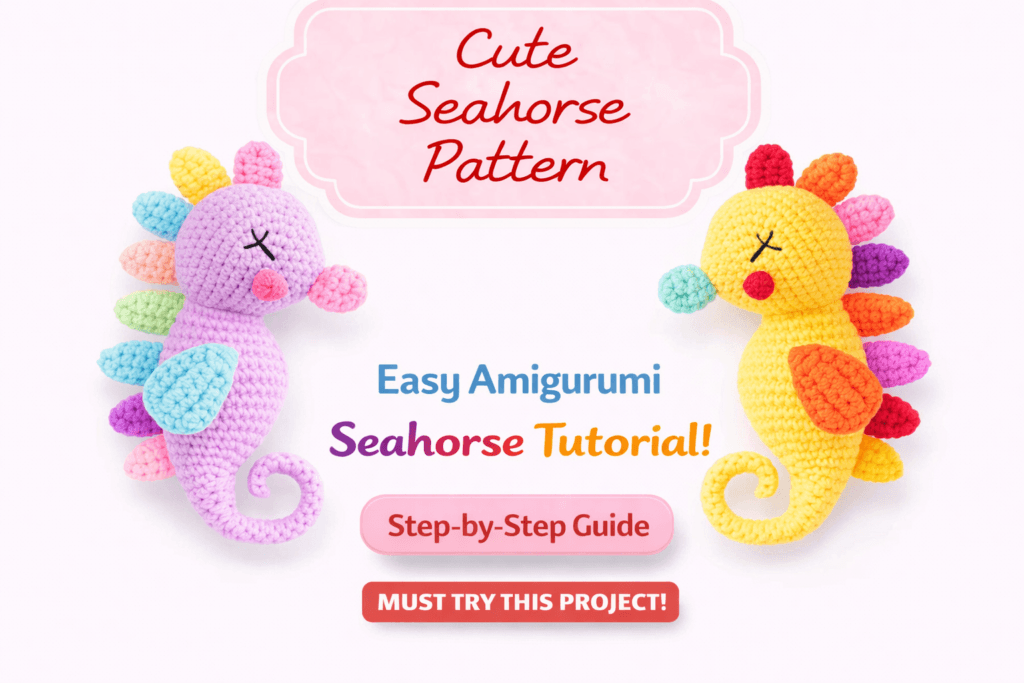
Stash yarn and an afternoon are genuinely all it takes to finish this one. The Mini Seahorse Amigurumi pattern from AmigurumiGratis is the kind of compact, character-packed make that earns a permanent spot in a beginner's project queue: small enough to complete in a single sitting, detailed enough to feel like a genuine skill-builder, and versatile enough to become a keychain, a mobile ornament, or a shelf-display centerpiece depending entirely on the yarn you reach for.
Why This Seahorse Works for Beginners
The pattern is an honest beginner project, not a beginner-adjacent one. The only stitches you need going in are the magic ring, single crochet, increases, and decreases. Those four tools, which most amigurumi newcomers learn within their first two or three makes, are the entire technical foundation of the seahorse's head and tail construction. The pattern provides step-by-step written rounds for both sections, so there is no moment where you are expected to interpret or adapt; you simply follow each round as written.
What makes the seahorse a stronger teaching tool than, say, a simple round ball or a basic bear head is that its body requires intentional shaping across multiple parts. The head narrows at the snout. The tail tapers and curves. These are not difficult maneuvers, but they introduce the kind of directional thinking that prepares you for more complex amigurumi later. You are not just stacking identical rounds; you are building a recognizable silhouette, which is satisfying in a way that pure repetition rarely is.
The Fins: More Than Just Decoration
The most instructive element of this pattern, and the feature that sets it apart from a basic ocean shape, is how the fins are handled. Rather than crocheting fins directly into the body as simple flat extensions, the pattern has you make them separately in multiples and sew them on. This is what designers mean by directional fins: each fin is oriented deliberately, attached at a specific angle to create the visual rhythm of a real seahorse's dorsal and lateral ridges.
For a beginner, this introduces an important foundational skill: working small flat pieces and then seaming them to a three-dimensional form. It is a technique that recurs constantly in amigurumi, from ears and wings to tails and hair. Learning it on a project where the fins are small and forgiving, rather than on a large structural element like an arm or leg, is excellent preparation. The difference between a basic crochet fin (a flat lobe crocheted directly into a stitch) and a directional sewn fin is visible immediately: the sewn-on version has dimension, can be positioned precisely, and holds its angle rather than lying flat against the body.
The pattern also includes guidance on eye placement and cheek embroidery, two finishing details that beginners consistently find intimidating. Having both addressed explicitly within the written pattern removes the guesswork that often causes finished amigurumi to look slightly off-center or unbalanced.
Your Practical Make Plan: Yarn Weight and Scale
One of the smartest things about this pattern is how easy it is to scale simply by changing your yarn weight, with no alteration to the written rounds required.
The pattern recommends a 2.2mm hook, which pairs naturally with fingering or sport-weight yarn. At that gauge, the finished seahorse is small enough to function as a keychain charm or a decorative element in a mobile, lightweight and compact without sacrificing the surface detail of the fins and ridged tail. The pattern includes specific yarn color suggestions designed to evoke real seahorse varieties, so even at keychain scale the finished piece reads as a recognizable, polished object rather than a novelty blob.
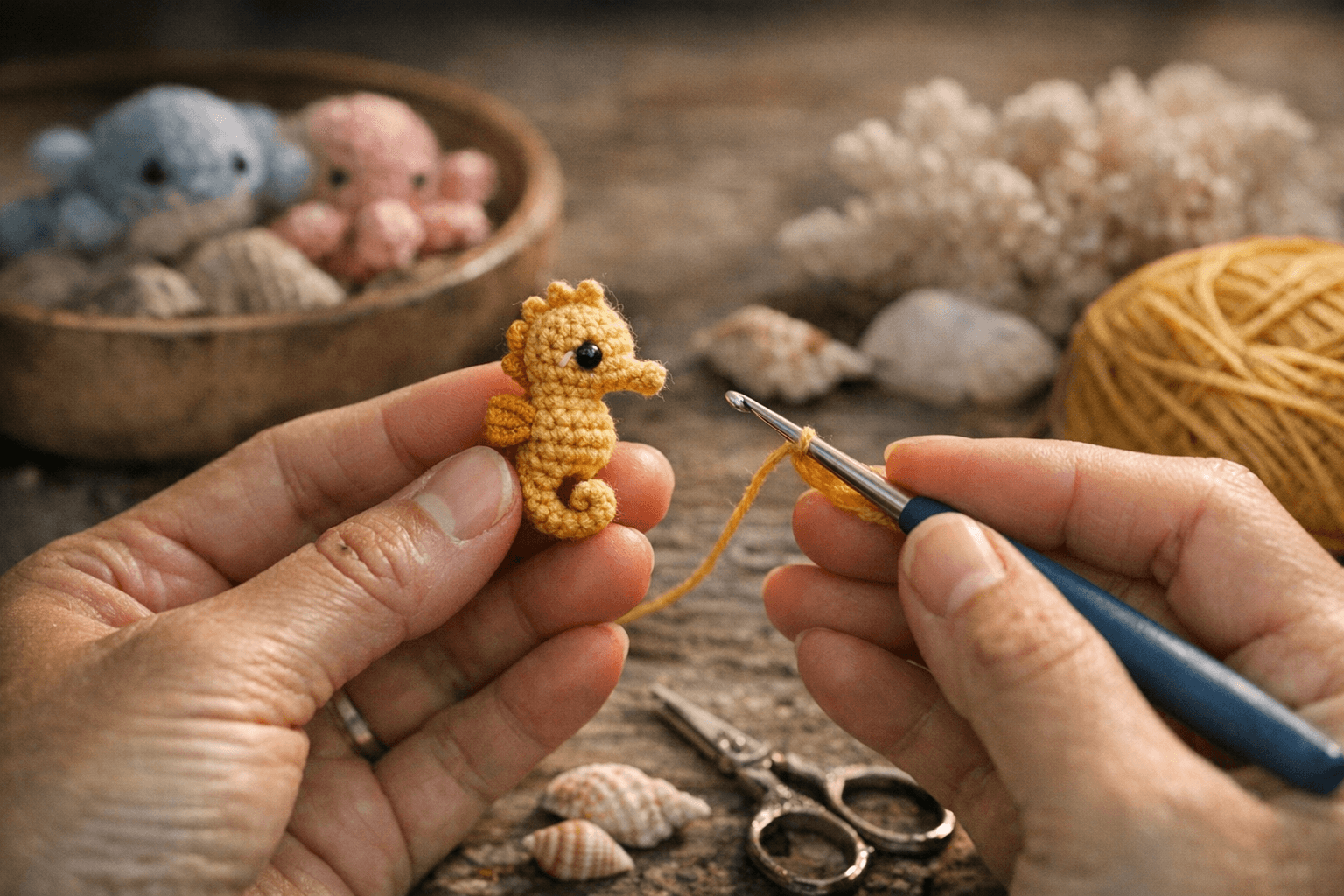
If your goal is a shelf plush or a nursery display piece, step up to a DK or light worsted yarn and switch to a proportionally larger hook (a 3.0mm to 3.5mm range keeps the fabric tight enough to hold stuffing without gaps). The same written rounds produce a larger, squishier seahorse with the same silhouette. For context on scale:
- Fingering weight, 2.2mm hook: keychain-ready, lightweight for mobiles, ideal for market multiples
- Sport weight, 2.5mm hook: small shelf plush, gift-sized, good for stash-busting small quantities
- DK or light worsted, 3.0–3.5mm hook: nursery décor scale, fuller stuffing, more visible fin detail
Makers selling at craft fairs or seaside markets will appreciate that the fingering-weight version uses very little yarn per piece, making the material cost minimal and the per-item margin strong, particularly when working through end-of-skein remnants.
One Customization Worth Trying: Striped Colorwork on the Body
The pattern's step-by-step round structure makes it straightforward to introduce color changes without modifying any stitch counts. Striping the body is the fastest, most visually dramatic customization available, and it takes only one extra step: switch yarn color at the start of a new round and carry the unused color loosely along the inside of your work until you need it again.
A two-color stripe sequence in rounds alternating every two to three rows gives the seahorse a banded look reminiscent of a dwarf seahorse or a ringed pygmy seahorse. The pattern already offers colorway suggestions for naturalistic seahorse varieties, so you have a starting reference point. Choose a main body color and a lighter contrast, work the fin pieces in one solid accent, and you have a custom colorway that looks intentional and species-specific rather than random. The whole process adds no extra time to the make itself, only the moment it takes to switch yarns.
From Stash Project to Social Content
The seahorse's compact size and defined construction stages (tail, body, head, fins, finishing) map cleanly onto the kind of short-form video content that performs well on social platforms. Each stage is visually distinct and brief enough to capture in a 15- to 60-second clip, making it a practical demo project for crochet content creators who want to show shaping and finishing techniques without committing to a multi-hour project on camera.
For community events, stitch-and-share groups, and crochet nights, the pattern works equally well as a shared group project. The low stitch count means participants at different skill levels can all reach a finished object in the same session, which keeps energy high and produces the kind of shareable group photo that actually circulates beyond the room.
Ocean-themed amigurumi hold steady demand across nursery décor, coastal gift markets, and collector communities, and the seahorse sits at an unusually useful intersection of all three. Its textural detail, the ridged tail, the dimensioned fins, the embroidered face, makes it feel like a more ambitious project than it actually is. That gap between perceived complexity and genuine accessibility is exactly what makes a pattern worth returning to.
This article was produced by Prism’s automated news system from verified source data, official records, and press releases, then run through automated quality and moderation checks before publishing. The system is built and supervised by the people who set the standards it runs under. Read our full AI policy.
Did this article answer your question?