Free Scottish Fold Cat Amigurumi Pattern Captures the Breed's Signature Charm
Amigurumi Today's free Scottish Fold cat pattern nails the breed's owl-eared charm in a beginner-friendly make that's as giftable as it is quick to finish.
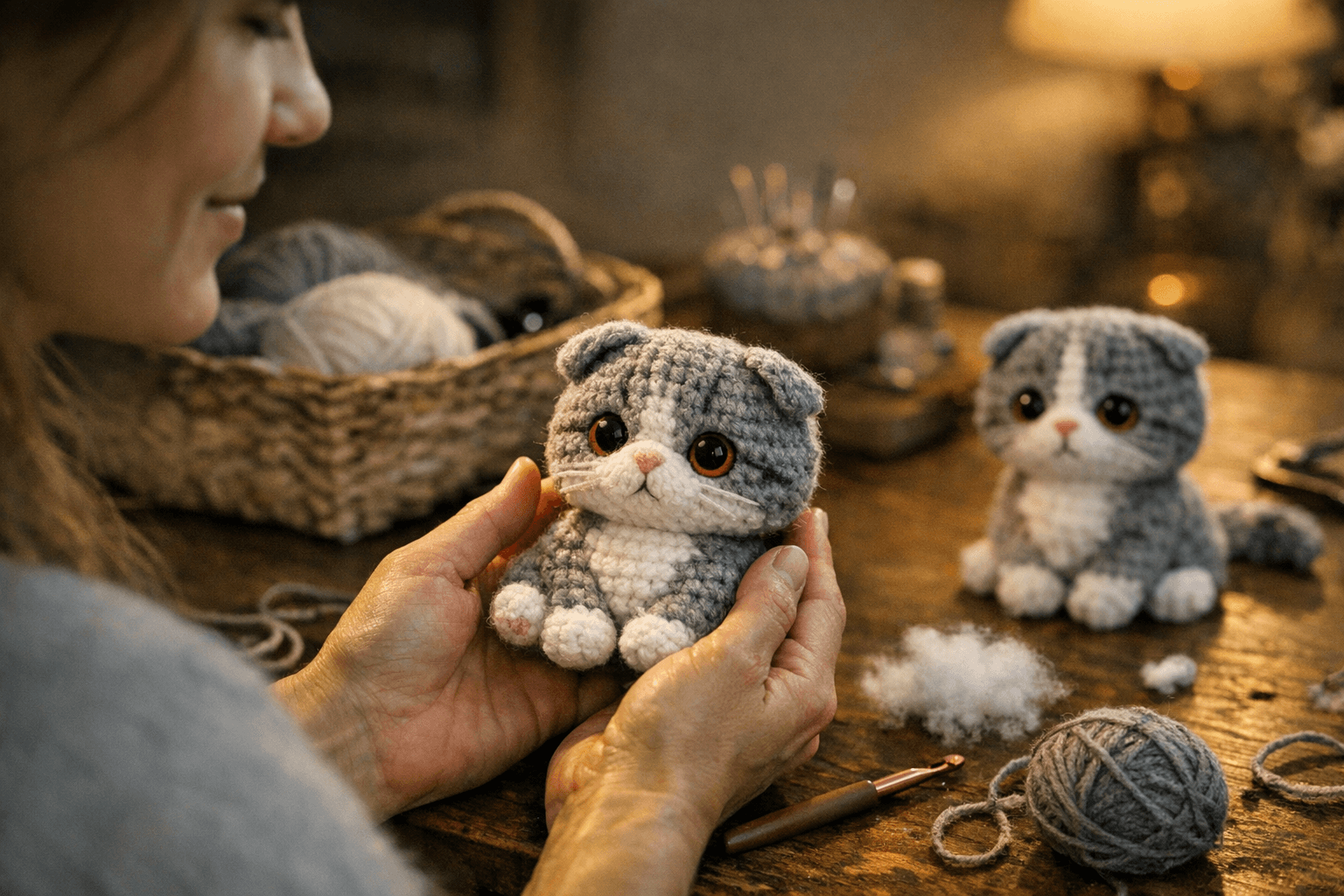
The Scottish Fold's round, forward-eared face is one of the most recognizable silhouettes in cat culture — it's the same look that made Taylor Swift's two Scottish Folds, Meredith Grey and Olivia Benson, stop-everything famous on social media. Translating that specific breed character into a crocheted amigurumi is harder than it sounds, because a poorly placed ear turns a Fold into any generic cat instantly. Amigurumi Today's featured free pattern solves that problem directly, giving makers the construction logic to get the silhouette right on the first attempt.
Who This Pattern Is Actually For
If you've got a project queue full of ambitious multi-part makes and you need something that delivers a finished object fast, this is it. The design works as a desk buddy at its default size, a quick-gift option for any cat owner on your list, or a keychain charm when you scale it down with a lighter yarn. It's rated easy to beginner-friendly, which means intermediate makers will move through it in a single long session, and newer makers working through amigurumi for the first time will find it a genuinely teachable introduction to the core techniques: shaping a sphere, working increases and decreases in the round, and sewing on separate pieces with clean alignment.
This is also a stashbuster in the truest sense. The Yarnart Jeans colorway used in the source pattern — gray #46, white #01, and golden brown #40 — calls for modest amounts across three colors, so it draws from scraps rather than demanding a full skein. Any sport-weight or fine cotton-blend in your stash will serve the same function.
Quick-Reference Specs
- Finished size: approximately 18 cm (7 inches) tall at default gauge
- Yarn: Fine-weight cotton-blend; the source pattern uses Yarnart Jeans (160 m / 50 g; 55% cotton, 45% acrylic) in gray #46, white #01, and golden brown #40
- Hook: Size down from the label recommendation — standard amigurumi practice — to produce tight, filling-concealing fabric; a 2.0–2.5 mm hook is typical for this yarn weight
- Eyes: 6–8 mm plastic safety eyes for display pieces and adult-use items; embroidered satin stitch in black yarn for anything destined for children under three
- Difficulty: Easy/beginner-friendly
- Core techniques: Magic ring, single crochet, increases, decreases, minimal embroidery for facial expression, and sewn assembly
What Makes It Read as a Scottish Fold
The entire personality of this breed lives in two design decisions: the angle of the ears and the proportions of the head. Both are where this pattern earns its keep, and both are where a generic cat pattern would fall apart.
Scottish Fold ears are worked as separate flat pieces and attached at a forward-tipping angle toward the face rather than pointing straight up. That distinction is the whole game. Upright ears make a tabby. Forward-tipped ears at roughly the mid-point of the head's crown make a Fold, and the "owl-cat" character Amigurumi Today specifically calls out in its editorial framing snaps into place immediately. The pattern's assembly notes address this placement directly, which is worth reading carefully before you pick up your needle, because it's the kind of detail that's easy to rush through and difficult to undo cleanly after the fact.
The head construction uses a generously oversized sphere relative to the body, with a wide, relatively flat face and a compressed muzzle area. That proportion is what gives the Scottish Fold its famously expressive look in real life, and replicating it in amigurumi requires committing to a head that looks almost comically large before the body goes on. Trust the construction — it resolves once the full figure is assembled. Eye placement reinforces the effect: wide-set and forward-facing eyes emphasize the round, open quality of the face rather than making the cat look side-glancing.
Three Personalization Swaps That Won't Change the Math
One of the real advantages of a stitch-count-based small amigurumi is that the design accommodates customization without requiring you to rework any numbers. Here are three changes you can make immediately:
1. Color substitution. The source pattern uses gray as the dominant color, but Scottish Folds come in nearly every coat color.
Swap gray for warm cream and you get a classic colorway; use a gently variegated self-striping yarn in your main color and you pick up a tabby effect without managing a single color change. Tortoiseshell requires slightly more color-blocking at the body stage, but the stitch counts stay identical.
2. Eye style. Plastic safety eyes are the fastest route to expression and give a clean, polished finish for display pieces.
For a softer, hand-crafted look, embroider the eyes in black satin stitch, then add a single white straight-stitch highlight after the base layer to bring the eye to life without any hardware. Both approaches work at this scale; the embroidered version is the safer choice for items going to small children.
3. Scale shift. The pattern is not gauge-sensitive in the way a sweater is, so changing yarn weight changes the finished size without changing the stitch counts.
Drop to fingering weight at a 1.5 mm hook and the finished cat lands around 9–10 cm — keychain territory. Step up to worsted at a 4.0 mm hook and you're looking at a 25 cm plush with real presence on a shelf. The folded-ear proportions track with scale, so the breed character holds at both extremes.
Why This Pattern Has Real Shareability
Named-breed amigurumi consistently outperform generic animal shapes in community engagement, and the Scottish Fold is unusually potent in that regard. The breed carries enormous cultural recognition thanks to pop-culture figures like Swift, whose Scottish Folds Meredith Grey and Olivia Benson have their own fan bases, merchandise appearances, and film cameos. When someone posts a crocheted Scottish Fold, it lands with an audience that already has an emotional relationship with the subject — that built-in recognition is a meaningful share advantage over abstract shapes.
For group projects, the format is near-ideal for crochet-alongs. The small finished size means participants can complete one in a single afternoon or a weekend, and the color-swap flexibility means no two cats in a group look identical. The stitch structure is simple enough that participants can talk through the ear-placement step together in real time, which makes it a strong candidate for beginner-inclusive group events.
For designers and small shops, there is also a practical traffic consideration here. Free, high-visibility animal patterns on aggregator platforms consistently drive traffic back to a designer's premium PDF shop and email list, particularly when the free version links through to expanded resources. The Scottish Fold pattern follows that model precisely, with Amigurumi Today's editorial framing pointing makers toward the full instructions and original designer page.
Pull your gray sport-weight yarn, drop your hook size two steps below the label, and read the ear-placement notes before you start assembly. The rest moves quickly — and the finished cat looks exactly like the owl-faced original that made the breed famous.
This article was produced by Prism’s automated news system from verified source data, official records, and press releases, then run through automated quality and moderation checks before publishing. The system is built and supervised by the people who set the standards it runs under. Read our full AI policy.
Did this article answer your question?