Free Crochet Piglet Amigurumi Pattern Features Seamless Leg-Joining Technique
Martha Miller's free piglet amigurumi uses a leg-joining round for a seamless, stable base and caps it with a signature springy coiled tail, finishing at 18-20 cm.
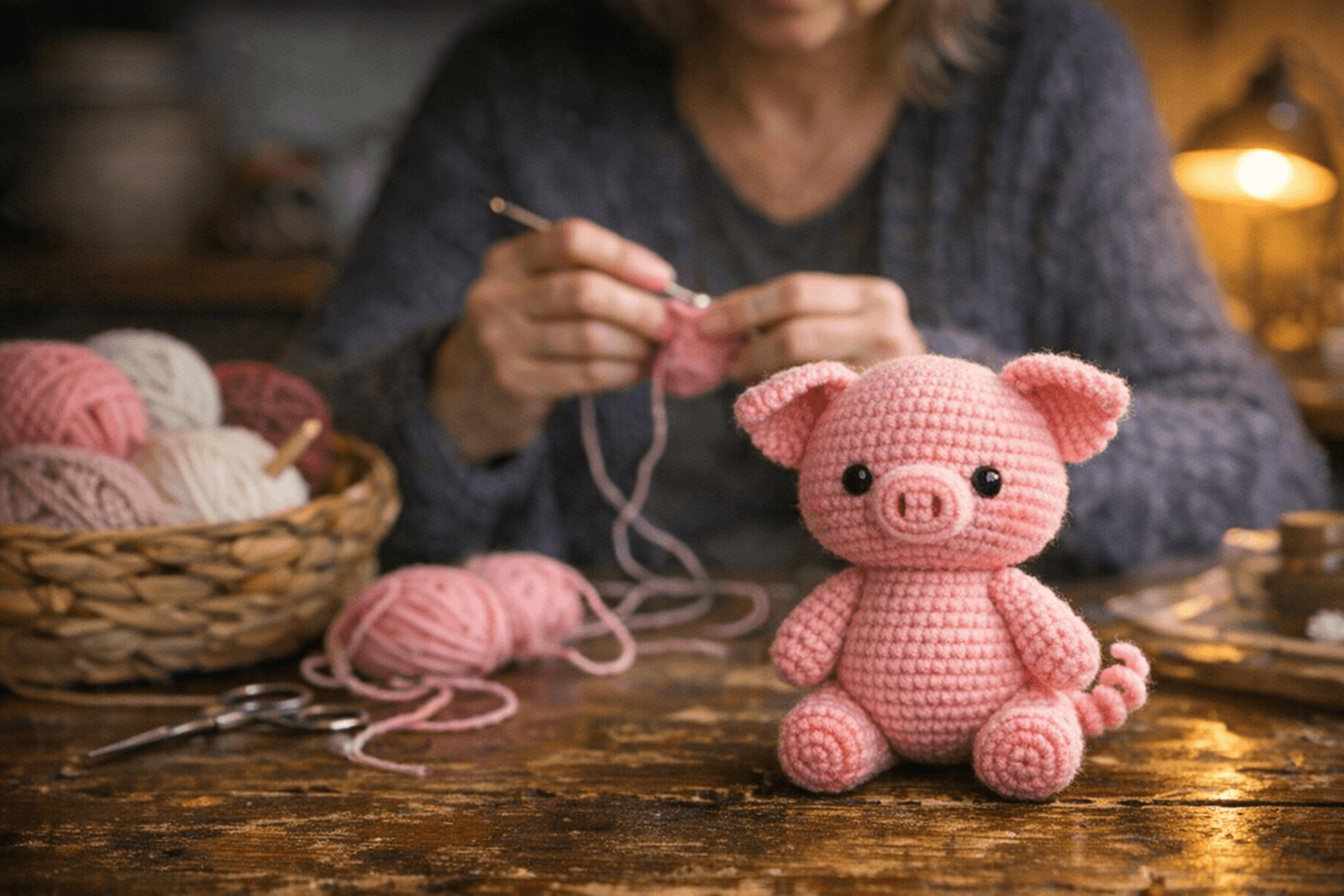
Sewn-on legs are the fastest way to spot a beginner's amigurumi at ten feet: the gaps, the puckering, the slight sideways splay that no amount of careful stuffing can fix. The free crochet piglet pattern Martha Miller published through Amigurumi Corner on April 2 skips all of that by folding the legs directly into the body's foundation round, producing a base that is visually clean and structurally sound from the first attempt.
Miller used a 2.5mm hook paired with light-worsted weight yarn, the tighter-gauge combination that keeps amigurumi fabric dense enough to hide stuffing without gaping at the seams. Safety eyes clock in at 8mm, a size large enough to read clearly across the snout without overpowering the face. The snout itself is worked as a separate piece and attached before final facial assembly, which keeps the embroidery work accessible before the head is closed.
The leg-joining round is the pattern's central teaching moment. Two finished legs are held parallel, and a single continuous round of stitches crosses directly over both open tops, locking them into the lower body in one pass. The technique, which Miller has used across other Amigurumi Corner designs including her Strawberry Cow, eliminates the visible seam line that sewn attachment leaves and distributes the toy's weight across both legs evenly so the finished piglet sits flat. Once a maker internalizes the method here, it transfers to virtually any multi-limbed rounded amigurumi body.
The curly tail is the pattern's signature detail and its most satisfying finish. A properly coiled pig tail needs to be anchored at the tip only; securing the full length against the body flattens the spiral and defeats the point. To keep the coil springy after the body is closed, leave the tail body free and attach only the very end, letting the remaining chain stitches hold their natural curve. Leg-gap prevention comes down to tension on the very first stitch of the joining round: pull it firm before proceeding, and the crotch point closes without any post-finishing intervention. Stuffing density at the body base matters more than most makers expect. Underfilling the lower body lets the legs angle outward under the weight of the head; overfilling tightens the base into a rigid dome that obscures the joined seam. Aim for a firm, yielding feel, enough resistance to hold the rounded shape but with a slight give when pressed.
The finished piglet measures approximately 18 to 20 centimeters, a size that makes it practical for gift bags, nursery shelves, and product photography. Miller proposed three colorways: classic pink throughout, a rosy-snout contrast version with a deeper pink reserved for the snout and inner ears, and an open novelty palette for makers who want to depart from the standard. The contrast version photographs best at a distance, which counts if the finished object is destined for an online shop listing.
Yarn groups looking for a short-class project will find the piglet covers continuous-round construction, the joining technique, and facial expression embroidery in a single session. That range of skills inside a compact, quick make is exactly what keeps a free pattern active in the project queue long after its release week.
This article was produced by Prism’s automated news system from verified source data, official records, and press releases, then run through automated quality and moderation checks before publishing. The system is built and supervised by the people who set the standards it runs under. Read our full AI policy.
Did this article answer your question?