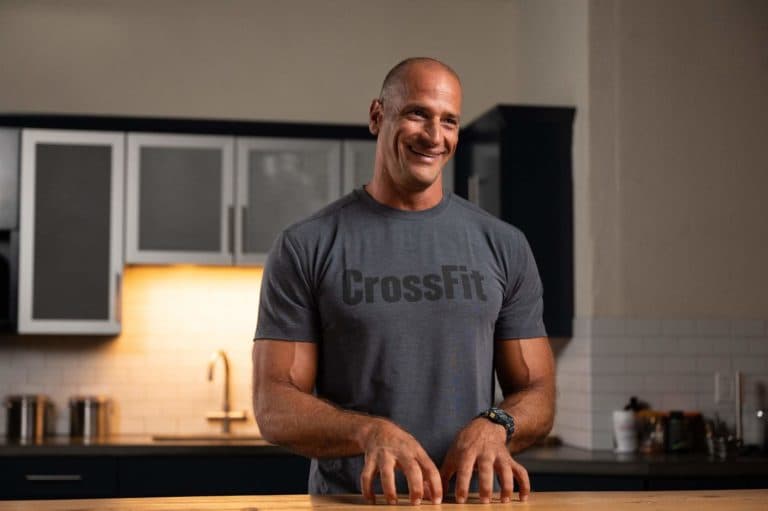
Nick Wells finds redemption through CrossFit after 48-year prison sentence
CrossFit turned Nick Wells’s prison routine into a path out, from a 48-year sentence to coaching and more than 17 years sober. The breakthrough was structure, not hype.
Nick Wells did not find redemption through a slogan. He found it in a prison gym, where a health scare, a long sentence, and a small group of inmates turned CrossFit into the one routine that actually changed his direction.
What changed inside the prison walls
Wells found CrossFit while incarcerated in Colorado Department of Corrections custody at Limon Correctional Facility, facing a 48-year sentence under Colorado’s habitual offender law for nonviolent crimes. The newer episode description says he had reached nearly 400 pounds after his arrest, and that he “traded one destructive dependency for another, food.” That detail matters because it shows the first win was not a trophy or a PR, it was getting his body and his day back under control.
CrossFit gave him a structure he could repeat. He started training with another inmate after realizing his health was deteriorating, and that simple move, one person showing up with another, became the seed of something larger. In CrossFit terms, it was the kind of consistency that changes a trajectory: same work, same pressure, same standard, repeated until the work stops feeling optional.
Why the first real breakthrough was accountability
The most important part of Wells’s story is not that he worked out in prison. Plenty of people exercise in prison. The difference is that CrossFit turned exercise into a social contract. A group formed around the training, and that group eventually became Redemption Road CrossFit, described as the first in-prison CrossFit gym.
That distinction is the heart of the redemption arc. Instead of training alone and disappearing when motivation dipped, Wells was part of a crew that had to show up for each other. The method became bigger than the workout itself because the box had a social structure: people counted on one another, and the routine carried consequences when someone slacked off.
CrossFit’s own prison reporting makes the setup even clearer. The Redemption Road Fitness program grew out of the Incentive Unit at Limon, where classes were held three times a week for upward of 30 other prisoners. That is not a casual side project. It is a scheduled, repeated, accountable system, and it is exactly the kind of environment where CrossFit’s built-in pressure can matter more than the equipment.
How the program scaled beyond one inmate
The story gets more interesting when the training stops being personal and starts becoming institutional. CrossFit Journal reporting says Unit 6 inmates had to maintain two years without Class 1 convictions to be housed there, which means the program grew inside a controlled setting with real behavioral expectations already in place. In other words, the culture around the classes mattered just as much as the classes themselves.
That structure helped the work spread. Ten men from the core group attended CrossFit Inc.’s first seminar held at a prison in April, a telling milestone because it shows the program was no longer just improvised fitness inside a cell block. It had become a recognized model with enough traction to draw outside attention and enough discipline to survive an official seminar. For anyone who treats CrossFit as only competition prep, that number should hit hard: 10 men, from one prison-based crew, in the first prison seminar CrossFit Inc. ever held.
The clemency case was built on measurable change
The earlier CrossFit feature framed Wells as an inmate at Limon Correctional Facility petitioning for clemency, with interviews from his lawyer, Violet R. Chapin, and Aaron Brill, president and CEO of Redemption Road CrossFit. That framing matters because it shows how the story was being built before the outcome was secured. This was never only about feeling better. It was about making a case with evidence.
Governor Jared Polis’s clemency letter sharpened that evidence into specifics. It says Wells became a Level 2 certified CrossFit coach, had an exemplary disciplinary record, had no COPD violations in the last 10 years, and worked collaboratively with prison guards, including one who became a mentor to him. Those details are the opposite of vague inspiration. They are measurable markers of change, the kind of things that can survive scrutiny from people who do not care about your intentions.
That is also what makes Wells’s arc more useful than a standard redemption profile. He did not simply say he had changed. He built a record that showed it: training, coaching, behavior, cooperation, and years of sobriety. The newer episode says he is now more than 17 years sober, which gives the story its present-day weight. This is not a one-time turnaround. It is a long maintenance cycle.
What CrossFit actually did for him
If you strip the headline down to its parts, the case for CrossFit in Wells’s life comes from five things:
- A fixed training cadence, three times a week, instead of random effort.
- A peer group that kept accountability visible.
- A path from athlete to coach, capped by a Level 2 certification.
- A culture of mentorship, including a prison guard who became a mentor.
- A record of conduct strong enough to matter in a clemency case.
That is the practical lesson here. CrossFit did not erase Wells’s sentence, his past, or the consequences of his crimes. It gave him a framework sturdy enough to hold a different identity, first as an inmate with a routine, then as a coach with a standard, and now as someone using Redemption Road CrossFit and the Redemption Road Fitness Foundation to change prison culture through mentorship, accountability, and purpose.
Wells’s story lands because it shows what CrossFit can do when the box is more than a room with barbells. In his case, it became a place where discipline was visible, community was unavoidable, and redemption had to be earned one class at a time.
Know something we missed? Have a correction or additional information?
Submit a Tip