Cuba Moves to Let Diaspora Invest in and Own Island Businesses
Deputy PM Oscar Pérez-Oliva Fraga announced Cubans abroad can invest in private companies under Law 118 for the first time, ending a restriction that limited such deals to state entities.

Deputy Prime Minister Oscar Pérez-Oliva Fraga announced on Mesa Redonda, Cuba's state television program, that Cubans residing abroad without legal residency on the island will be able to invest in and partner with Cuban private companies for the first time, ending a longstanding restriction that had confined such arrangements under Law 118 on Foreign Investment exclusively to state-owned entities.
The announcement, which Granma published in formal coverage on March 17 with a timestamp of 14:03:56, capped a two-day media rollout that began when NBC News posted an exclusive interview with Pérez-Oliva on March 16, hours before the Mesa Redonda broadcast. In that interview, the deputy prime minister told NBC reporter George Solis that "Cuba is open to having a fluid commercial relationship with U.S. companies" and "also with Cubans residing in the United States and their descendants."
The legal change is specific: Cubans abroad may now, through companies established in other countries, partner with Cuban private companies under Law 118. Previously, that law permitted foreign and diaspora-linked investment only with state entities. Under current legislation, Cubans living abroad also could not be partners in micro, small, or medium-sized enterprises, though they could participate in foreign and joint ventures. The new measures aim to change that.
Pérez-Oliva framed the scope of the opening broadly. "We have reiterated on several occasions that Cuba's doors are open to investment from the Cuban community residing abroad, and when we say that, we are not only referring to small businesses, but also to the possibility of participating in sectors key to our development," he said, as quoted by Granma. He described the intended result as "alliances that could be established, for example, between the Cuban private sector and foreign capital linked to our diaspora." Separate reporting indicated the measures would extend beyond commerce into large infrastructure investments in priority sectors including tourism, mining, and energy. The government also said it would improve internal processes for handling diaspora investment applications, including "a more targeted approach to the portfolio of business opportunities and better control and processing of applications to avoid unnecessary delays."
President Miguel Díaz-Canel had previewed the measures at a March 13 press conference, framing them as new steps to "reach out to Cuban emigrants." Lawyer and political analyst Eloy Viera Cañive, director of elTOQUE Jurídico, analyzed that preview on his program Ahora Qué before the formal announcement. The Mesa Redonda broadcast also reportedly covered the ability for expatriates to open foreign-currency accounts in Cuban banks, though no implementing regulations or detailed procedures were published.
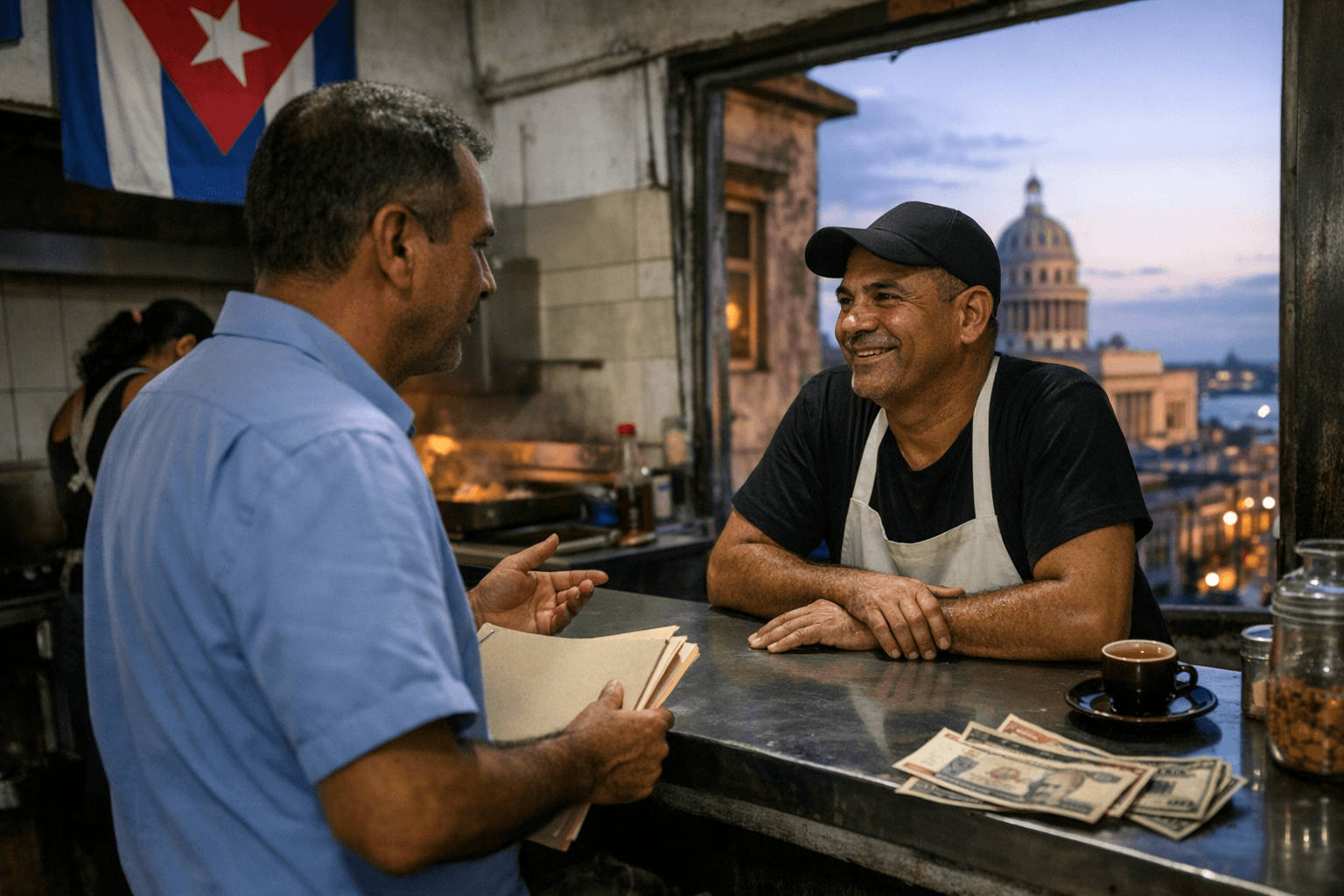
The timing was pointed. The announcement came just three days after Havana acknowledged it had initiated a dialogue with Washington, something Cuban officials had denied for weeks. El País noted it was the first major policy statement since Díaz-Canel confirmed those negotiations. Weeks earlier, the White House had cleared private Cuban businesses to import unlimited fuel from the United States, with the U.S. Treasury specifying the transactions were intended to "solely support 'the Cuban people'" and would not pass through the state.
On the ground in Havana, the gap between policy announcement and lived reality was stark. Diana Sainz and her husband Andrea Gallina, who invested heavily in private enterprise when Cuba expanded that space a decade ago, now own two boutique hotels with restaurants, three small markets, and a production center for frozen prepared meals. With fuel shortages and daily electrical outages battering the capital, 90 percent of their reservations for this year were canceled and they were forced to lay off dozens of employees. Many Cubans missed the Mesa Redonda broadcast entirely because the power was out during transmission.
Experts who followed the announcement told the New York Times they were disappointed the measures did not go further. In Miami, NBC6 correspondent Shane Amara reported from a rally at Lumis Park where activists supporting island protesters described the news as unwelcome. The reaction underscored how the Cuban government's attempt to attract diaspora capital lands very differently among Cuban Americans who want structural political change alongside economic reform.
No implementing regulations, ownership caps, effective dates, or application procedures had been published as of March 18.
This article was produced by Prism’s automated news system from verified source data, official records, and press releases, then run through automated quality and moderation checks before publishing. The system is built and supervised by the people who set the standards it runs under. Read our full AI policy.
Did this article answer your question?