Cuba Requires Authorization for Solar Panels Amid Historic Energy Crisis
Cuba's new authorization rules for private solar panels lock ordinary Cubans out of their last self-help solution as blackouts stretch 18–20 hours daily and oil imports hit zero.
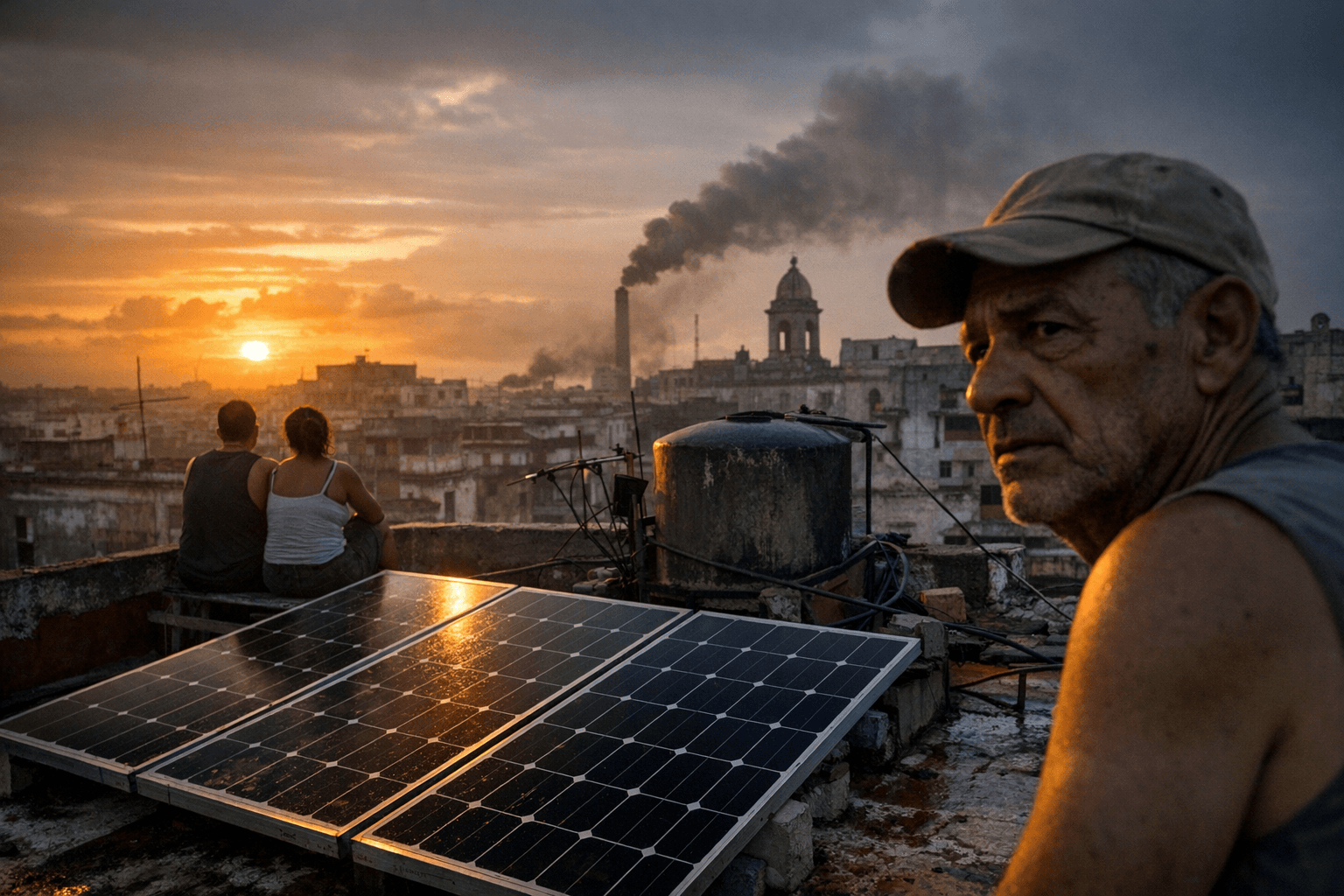
Cuba's government now requires official authorization before any citizen or private entity can install a solar panel, a regulatory turn that strips away the one energy workaround most ordinary Cubans had been quietly building for themselves amid the worst grid crisis in the island's history.
The measure arrives at an extraordinary moment of vulnerability. By January 2026, Cuba's oil imports had reportedly dropped to zero for the first time since 2015, capping a slide in which imports fell 35% in the first ten months of 2025 compared to the same period a year earlier. Venezuela and Russia, historically Cuba's two main fuel suppliers, have become increasingly unreliable. Unión Eléctrica, the state utility known as UNE, can generate roughly 1,185 megawatts against an evening-peak demand of 3,180 MW, a structural gap that regularly leaves entire provinces dark for 18 to 20 hours a day. Cuba has experienced at least six complete or near-complete grid collapses since late 2024, including a total nationwide blackout from October 18 through 22, 2024, and another that left nearly 10 million people without power on March 12, 2026.
Against that backdrop, rooftop solar had become the closest thing Cuba had to household energy self-defense. The new authorization framework makes that route significantly harder to navigate.
Under current rules, any installation requires UNE to certify that technical requirements have been met and to verify energy metering before a system can go live. Cubans who generate solar electricity are also required to feed any surplus back into the National Electric System (SEN), a grid so aged and underfunded that experts estimate it would cost between $8 billion and $10 billion to rehabilitate. Legal scholar Vladimir Bu Marcheco, who published a detailed analysis of Cuba's solar energy legal framework in January 2025, documented how these discretionary layers create a system in which approval is technically possible but structurally difficult to obtain.
The timeline is the practical problem. UNE inspections routinely take weeks. Import paperwork for photovoltaic equipment, which must be declared non-commercial to qualify for customs duty exemptions established in 2021 and confirmed through Resolution No. 169/2025 from the Ministry of Finance and Prices, can stall at customs offices across the island. For a family already managing 18-hour blackouts in Camagüey or Santiago de Cuba, a two-month authorization process is not a minor inconvenience; it is a season of spoiled food, lost work, and failed medical equipment.
Cost further narrows the window. Solar panels in Cuba must be purchased in foreign currency, pricing out the vast majority of citizens paid in Cuban pesos. As CiberCuba reported in October 2025, the solar divide has created a visible new inequality: some Cubans run lights, refrigerators, and fans through the blackouts while most of their neighbors do not. Cuban President Miguel Díaz-Canel has acknowledged the disparity, though he has characterized it as "smaller" than critics contend.
Then came Resolution 76/2025, published in Cuba's Official Gazette on March 26, 2026. Issued by the Ministry of Energy and Mines, it introduces a model in which individuals and businesses purchase solar power capacity within the state-controlled grid rather than installing independent systems. One kilowatt contracted for 20 years costs $600, down from the MLC equivalent of $1,500 when a similar scheme was introduced in 2021. Shorter terms run $312 for ten years, $168 for five, and $90 for two, with each contracted kilowatt yielding a monthly discount of 125 kilowatt-hours on the customer's bill. What Resolution 76/2025 does not do is reduce the authorization requirements for independent installation. It redirects would-be solar adopters toward a state-managed service, payable in U.S. dollars, with the government retaining control of the hardware and the grid connection.
The institutions that benefit from this arrangement are clear. Approved installers working within the state framework bypass the bottlenecks that private buyers face. UNE gains both the metering relationship and, under Resolution 76/2025, hard currency revenue. Private buyers without approved installer relationships, and the growing informal solar installation market that has emerged across Havana, Santiago de Cuba, and Camagüey, absorb the compliance risk. Installing without authorization carries penalties under Cuba's energy regulations, though enforcement has been uneven in practice.
The government's stated justification for tight control is a national solar expansion it presents as progress. Cuba's plan calls for 55 solar parks of 21.8 MW each, targeting a total of 1,200 MW by the end of 2025 and 2,000 MW by 2028. Chinese companies operating through the Belt and Road Initiative delivered a 12 MW photovoltaic plant in 2024 and launched a 35 MW project in 2025. In March 2025, Granma reported that 5,000 solar panels donated by China were being installed, with half allocated to hospitals, maternity homes, senior centers, banks, and radio stations. Brazil sent 300 panel kits in 2025 as well, and China's Ambassador to Havana, Hua Xi, pledged further solar projects following one of the major blackouts. The results registered in February 2026, when Cuba set consecutive daily generation records of 800 MW and then 900 MW, milestones the Ministry of Energy and Mines celebrated publicly.
Those records also illustrate the asymmetry at the core of Cuba's energy politics. The same government that hit a 900 MW solar record in February 2026 published regulations the following month requiring its citizens to seek permission before installing a single panel on their own roof. The Antonio Guiteras Thermoelectric Power Plant, Cuba's largest, has suffered repeated breakdowns central to the ongoing crisis, failures rooted in decades of underinvestment and bureaucratic neglect. Energy expert Jorge Piñón has warned that genuine recovery requires three to five years and $8 to $10 billion. The authorization framework for private solar installation, far from accelerating that recovery, inserts the state as gatekeeper over the one energy solution that requires no functioning grid at all.
This article was produced by Prism’s automated news system from verified source data, official records, and press releases, then run through automated quality and moderation checks before publishing. The system is built and supervised by the people who set the standards it runs under. Read our full AI policy.
Did this article answer your question?