Cuba's Cadeca Changes Remittance Rules, Raising Concerns for Diaspora Families
Cadeca promised cash remittance pickups "in minutes," but Fincimex launched the service without disclosing fees, approved senders, or exchange rates, while users report waiting days.
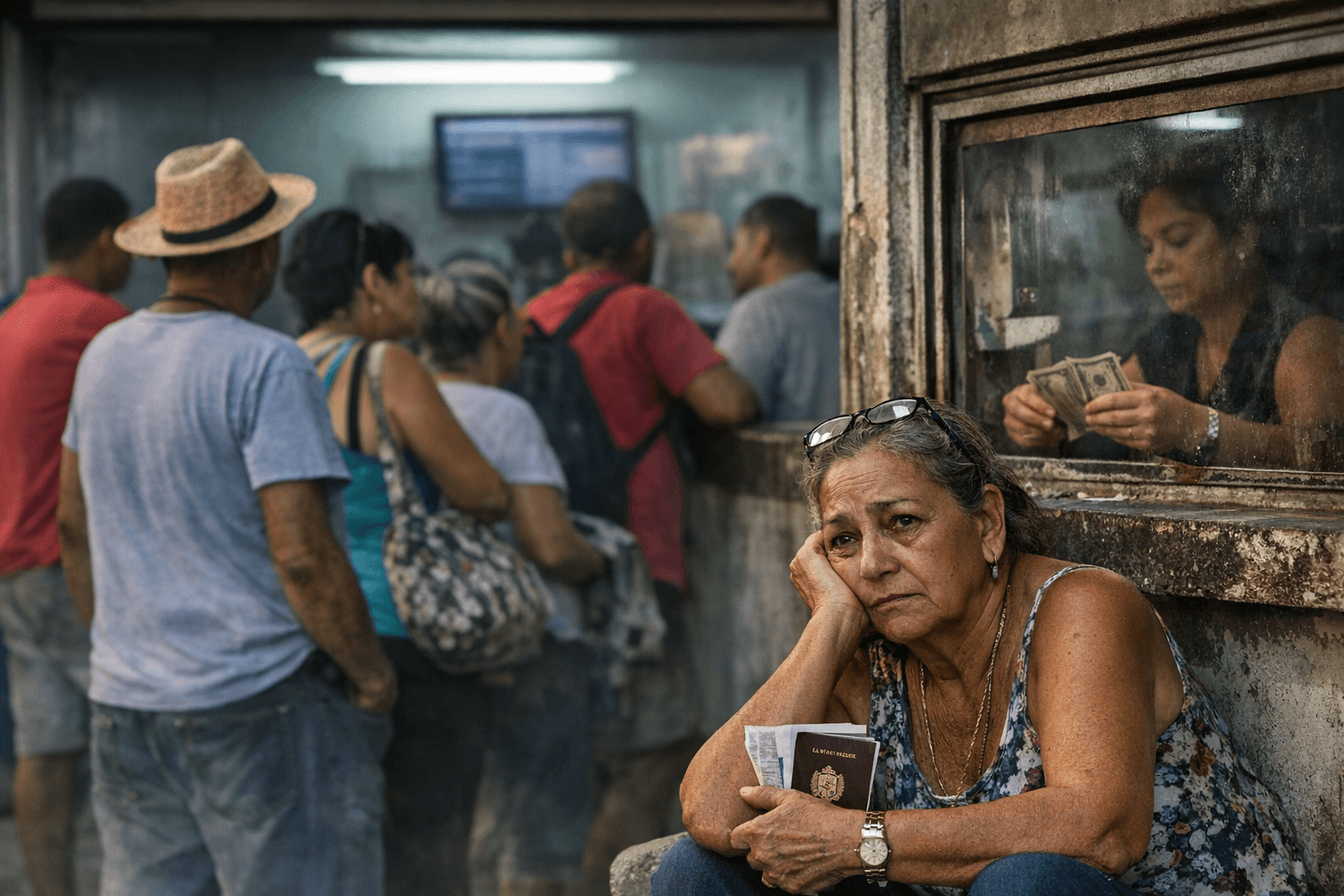
Your mother needs $200 this month. You wire it Monday from Miami through an approved remittance service — assuming you can figure out which ones qualify, because Fincimex has not said. She walks to the CADECA office by Thursday. Hours are Monday through Friday, 8:30 a.m. to 4:00 p.m. There may be a line. The power may be out. The computer system may be down. And there may be no cash. "Lo que hace falta es que a la hora de recoger el money esté el efectivo y no den la muela de que no hay" — what's needed is that when you show up, the money is actually there, not excuses — as one commenter put it on the day of the announcement.
That is the practical reality behind Fincimex's April 7, 2026 Facebook post declaring that remittances from abroad can now be collected in cash US dollars at CADECA offices, promising the service would be available "desde el mundo entero, en minutos." The announcement from La Financiera CIMEX S.A. was framed around the third anniversary of the Tarjeta Clásica, the dollar-denominated card that recipients can use to deposit part or all of the funds instead of taking cash. The Clásica costs $4 USD to obtain and Fincimex recommends loading at least $5 so a usable balance remains after the issuance fee; it is available at CADECA offices or can be ordered abroad via Tocopay and picked up at Fincimex locations across the island.
One rule is firm: "si la remesa fue enviada a pagar en efectivo, solo sería pagada en esa modalidad." The payment format is locked at the moment the sender initiates the transfer, not when the recipient arrives. Beyond that, the announcement contained almost no operational detail. Fincimex did not name which remittance companies are authorized. It did not disclose fees or commissions. It did not specify the exchange rates applied. Users who asked were told the Clásica does not allow cash withdrawals, only point-of-sale purchases at state stores and authorized merchants — a distinction that matters enormously for families who need liquid pesos for the market.
The public response was pointed. "Acciones tardías esto tenían que hacerlo hace mucho… recuperar la confianza en los bancos cubanos les va a costar," wrote one user, before flagging the cash availability problem. Another was blunter about the "in minutes" claim: "En minutos… No es cierto" — written by someone who had already been waiting days for a transfer to arrive. The comparison to informal networks was direct: "los particulares entregan al momento." Private couriers deliver on the spot. "Entre las colas, los apagones y las caídas de los sistemas informáticos de CADECA, el dolor de cabeza… es inmenso," noted a third commenter.
Geographic coverage exposed another fault line. Users in the Isla de la Juventud asked pointedly how the service would work where CADECA does not operate. The official answer was brief: "por el momento solo en Cadecas." In some localities, the Clásica card itself was unavailable: "no hay tarjeta clásica hasta nuevo aviso."
The exchange rate calculus compounds the pain for families who need to convert dollars into pesos for day-to-day spending. CADECA's floating rate runs between 409 and 417 CUP per dollar; the informal market trades near 500 CUP per dollar. On a $100 remittance converted through the official channel, a family loses roughly 8,700 CUP to the rate gap — nearly twice the average monthly Cuban salary of 4,000 to 5,000 CUP. Since January 2026, US senders also absorb a federal 1% tax on cash remittances under the "One Big Beautiful Bill" legislation, adding $2 to the cost of every $200 sent. Electronic and bank transfers are exempt from the tax, but most Cuban-Americans rely on cash-based channels.
The broader stakes are stark. According to a Cuba Siglo 21 dossier, more than 95% of remittances from the diaspora now flow through informal networks. GAESA, Fincimex's parent military conglomerate, collected roughly $81.6 million from remittances in 2024 — just over 4% of a market that totaled nearly $2 billion in 2023. Leaked internal documents show GAESA controls 95% of foreign currency financial transactions in the Cuban economy, yet it has effectively ceded the remittance pipeline to a network of more than 150 informal operators.
BEFORE vs NOW: What changed for your family's monthly transfer
| Before (informal networks) | Now (CADECA/Fincimex) | |
|---|---|---|
| Delivery speed | Same or next day, door-to-door | CADECA only, office hours |
| Geographic reach | Anywhere on the island | CADECA locations only; Isla de la Juventud excluded |
| Fees | Negotiated directly | Undisclosed |
| Exchange rate on conversion | ~500 CUP/dollar (informal) | 409-417 CUP/dollar (official float) |
| Card required | No | Optional Clásica ($4 to obtain) |
| Cash withdrawal | Yes | No (Clásica is POS-only) |
| US sender cost | Informal | 1% federal tax on cash transfers since January 2026 |
| System reliability | Person-to-person | Subject to blackouts, crashes, lines |
Who is most likely to be cut out entirely: elderly recipients who cannot navigate digital appointment systems like MiTurno; families in rural areas and territories like Isla de la Juventud without a functioning CADECA; anyone in a town where Clásica cards are temporarily out of stock; senders using cash remittance services not yet authorized under the new framework.
The informal operators who captured 95% of Cuba's remittance market did not win it on price alone. They won it because they were there when the state was not, and Fincimex's launch announcement suggests little has changed about which one of those the state actually understands.
This article was produced by Prism’s automated news system from verified source data, official records, and press releases, then run through automated quality and moderation checks before publishing. The system is built and supervised by the people who set the standards it runs under. Read our full AI policy.
Did this article answer your question?