Cuba's Economic Collapse Signals Final Unraveling of Socialist Ideology
Cuba has lost 90% of its fuel supply since Trump's January 2026 oil embargo, accelerating an economic collapse that analyst Ken Cao argues makes the socialist model's end a measurable question, not just an ideological debate.
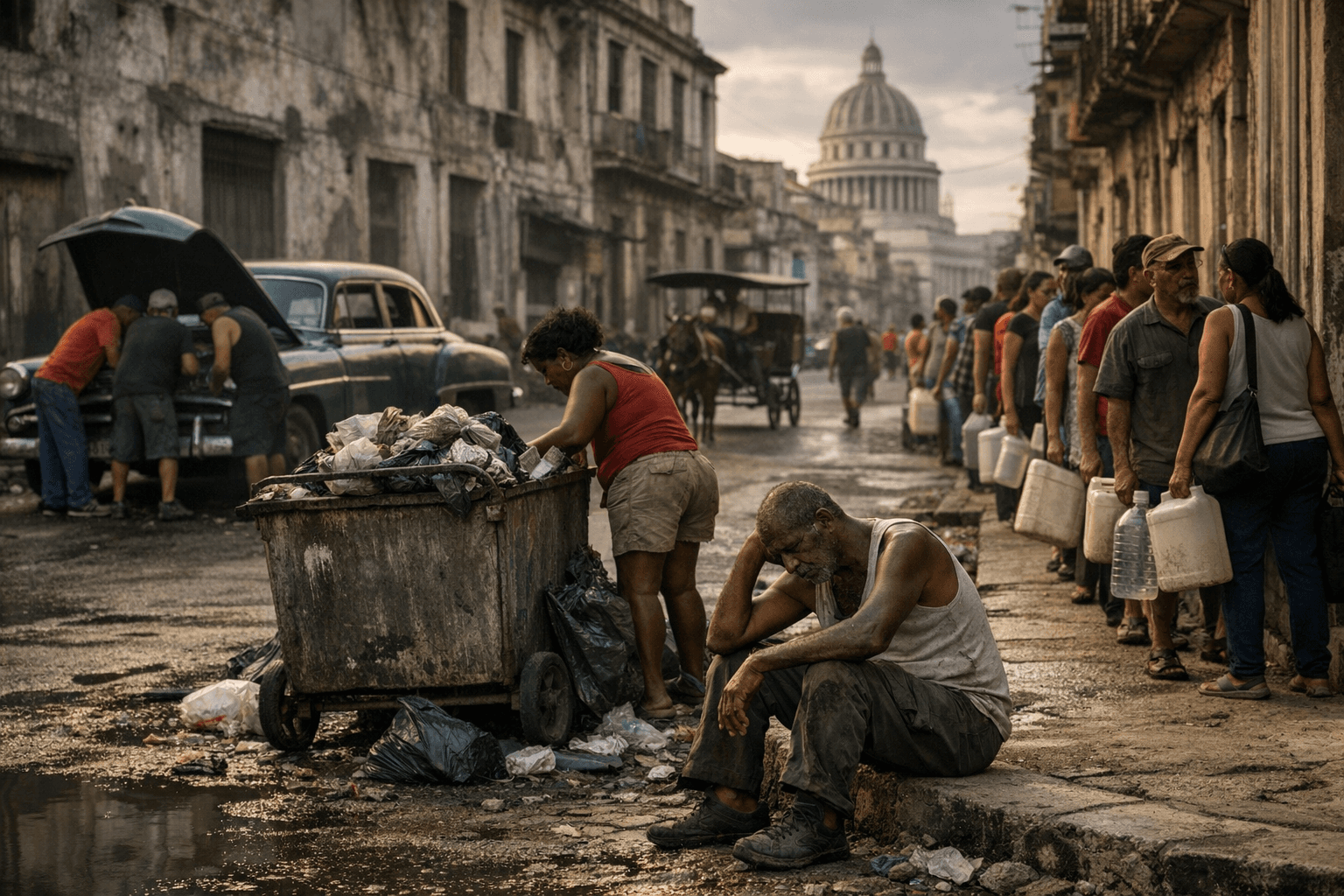
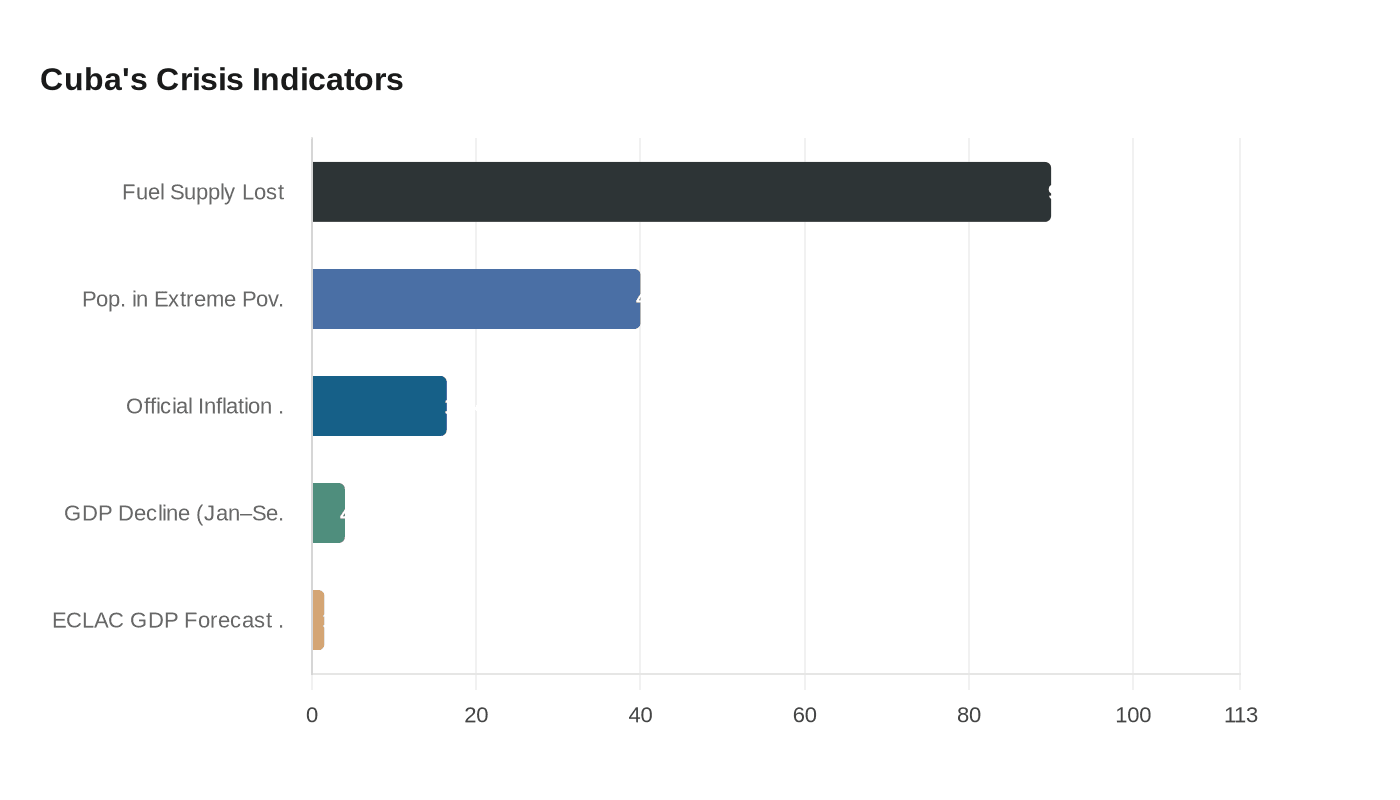
Cuba has lost 90 percent of its fuel supply. Not in some projected worst-case scenario — but as a documented reality since Executive Order 14380 took effect on January 30, 2026, threatening tariffs on any country that exported oil to the island. That single data point reframes the entire debate over Cuba's socialist model: the question is no longer whether the system is under stress. The question is whether any combination of reform, resilience, or diplomatic maneuver can keep it intact.
Analyst Ken Cao frames it plainly: Cuba's economic collapse and the reform pressures now radiating from Havana represent the final unraveling of socialist ideology as a viable governing alternative to markets. That is a falsifiable claim, and the evidence on the scoreboard deserves a hard look.
The Collapse Scorecard
Cuba's GDP decreased by 4 percent in the first nine months of 2025 alone, according to President Miguel Díaz-Canel's own acknowledgment. The UN's Economic Commission for Latin America and the Caribbean ranks Cuba's economic outlook second only to Haiti in terms of decline across the hemisphere. ECLAC predicted Cuba's GDP would shrink 1.5 percent in 2025, with barely any growth projected for 2026.
Inflation remains the most corrosive force on the ground. Officially, the government reported a 16.4 percent year-on-year increase in May 2025, but the official Consumer Price Index likely underestimates actual inflation, as it excludes the informal markets where most Cubans shop. Pensions were nearly doubled to 4,000 pesos a month in August, yet at the informal exchange rate of roughly 400 pesos to the dollar, that sum translates to just $7 to $8, clearly not enough to buy basics like chicken or eggs, even at subsidized prices. Cuban economist Pedro Monreal described inflation as "climbing for five consecutive months, indicating a situation spinning out of control."
Widespread power blackouts of up to 20 hours at a time are now being reported across Cuba, impacting hospitals, businesses, and households alike. At least 40 percent of the population is estimated to be living in extreme poverty, with widespread malnutrition, especially among older people and children, and many people surviving on one poor meal a day.
The Oil Lifeline, Severed
Venezuela had provided Cuba with 70,000 barrels of crude oil per day and refined products worth about $1.3 billion from late 2024 to late 2025. In December 2025, as part of the escalation that ended with the United States intervention in Venezuela, the United States seized tankers with Venezuelan oil destined for Cuba and declared a blockade on exports of Venezuelan oil. Executive Order 14380 was signed on January 29, 2026, and entered into force the following day.
In early January, the Trump administration had already put an end to Venezuela's subsidized oil shipments, which had kept the country afloat since the early 2000s. Cuba lost 90 percent of its fuel supply, and despite shutting beach resorts and restricting aviation fuel sales, the country risked a total blackout as early as late February, according to risk analyst Ignacio Seni. The United States confirmed that regime change in Cuba is a goal by the end of the year, asking the government of First Secretary Miguel Díaz-Canel to "make a deal before it's too late."
Reform Signals: The Measurable Indicators
This is where Ken Cao's "end-of-model" hypothesis becomes testable. A socialist system does not announce its own unraveling; it reforms incrementally until the reforms contradict the ideology itself. Cuba is generating measurable signals on at least four fronts.
*Dollarization:* In November 2025, Cuban authorities signaled they would consider allowing investors to operate more freely in U.S. dollars, hire employees directly, and participate in the real estate market, aiming for a "simpler, more flexible, and more transparent" investment environment. The Central Bank of Cuba activated a new currency exchange scheme starting December 18, 2025, introducing a daily floating exchange rate alongside the two existing rates. In practice, the use of the U.S. dollar and other hard currencies has continued to expand, with mechanisms such as MLC stores and foreign-exchange transactions effectively driving a partial dollarization of the economy.
*Private-sector expansion:* Resolution 24, released on March 3, 2026, details a framework for state enterprises to partner with non-state players, including private micro, small, and medium enterprises (MSMEs) and cooperatives. The regulation authorizes state enterprises to act as partners in private MSMEs and institutionalizes "productive linkages," a phrase that would have been ideologically unthinkable a decade ago. By the end of 2024, the state had stressed that its priority was "control" of the private sector, not its expansion; the pivot since then has been rapid.
*Diaspora investment:* Building on the currency reforms, in March 2026 Cuba further expanded openness to include the diaspora, announcing that Cubans living abroad, especially Cuban Americans and other expatriate communities, would be permitted to invest in and own businesses on the island. The explicit inclusion of the diaspora signals a redefinition of a group that has long been highly politicized.
*Diplomatic contact:* Díaz-Canel confirmed on March 13 that his officials have been meeting with American officials to explore "potential solutions for our bilateral differences." His government has also opened the country up to more Cuban exile investment in an effort to keep the state-dominated economy afloat.
The Counter-Narrative: What Survival Would Look Like
Cao's hypothesis is falsifiable precisely because the conditions for disproving it are visible. The Cuban state has survived shocks before: the collapse of the Soviet Union, the "Special Period" of the 1990s, and the COVID-19 pandemic all triggered predictions of imminent collapse that did not materialize. The 2019 constitutional reform further affirmed the Communist Party's role as the "leading force in the state and society," and the armed forces continue to occupy key positions in the state, party, and economy.
For the system to persist, several things would need to happen simultaneously. The oil embargo would need to soften, either through a diplomatic deal, a third-country workaround, or a shift in US policy. Economy and Planning Minister Joaquín Alonso outlined priorities for 2026 that include boosting national production and increasing foreign exchange earnings while strengthening social policies, a plan that only functions if external pressure eases. The partial dollarization would need to generate enough hard currency to stabilize the peso without triggering the kind of inequality spiral that delegitimizes the state. And the MSME framework would need to function with the flexibility the crisis demands rather than being trapped in the bureaucratic structure it nominally aims to overcome.
Cuban economist Omar Everleny Pérez has argued that "reform demands political courage and decentralisation," which is precisely the opposite of what the current regulatory apparatus delivers. Cuban bishops have urged economic and political reforms, asserting that "we cannot continue on this path … we need to do something to save Cuba and restore our hope."
Reading the Signals Going Forward
The scoreboard is not a prediction; it is a tracking mechanism. Watch the informal peso-to-dollar rate: if it stabilizes below 300 CUP per dollar, that signals genuine hard-currency inflow. Watch whether MSME partnerships under Resolution 24 scale or stall under bureaucratic friction. Watch whether diaspora investment translates into visible capital formation or remains symbolic. Watch whether the bilateral meetings between Havana and Washington produce any concrete framework, or collapse under the weight of regime-change rhetoric.
Mass emigration of Cuba's skilled labor force, particularly during the COVID-19 pandemic, has compounded the country's structural difficulties, and that brain drain accelerates with every month the blackouts continue. Cuba is not merely an ideological case study; it is a live test of whether a centrally planned state can absorb an externally imposed energy shock while simultaneously liberalizing enough to survive it. The indicators say the margin is narrowing fast.
This article was produced by Prism’s automated news system from verified source data, official records, and press releases, then run through automated quality and moderation checks before publishing. The system is built and supervised by the people who set the standards it runs under. Read our full AI policy.
Did this article answer your question?