Cuba's Economic Decline Driven by Socialism, Not US Embargo, Study Finds
A new study puts a number on the regime's biggest excuse: the US embargo accounts for just 10% of Cuba's economic gap, with socialist mismanagement driving the rest.

The figure the Cuban regime has spent six decades obscuring is now in print: the US trade embargo accounts for just 10 percent of the island's economic underperformance since Fidel Castro took power in 1959. Socialist central planning is responsible for the remaining 90 percent.
That finding comes from "The Forsaken Road: Reassessing Living Standards Following the Cuban Revolution and the American Embargo," a working paper by economists João Pedro Bastos, Vincent Geloso, a senior fellow at AIER and assistant professor of economics at George Mason University with a PhD in Economic History from the London School of Economics, and Jamie Bologna Pavlik. Their methodology, the synthetic control method, constructs a statistical "synthetic Cuba" built from a weighted mix of comparable economies unaffected by socialist policies, serving as a counterfactual for what the island's economy would have looked like had the revolution never occurred.
The result is a timeline that tells a damning story independent of political allegiance.
By 1960, Cuba's trade openness, measured as the ratio of total exports plus imports to GDP, had already begun its collapse. Cut off from its most natural trading partner, the island was forced to reallocate commerce to the Soviet bloc, Eastern European nations, and distant developing countries, all less efficient partners that drove up costs and suppressed productivity. The researchers were able to isolate that embargo-driven cost: significant in isolation, but marginal relative to the damage done by central planning itself.
By 1989, thirty years into the revolution, Cuba's GDP per capita sat approximately 55 percent below where it would have stood in the absence of both socialism and the embargo. Even before the collapse of Soviet support, the costs of central planning and isolation had already taken a severe toll on Cuban living standards. Soviet aid to Cuba amounted generally to around 20 percent of GDP annually, effectively masking the structural rot in real time. Strip out that subsidy and the gap widens further.
Three pressure points trace the exact shape of that widening: productivity, real wages, and food and import dependence.
On productivity, Cuba's post-1959 record is one of relentless contraction driven by state direction rather than market signals. GDP has fallen 10.1 percent from 2018, while exports have halved since 2013 and imports are down 37 percent over the same period, a double compression that becomes self-reinforcing: less output means less foreign exchange, which means fewer inputs, which means less output.
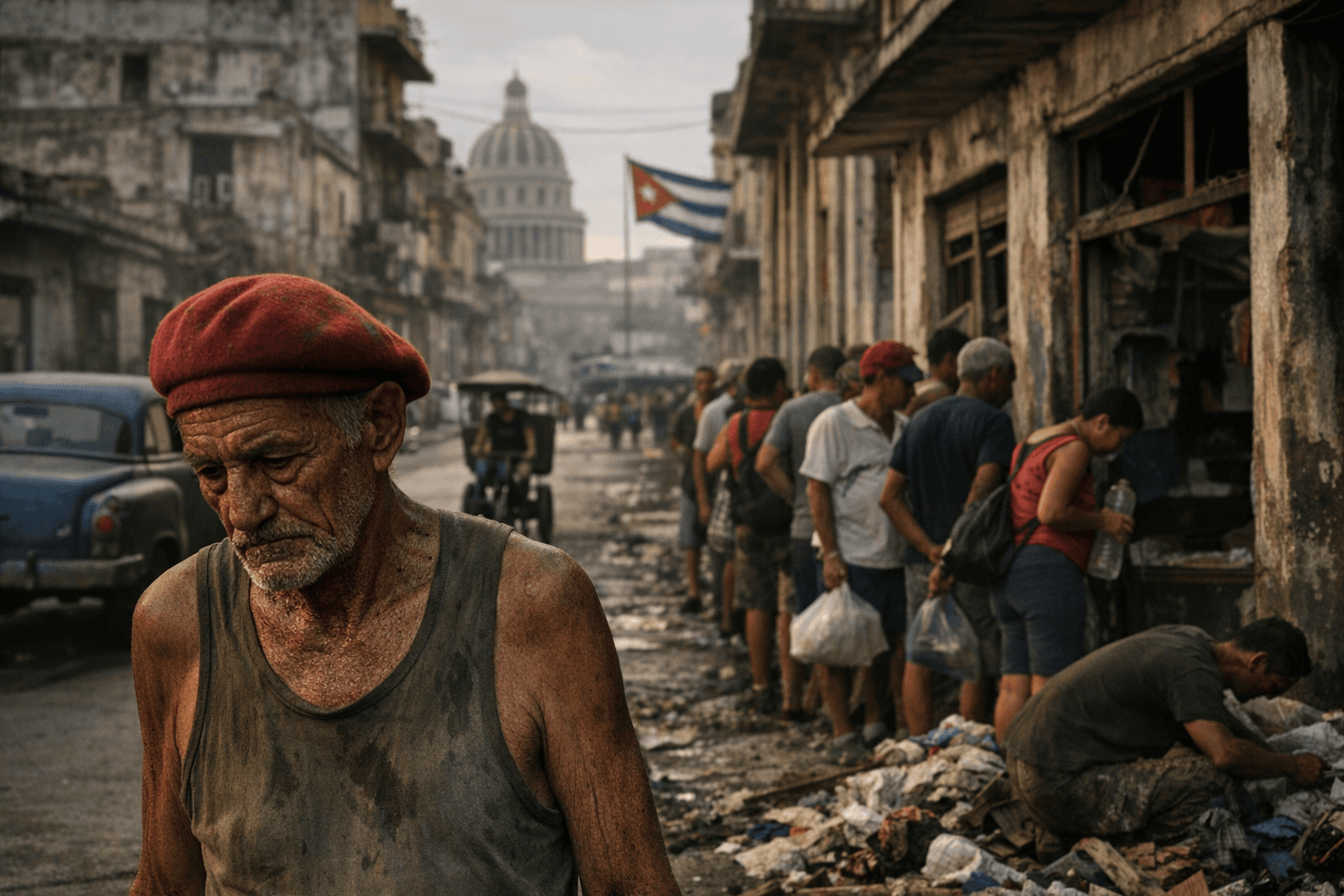
Real wages offer a shorter but no less instructive lesson. In December 2020, the government more than tripled state sector salaries in anticipation of price hikes from the higher cost of imports, but those higher costs and increased consumer spending power triggered a surge in inflation that erased the nominal gains before workers could benefit from them. The raise had been priced in by the system before it reached anyone's pocket.
Food and import dependence is the most visceral indicator of where central planning left the agricultural sector. Cuba, which once exported sugar as a primary revenue engine, reorganized its farms under collective management from the early 1960s onward and never recovered pre-revolution productivity levels. The result is an island that cannot feed itself, held together by hard-currency food imports that its stagnant export base cannot reliably finance. When Soviet subsidies disappeared in the early 1990s, the "Special Period" brought caloric rationing to a country that had once been a net food exporter, not because of any new foreign sanction, but because collectivization had spent thirty years hollowing out the sector's productive base.
The study deliberately uses GDP data that does not rely on the regime's self-reported statistics, addressing a long-standing problem in Cuba research. Havana's official numbers have historically overstated performance, meaning the 55 percent gap may itself be conservative.
None of this renders the embargo irrelevant. As Geloso writes, "the US embargo clearly makes Cubans poorer," and the consensus among economists holds that any trade restriction carries a measurable cost. But the study quantifies that cost at roughly 10 percent of the total gap, which removes the regime's primary rhetorical shield. Every year since 1992, the UN General Assembly has voted on a Cuban resolution condemning the embargo; for six decades that vote has served as political cover. The study establishes what it was covering for.
The current economic data has stopped being ambiguous. ECLAC projects Cuba's GDP will shrink 1.5 percent in 2025 and grow by only 0.1 percent in 2026, conditions under which crisis would still prevail. Only Haiti faces a worse regional outlook. Tourist arrivals through April 2025 fell 72 percent compared to the prior year, with hotel occupancy sitting at just 24.1 percent. Blackouts stretching through the day in provinces across the island are not a foreign trade restriction at work; they are the output of a state energy monopoly that failed to invest across six decades of central control.
The study's authors built their case on data that bypasses both the regime's statistics and the usual ideological stalemate. The arithmetic points in one direction. The embargo imposed a cost Cuba did not have to bear. Socialism imposed the rest.
This article was produced by Prism’s automated news system from verified source data, official records, and press releases, then run through automated quality and moderation checks before publishing. The system is built and supervised by the people who set the standards it runs under. Read our full AI policy.
Did this article answer your question?