Cuba's Power Structure Explained: Who Rules Amid Crisis and Could Díaz-Canel Fall?
Díaz-Canel holds the titles but not the power: Cuba's real decisions flow through GAESA, the Castro network, and a 90-year-old general's shadow while 11 million people go dark.
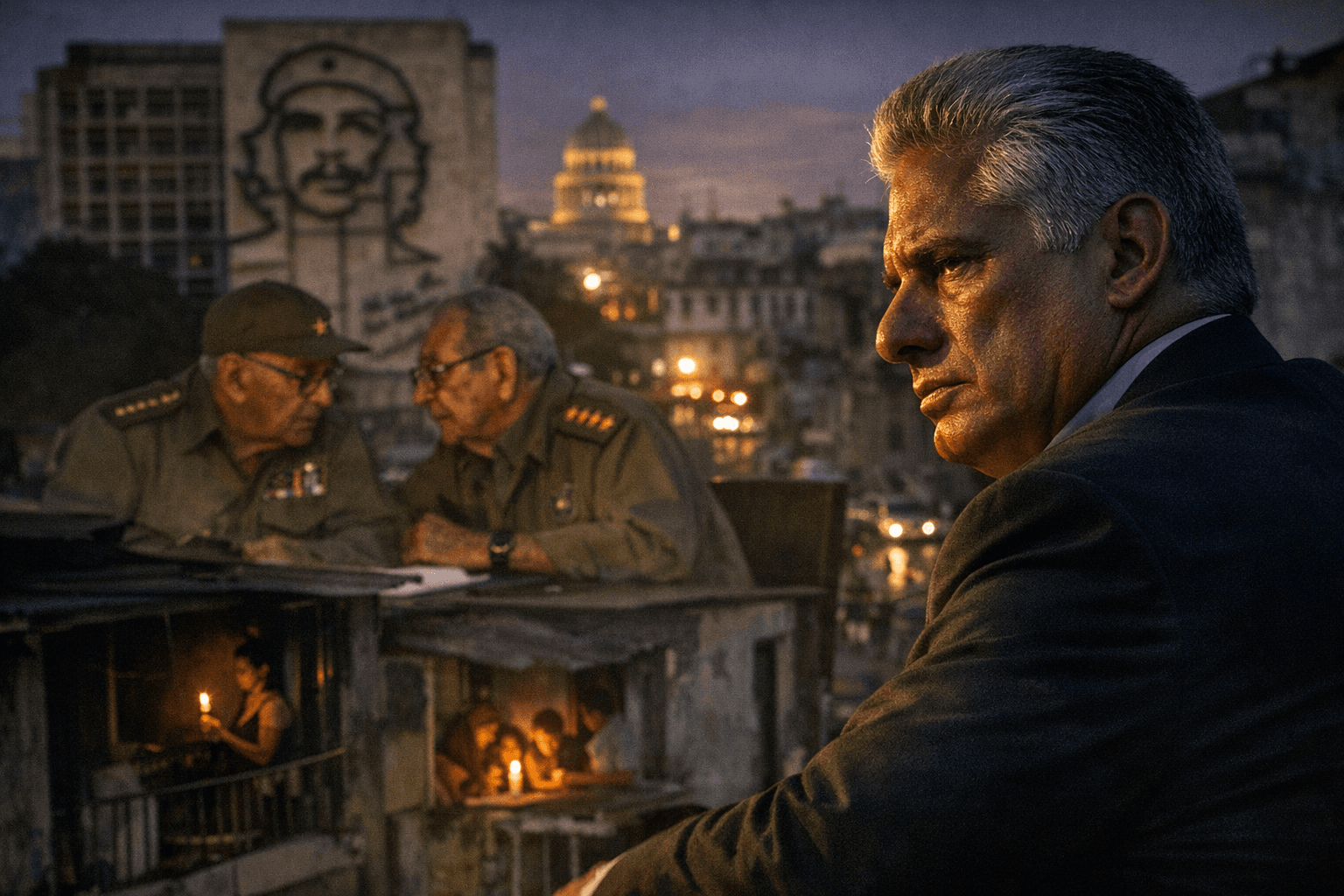
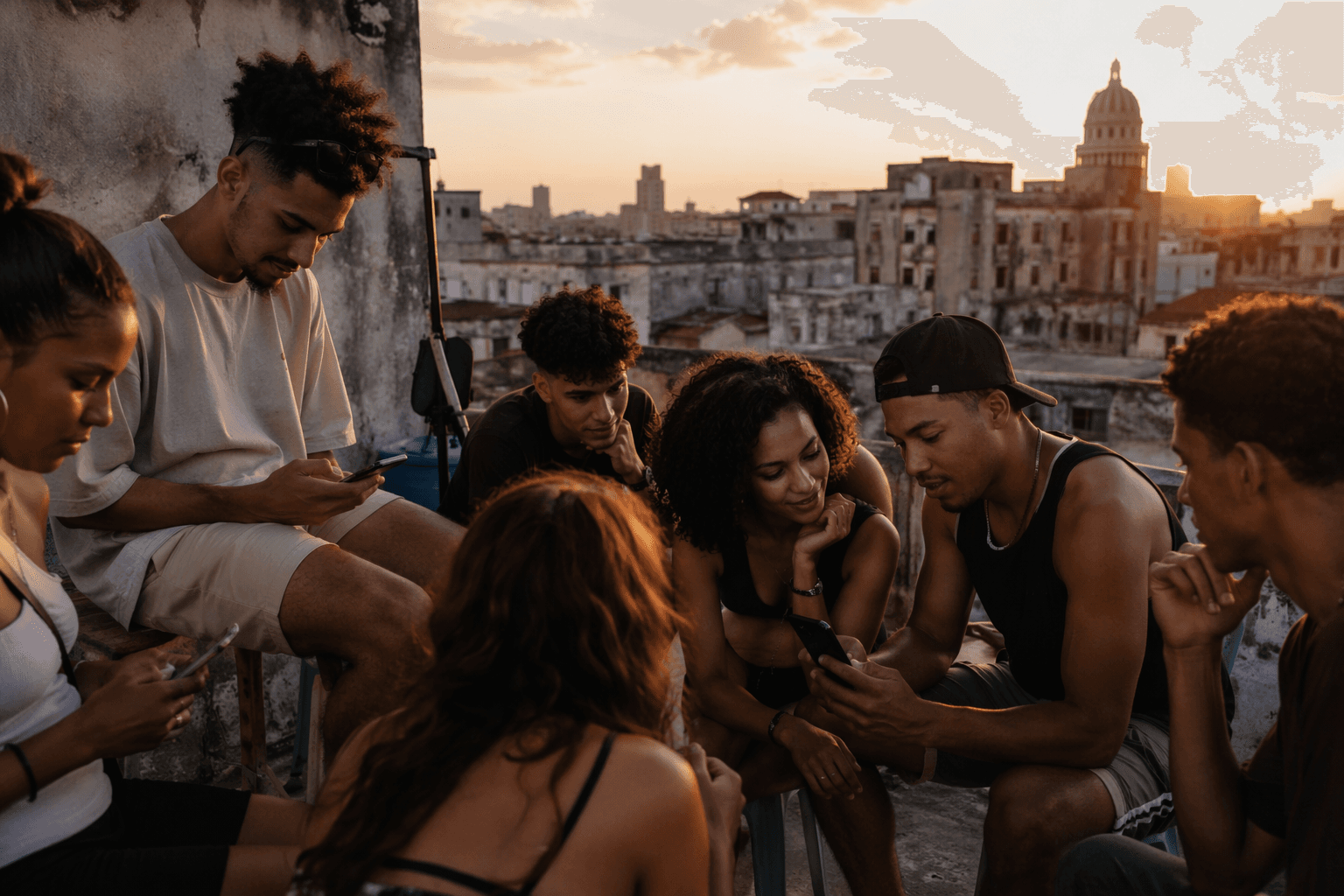
Cuba's national power grid collapsed completely three times in March 2026 alone. On March 16, all 11 million people on the island lost electricity in a single event officials called a "complete disconnection." By Díaz-Canel's own admission on March 13, Cuba was running on 40 percent of the fuel it needs. Locals in Havana say power arrives for two to five hours a day, families are cooking with wood and coal, bus stops stand empty, and garbage accumulates on streets because trucks have no fuel to run. Tens of thousands of Cubans are waiting for surgical operations that cannot proceed without electricity. This is the daily texture of the 2026 crisis. Understanding who decides how long it lasts requires a map of power that goes well beyond the presidential office.
The Titles and the Reality
Miguel Díaz-Canel holds two of the most important formal posts in the Cuban state: President of the Republic and First Secretary of the Central Committee of the Communist Party, a dual role he has occupied since 2021 when Raúl Castro formally stepped aside. That transition was historic on paper; it was the first time in more than six decades that someone outside the Castro family led the government. In practice, the transfer was narrower than the titles suggested.
"Politically, I think what is happening is that we are seeing the real power, the real authority within the Cuban regime, which is not Diaz-Canel," Orlando Perez, a political science professor at the University of North Texas at Dallas, told Al Jazeera. Analysts across the board describe Díaz-Canel as a political manager inside a system where the presidency is one node in a much larger network, not its commanding center. The clearest recent proof: when Cuba's National Defense Council convened, Raúl Castro led it, directly contradicting the constitutional text that assigns that role to the President of the Republic. Official state newspaper Granma confirmed the discrepancy without apparent embarrassment.
GAESA: The Conglomerate That Controls the Lights
The institution that most directly shapes the material conditions of Cuban life is not a ministry or a Party bureau. It is GAESA, the military-run conglomerate that controls tourism, ports, retail, banking and financial operations. GAESA is effectively the financial backbone of the political system, capturing the hard-currency flows that determine what the government can import, including the fuel that runs the thermoelectric plants whose failure produces the blackouts. When the grid goes dark, the supply chain failure traces back, at least in part, to who controls Cuba's strategic economic sectors and what they prioritize.
GAESA's founding figure, General Luis Alberto Rodríguez López-Calleja, died of a heart attack in 2022 at age 62. He was the father of Raúl Guillermo Rodríguez Castro, known by the nickname "El Cangrejo," and the son-in-law of Raúl Castro himself. That lineage places the conglomerate squarely within the Castro family network, and reports suggest Rodríguez Castro has assumed a role in his late father's organization. The Trump administration's advisors, including officials close to Secretary of State Marco Rubio, have been communicating with Rodríguez Castro directly, most recently at a meeting in Saint Kitts during the CARICOM summit, bypassing Díaz-Canel entirely.
Raúl Castro at 90: The Shadow Architecture
Raúl Castro, 90 years old and nominally retired from public life, remains the gravitational center of Cuban elite politics. The most telling recent demonstration came in December 2025, when Castro sent a letter to the 11th Plenary Session of the Central Committee ordering the postponement of the 9th Communist Party Congress, which had been scheduled for April 2026. Díaz-Canel read the letter aloud at the session; the Central Committee approved the proposal unanimously. A sitting First Secretary reading a retiree's instructions and the entire Central Committee falling in line is a precise illustration of where authority actually resides.
That same structural reality means any leadership transition in Cuba would be elite-driven and negotiated from within this network, not imposed from outside by popular pressure alone. The nightly protests spreading through Havana neighborhoods feed real political risk, but the system's architecture routes decisions through the Party, the military, and the security apparatus rather than through streets or ballot boxes.
The Replacement Mechanism: What Body Votes, and When
Formally, Cuba's governance works in layers. The Party Congress, which convenes every five years, is the supreme Party body and the venue where First Secretary transitions are legitimized. With the 9th Congress now postponed indefinitely, that channel is blocked. Between congresses, the Central Committee (which meets twice a year) is the highest Party organ, and daily operational authority sits with the Politburo. On the state side, the National Assembly of People's Power, with 470 deputies, is the body that ratifies the President; it meets only twice a year, with the 31-member Council of State exercising power in the intervals.
A leadership change would require coordination across these layers. The Politburo would need to signal consensus, the Central Committee would need to ratify it, and the National Assembly would formalize a presidential succession. The fact that the Party Congress was postponed on Raúl Castro's instruction means the conventional five-year renewal cycle has been suspended at precisely the moment of maximum crisis, concentrating transition decisions in a smaller, less predictable set of hands.
The Candidates Waiting in the Architecture
Two figures stand out as the most plausible faces of any succession scenario, and both are connected to the Castro-GAESA nexus.
Roberto Morales Ojeda is the institutional frontrunner if the transition follows party channels. A former physician from Cienfuegos, he served eight years as public health minister starting in 2010 and was deputy prime minister from 2019 to 2021, giving him high-level exposure under both Raúl Castro and Díaz-Canel. He currently serves as Secretary of Organisation of the Central Committee, a position analysts describe as the conventional fallback for a party-managed succession.
Oscar Pérez-Oliva Fraga, a great-nephew of Raúl Castro, represents the GAESA track. He was virtually unknown until May 2024, when he was appointed Minister of Foreign Trade and Investment, and he was elevated to deputy prime minister in October of the same year. "The key is that he has spent years inside GAESA, the military conglomerate," Perez noted. "He carries the Castro blood but not the name," allowing the regime to project a technocratic image without appearing dynastic. Pérez-Oliva Fraga has already led high-level delegations as part of Cuba's diplomatic maneuvering, positioning him as a possible public face for any economic opening that accompanies or follows a leadership shift.
Rodríguez Castro himself is also in the conversation, though experts note that his last name, while a sign of lineage credibility inside Cuba, could complicate external legitimacy given the pressure from Washington for visible change.
The External Pressure Variable
The Trump administration has explicitly named regime change in Cuba as a goal, and Executive Order 14380, signed on January 29, 2026, authorized additional tariffs on countries that supply oil to Cuba, extending the pressure that began with the seizure of Venezuelan oil tankers in December 2025. Trump has also signaled publicly that Cuba "wants to negotiate," and both Washington and Havana have confirmed bilateral talks are ongoing. That channel runs not through Díaz-Canel but through the Castro-GAESA network that controls actual leverage.
Decree-Law 144, enacted in late 2025 and published in March 2026, allows partnerships between state enterprises and private actors. Some economists read it as a structural concession; others see it as a diplomatic signal to foreign capitals rather than a genuine reordering of the economy. The distinction matters for ordinary Cubans: a signal without implementation changes nothing about the hours the lights stay on.
What to Watch
The signals that would indicate genuine elite movement rather than managed continuity are specific: personnel changes at the top of the Party Secretariat or in the security services, emergency decrees that transfer economic authority away from GAESA, and the convening of a rescheduled Party Congress. Watch Cuban state media alongside independent reporting; the gap between what Granma publishes and what independent outlets document has historically been the clearest indicator of whether the leadership is managing a narrative or managing an actual transition. Whether the regime ultimately chooses intensified repression, negotiated reform, or the kind of elite reconfiguration now being discussed in Saint Kitts, the answer will be visible first in the institutional appointments, not in the speeches.
This article was produced by Prism’s automated news system from verified source data, official records, and press releases, then run through automated quality and moderation checks before publishing. The system is built and supervised by the people who set the standards it runs under. Read our full AI policy.
Did this article answer your question?