FBI Team Arrives in Havana to Probe Deadly February Speedboat Shootout
An FBI technical team in Havana is independently probing a five-death Florida Straits firefight; at least one American was killed and another detained.
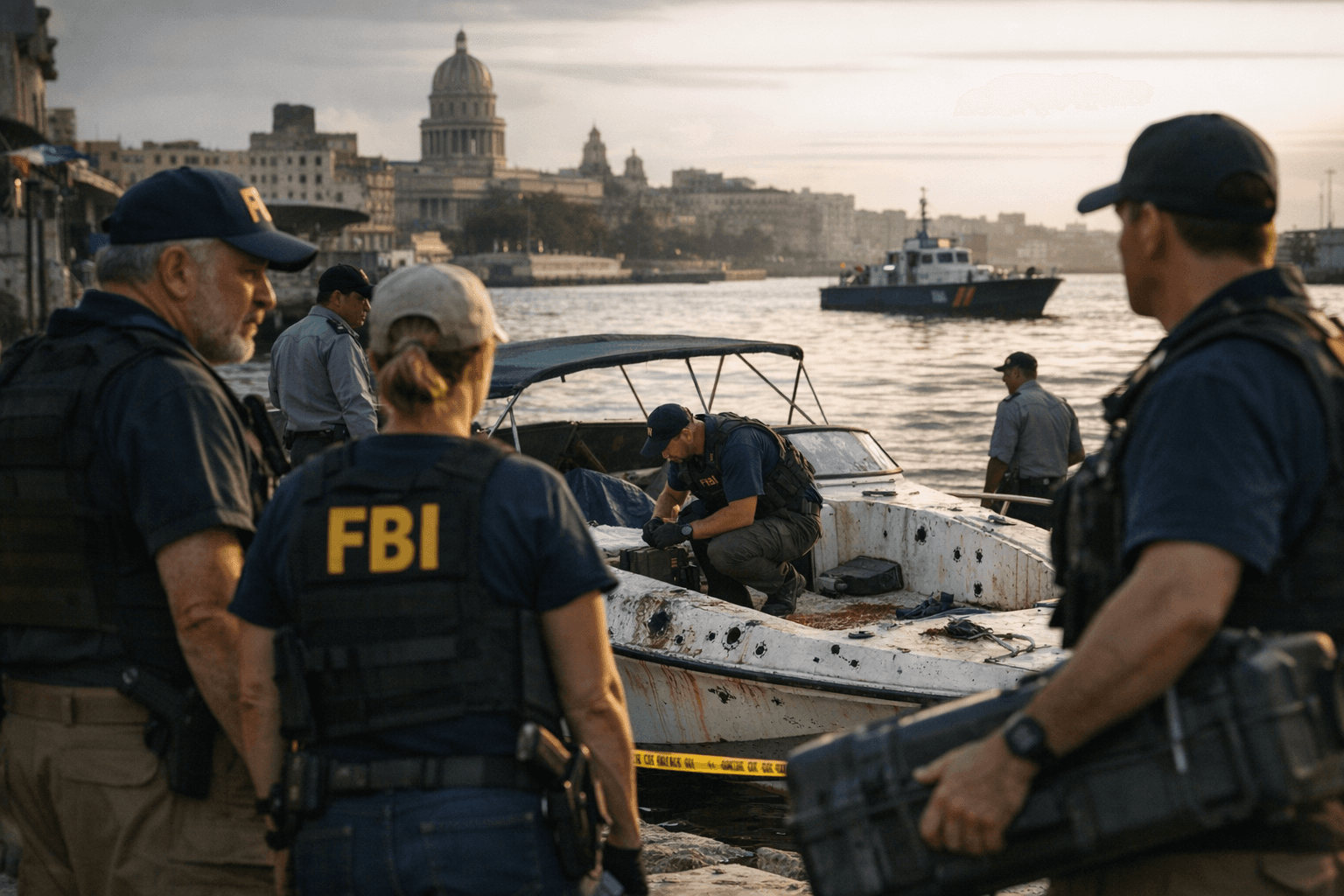
Getting a U.S. law-enforcement team onto Cuban soil takes an extraordinary set of circumstances. The February 25 speedboat shootout off Cuba's northern coast apparently qualified.
An FBI technical team arrived in Havana the week of April 1 to conduct what the U.S. Embassy described as an "independent investigation" into a firefight that left five people dead and five others now facing terrorism charges on the island. The bureau's presence, confirmed by the embassy on April 1, is a rare instance of active U.S. law-enforcement work inside Cuba, and it signals that Washington treats this incident as something well beyond a bilateral diplomatic quarrel.
The sequence of events began late on February 25, when a U.S.-registered speedboat carrying ten Cuban nationals came within one nautical mile of Cuba's northern shore, roughly 160 kilometers from Marathon, Florida. Cuban authorities say a coast guard vessel approached to demand identification and the crew opened fire. The shootout killed four people aboard the speedboat and wounded at least one Cuban border guard. A fifth boater, Roberto Alvarez Avila, died on March 4 from his injuries. Cuba's Interior Ministry reported the boat was stocked with 13 rifles, 11 pistols, close to 13,000 rounds of ammunition, bulletproof vests, and Molotov cocktails.
Cuban prosecutors charged six survivors with "crimes of terrorism" and ordered pretrial detention on March 3, before Alvarez Avila's death. Five survivors currently face those charges. Havana's official account branded the group as armed exiles who departed U.S. territory with explicit intent to overthrow the government and strike military installations.
What elevates this beyond a straightforward Cuban domestic prosecution is the U.S. citizenship question. At least one of the five killed held U.S. citizenship, and at least one survivor also carried a U.S. passport. Those facts pull the incident squarely into federal jurisdiction and explain why independent forensic review was never optional for Washington. Secretary of State Marco Rubio stated publicly that the operation was not a U.S. government action, distancing official Washington from the armed raid while the bureau moved to gather its own evidence.
The U.S. Embassy was direct about the limits of what Cuban accounts alone can establish. "Consistent with U.S. policy, we do not make decisions in the United States on the basis of what Cuban authorities are saying," an embassy official said. "We will independently verify the facts and make decisions based solely on U.S. interest, U.S. law, and the protection of U.S. citizens."
That framing serves two audiences simultaneously. It shields Washington from appearing to validate Havana's terrorism prosecution while preserving the bureau's ability to pursue criminal or administrative action on U.S. soil if the evidence points there. The FBI team's forensic work, which may include examining the weapons' chain of custody and taking statements from detained survivors, could corroborate or directly challenge the Cuban account of who fired first and where logistical support originated.
The investigation drops into the middle of what analysts describe as the sharpest U.S.–Cuba tensions in years. An ongoing oil blockade has gutted Cuba's energy infrastructure and generated months of domestic hardship, adding combustible context to an already charged political moment. Any friction over evidence access or the legal status of detained Americans could widen that breach further.
For the Florida Straits corridor, an armed incursion launched barely 100 miles from the Florida Keys raises pointed questions about maritime enforcement along a route that carries both irregular migration and smuggling traffic at scale. Whether the FBI's findings eventually produce new pressure on exile networks, fresh criminal referrals, or a recalibrated U.S. enforcement posture in the Straits may hinge on how much access and cooperation Havana extends in the weeks ahead.
This article was produced by Prism’s automated news system from verified source data, official records, and press releases, then run through automated quality and moderation checks before publishing. The system is built and supervised by the people who set the standards it runs under. Read our full AI policy.
Did this article answer your question?