Senate Democrats File War Powers Resolution to Block Cuba Military Action
Trump mused Cuba's takeover could be "friendly or not friendly." Now three Senate Democrats want Congress to have the final say before any shots are fired.

Three Senate Democrats filed a war powers resolution this week requiring President Donald Trump to obtain congressional authorization before ordering any military action against Cuba, a direct legislative response to Trump's public musings about a possible "takeover" of the Caribbean island.
Sens. Tim Kaine of Virginia, Ruben Gallego of Arizona, and Adam Schiff of California introduced the measure, which would compel the president to remove U.S. military forces from any hostilities with Cuba and bar attacks on the island without explicit approval from Congress. The resolution could receive a Senate floor vote by the end of the month, though it faces a steep climb in a Republican-controlled chamber whose members have largely backed Trump's aggressive foreign policy posture.
The filing came days after Trump told reporters at a news conference in Florida that Cuba's fate could involve an American takeover. "It may be a friendly takeover, it may not be a friendly takeover," Trump said, adding that he and Secretary of State Marco Rubio would turn their attention to that goal after what he described as the war with Iran. Rubio, whose family immigrated to the United States from Cuba in the 1950s, told senators earlier this year that the Trump administration would "love" to see a Cuban regime change, but cautioned that "does not mean we are going to provoke it directly."
Kaine framed the resolution in stark constitutional terms. "Only Congress has the power to declare war under the Constitution, but he operates with the belief that the U.S. military is a palace guard, ordering military action in the Caribbean, Venezuela and Iran without Congress' authorization or any explanation for his actions to the American people," Kaine said in a statement. "We shouldn't risk our sons and daughters' lives at the whims of any one person."
Gallego was blunter about the political calculus. "Trump ran on America First, but now it's clear he's become a puppet of the war hawks in his party. The American people want nothing to do with nation building they want lower prices, good health care and affordable homes, not a new war to satisfy neoconservatives in South Florida," he said.
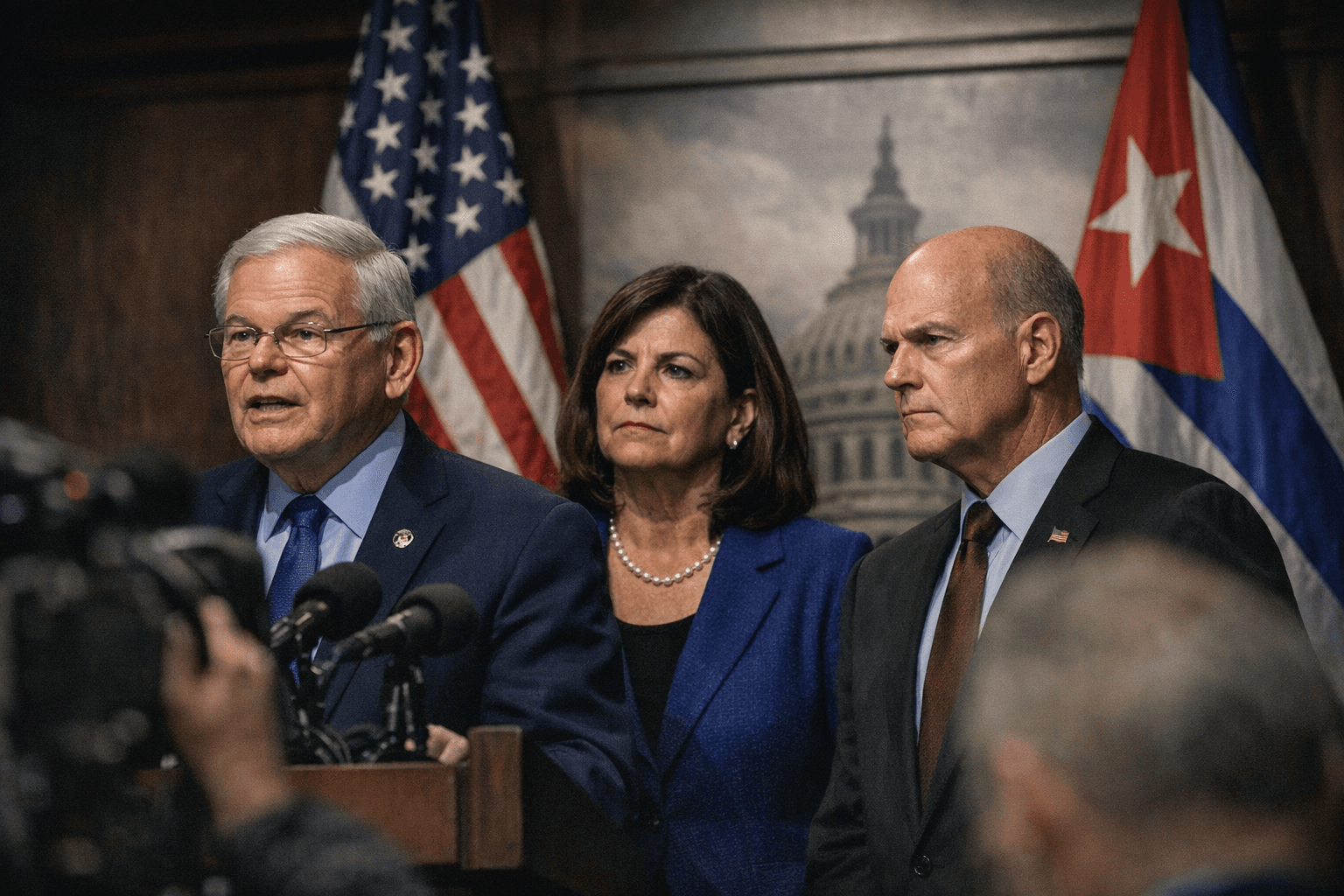
The resolution arrives against a backdrop of deepening pressure on the island. The United States has maintained a blockade of Cuba since January to cut off fuel imports, a policy that has produced a serious energy crisis there. Cuban President Manuel Díaz-Canel confirmed this week that talks between Havana and Washington have taken place, stating that Cuba is willing to advance any process "on the basis of equality and respect for the political systems of both states, for sovereignty and for the self-determination of our governments."
Democrats have leaned on war powers resolutions repeatedly in recent months as an oversight tool, filing similar measures tied to Trump's actions toward Venezuela and Iran. None have passed, but the tactic has at times forced the administration to articulate its objectives to Congress. Democrats are also preparing to push a separate series of war powers resolutions focused on Iran unless Republicans agree to hold public hearings on that conflict.
A Florida senator named Moody has criticized the Cuba resolution as propping up the regime, a view consistent with the broader Republican pattern of standing behind the administration. With the Senate calendar moving quickly, the resolution's sponsors are banking on procedural rules to demand a vote before the month ends, even if the outcome in a GOP-majority chamber is uncertain.
This article was produced by Prism’s automated news system from verified source data, official records, and press releases, then run through automated quality and moderation checks before publishing. The system is built and supervised by the people who set the standards it runs under. Read our full AI policy.
Did this article answer your question?