Wifredo Lam bridged Cuba, Surrealism and Afro-Caribbean art
Lam’s Jungle is the clearest shortcut into Cuban modernism: masks, cane and fragmented bodies turn Afro-Caribbean identity into a Surrealist, anti-colonial language.
Wifredo Lam is the fastest way into Cuban art because he refused to flatten Cuba into folklore. Born in Sagua La Grande in 1902 and dead in Paris in 1982, he made work that pulled Afro-Caribbean heritage, Spanish academic training and European Surrealism into the same frame, and museums still use him to explain how Cuban modernism became global.
Why Lam is the essential starting point
Lam’s life already reads like a map of the 20th-century art world. The Metropolitan Museum of Art places him between the Caribbean, Europe and the United States, and says he absorbed Afro-Caribbean heritage, academic training in Spain, exposure to avant-garde art in Europe and a sustained interest in African cultures. That same institutional record notes that he moved among the major figures of Cubism, Surrealism and the postwar avant-garde, while also building a serious collection of modern art and buying a significant group of African works of art.
That matters because Lam was never just a Cuban painter who happened to travel. He was a connector, someone who took the language of European modernism and made it answer to Cuban history, Black diasporic memory and anti-colonial pressure. Artnet links him to André Breton, Salvador Dalí, Paul Klee, Roberto Matta and Pablo Picasso, which gives you a quick sense of the circles he moved through and the scale of the conversation he was entering.
Start with The Jungle
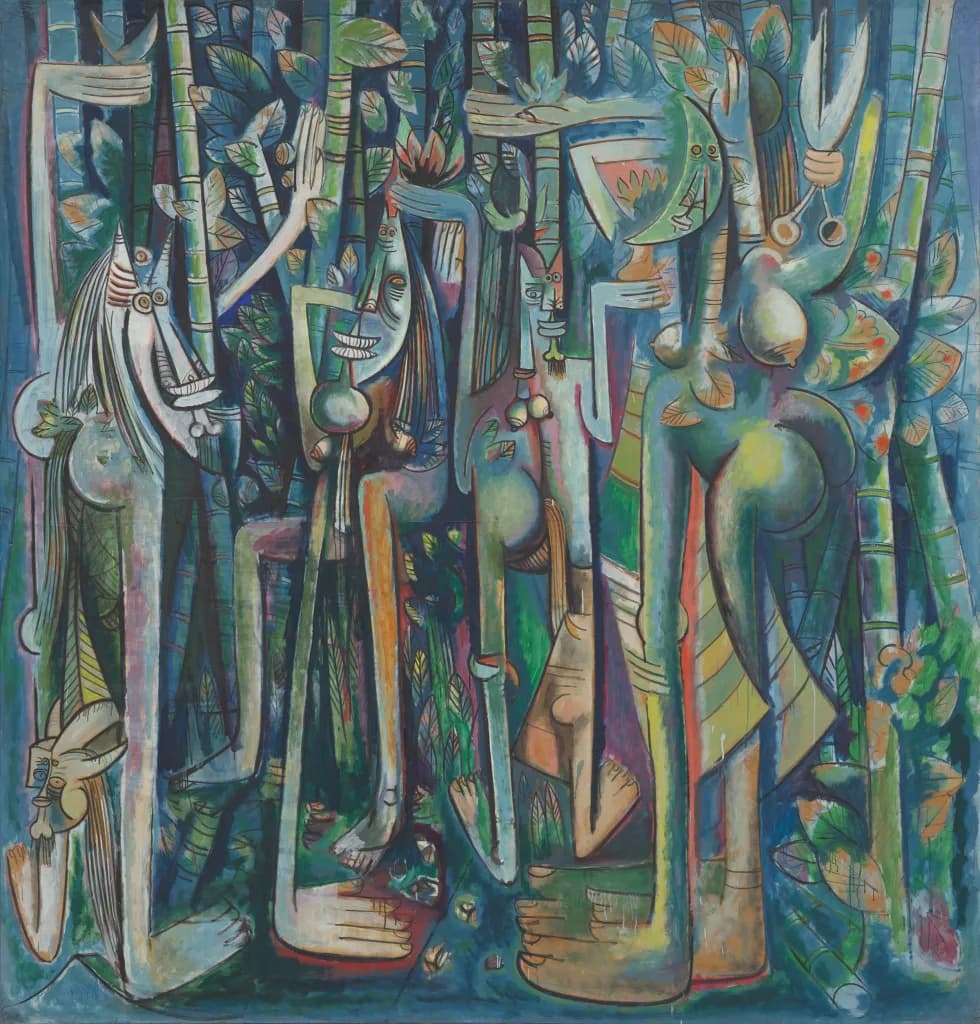
If you only have one work in mind, make it The Jungle, painted between 1942 and 1943. MoMA identifies it as oil and charcoal on paper mounted on canvas, measuring 94 1/4 x 90 1/2 inches, or 239.4 x 229.9 cm, so it is large enough to overwhelm the viewer rather than sit politely on a wall.
That scale matters because the painting does not behave like a tidy scene. It compresses bodies, leaves, cane-like forms and mask-like faces into a dense field that feels at once ceremonial and tense. The image is one of the clearest places to see how Lam fused Surrealist distortion with references tied to Afro-Cuban identity, without reducing either side to decoration.
What to notice first
- Fragmented bodies: the human figures do not fully resolve into ordinary anatomy, which gives the painting a charged, unstable rhythm.
- Mask-like faces: Lam turns the face into a surface of disguise, ritual presence and altered identity, a move that sits close to both Surrealism and Afro-diasporic visual memory.
- Sugarcane-like forms: the vertical, reed-like shapes call up plantation Cuba as well as the landscape itself, keeping labor and colonial history in the composition.
- A crowded, enclosed space: the painting feels tight, almost suffocating, which helps it hold both enchantment and violence at the same time.
Smarthistory adds an essential political frame here. When Lam painted The Jungle in 1943, Cuba had already spent more than four decades at the mercy of United States interests. That context helps explain why the painting reads as more than formal experiment: it becomes an argument about power, extraction and the way Cuban life was being seen from outside.
What Lam changed in Cuban art
Lam’s achievement was not that he simply painted Cuba. It was that he found a visual language capable of holding Cuba’s racial, spiritual and colonial complexity without turning any of it into postcard identity. He used the strategies of European modernism, fractured form, symbolic density, compressed space, then filled them with Afro-Caribbean and anti-colonial content.
That is why his work still travels so well across museum walls. It speaks to Surrealism, but it also speaks past Surrealism into questions of decolonization, Black Atlantic culture and the politics of representation. For readers trying to understand Cuban art quickly, Lam is the point where those conversations stop being abstract and become visible.
Why museums still center him
Lam’s staying power is not just a matter of art history departments. MoMA maintains an artist page for him, and Tate built The EY Exhibition: Wifredo Lam around his importance. Those are not casual gestures. They show that major institutions continue to present him as a canonical figure for understanding Cuban modernism, not a side note to European movements.
More recent coverage has pushed that reading further, describing Lam as a Cuban modernist whose politics and Afro-Asian roots shaped his paintings and inspired generations of artists. Put beside the Met’s account of his transnational life, that makes the picture clear: Lam sits at the intersection of Cuba, the African diaspora and the avant-garde, and that intersection is exactly why he remains so useful.
The shortcut that still works
Lam is still the cleanest entry point because he solves the central problem of Cuban art in public view: how to show a nation shaped by Africa, Spain, empire and migration without smoothing away the friction. The Jungle gives you the answer in one dense image, and the rest of his career confirms it. If you start with the masks, the cane, the crowded bodies and the pressure in the frame, you can trace Cuban art outward from there, into Surrealism, into anti-colonial thought and into the museum stories that still define how Cuba is seen.
This article was produced by Prism’s automated news system from verified source data, official records, and press releases, then run through automated quality and moderation checks before publishing. The system is built and supervised by the people who set the standards it runs under. Read our full AI policy.
Did this article answer your question?