10-Level Drumming Curriculum Takes Beginners From Sticks to Full Songs
Most beginners quit before they ever play a real song. This 10-level roadmap gets you from grip basics to a full 32-bar performance, one focused daily practice block at a time.
Most people who buy a drum kit never play a complete song. They noodle, they bash, they fall into YouTube rabbit holes for a few weeks, and then the kit becomes expensive furniture. The problem is rarely talent or time. It's the absence of a structured path that delivers clear wins early enough to keep you coming back.
This 10-level curriculum is built to solve that. It balances technique, coordination, reading, and musical application so every practice session has a purpose and every week ends with something you can actually play.
Your First 15 Minutes: Start Today
Before you open the curriculum, build a physical habit. Here's what your very first session looks like:
1. Sit at the kit and adjust your throne so your thighs slope slightly downward. Set your snare at roughly hip height.
2. Pick up your sticks and use matched grip: both palms facing down, sticks held between thumb and forefinger about a third of the way from the butt end. (Traditional grip, one hand palm-up, is worth learning eventually, but matched grip is the universal starting point.)
3. Play single strokes on the snare: right, left, right, left. Slow. Aim for identical rebound height on both hands. Do this for five minutes.
4. Add the bass drum on every right-hand stroke. Five more minutes.
5. Add the hi-hat closing on every stroke. You now have a rudimentary groove. Hold it for five minutes.
That's it. Fifteen minutes, a concrete result, no theory required. If you can do that much, you've already cleared the hardest barrier: starting.
Levels 1-3: Fundamentals
The first three levels cover everything you need to play without injuring yourself or sounding completely random. Kit setup and posture come first because bad ergonomics create bad habits that take years to unlearn. Stick grip follows, with matched grip as the default and traditional grip introduced as context rather than obligation. Then comes single-stroke control, the ability to play clean, even alternating strokes at a consistent volume, because every advanced technique you'll ever use is built on top of this.
Day 7 self-test: Play a steady 8th-note hi-hat pattern with your right hand while your left foot keeps quarter notes on the hi-hat pedal. Hold it for 32 bars at 70 BPM without rushing. If it's solid, you pass Level 3.
Levels 4-6: Coordination and Rudiments
This is where most beginners stall, and where a structured curriculum earns its keep. Level 4 introduces the 26 essential rudiments, starting with single and double paradiddles and flams. These are not abstract exercises; they are the vocabulary your hands use to navigate the kit in real musical situations. Level 5 builds basic limb independence: bass drum and hi-hat patterns that run independently of what your snare hand is doing, the coordination puzzle that stops most self-taught players in their tracks. Level 6 puts it together with common rock and funk grooves, basic fills, and your first play-along practice against actual songs.
Day 14 self-test: Play a standard rock groove (kick on beats 1 and 3, snare on 2 and 4, 8th-note hi-hat) at 90 BPM with consistent dynamics for one full minute without stopping. Add a four-beat fill leading cleanly back into the groove. If that feels controlled, you're through Level 6.
Levels 7-10: Musical Application and Advanced Technique
The final four levels are where drumming stops feeling like an obstacle course and starts sounding like music. Level 7 introduces odd time signatures, 5/4 and 7/8, alongside linear patterns where no two limbs play simultaneously, creating a more open, melodic quality in your grooves. Levels 8 and 9 convert advanced rudiments into kit phrasing, so the paradiddle-diddle you practiced on the snare now moves around the toms as a coherent musical statement. Level 10 is about musical form: crafting intro fills, verse-to-chorus transitions, and outros that serve the arrangement rather than showcase chops for their own sake.
Day 30 self-test: Play a full 32-bar song with tasteful comping and two fills that serve the arrangement. Record it. If you can listen back without wincing at tempo drift or fill placement, you've completed the curriculum.
The Minimum Effective Dose
Busy schedules kill practice habits. Here is what 45 focused minutes looks like, structured to be completed before work or school:
- 5-10 minutes: Warmup with single strokes, double strokes, and paradiddles on a practice pad or snare. No full kit needed.
- 10-15 minutes: Coordination and independence exercises with a metronome. The click is not optional. Tempo integrity is the foundation every other skill rests on.
- 10-15 minutes: Grooves and fills applied to songs. Pick one play-along track per level and work it until it's comfortable.
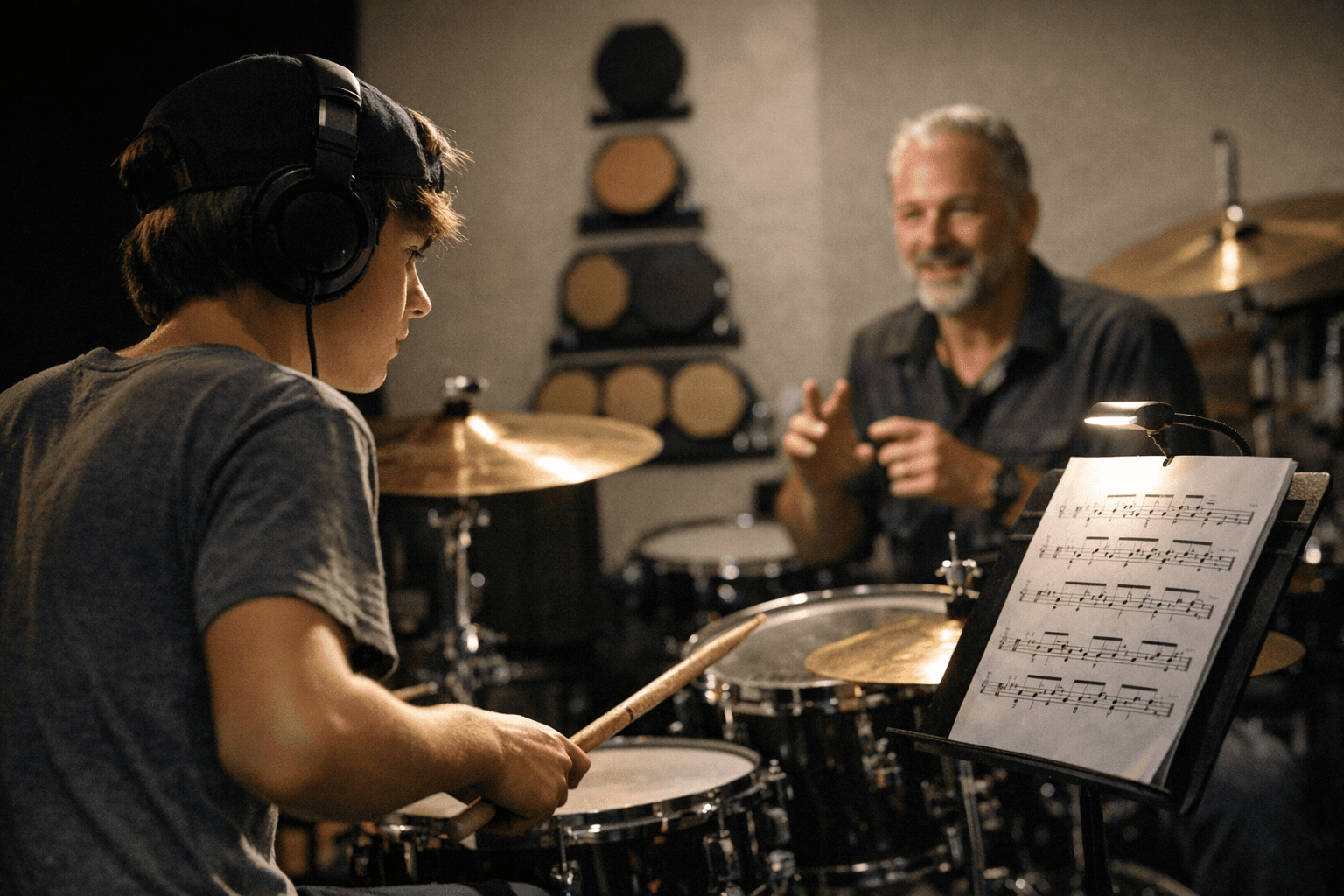
- 10 minutes: Reading or transcribing. Even one line of notation per day builds chart fluency faster than most players expect.
Five principles govern every session:
1. Slow and accurate now equals fast later. The metronome never lies.
2. Isolate the stubborn limb. If your left foot is the weak point, practice it alone against a drone until it isn't.
3. Record yourself weekly. Real-time progress is nearly invisible; recordings reveal it.
4. Taste and dynamics outweigh technical showmanship in almost every real-world playing context. A well-placed single-stroke fill beats a sloppy 16th-note run every time.
5. Practice musicality alongside mechanics. Listen to the song before you play it. Know where the chorus lands before you decide what fill leads into it.
Beyond Level 10
Finishing the curriculum is not the finish line; it's the entry point for specialty work. The four recommended tracks are jazz comping and brushes, metal double-bass technique, studio recording discipline (click integrity, headphone mix management, punch-in preparation), and band leadership, which covers charting songs, running rehearsals, and the etiquette of being the player everyone else locks in on.
At this stage, joining a community or taking occasional lessons for accountability and honest feedback accelerates everything. The fundamentals are internalized; what you need now are ears that are not your own.
Most drummers spend years figuring out what this curriculum teaches in 30 days: that technique without musicality is noise, and musicality without technique is frustration. The two have to develop together, level by level, and the roadmap for doing it efficiently starts with 15 minutes today.
This article was produced by Prism’s automated news system from verified source data, official records, and press releases, then run through automated quality and moderation checks before publishing. The system is built and supervised by the people who set the standards it runs under. Read our full AI policy.
Did this article answer your question?