Gunnar Olsen Shapes Puscifer’s Shifting Sound on Normal Isn’t
Gunnar Olsen turns Puscifer’s shifting arrangements into a lesson in listening, anchoring, and controlled disruption. On Normal Isn’t, the drum chair becomes part of the songwriting engine.

The drum part is only the starting point
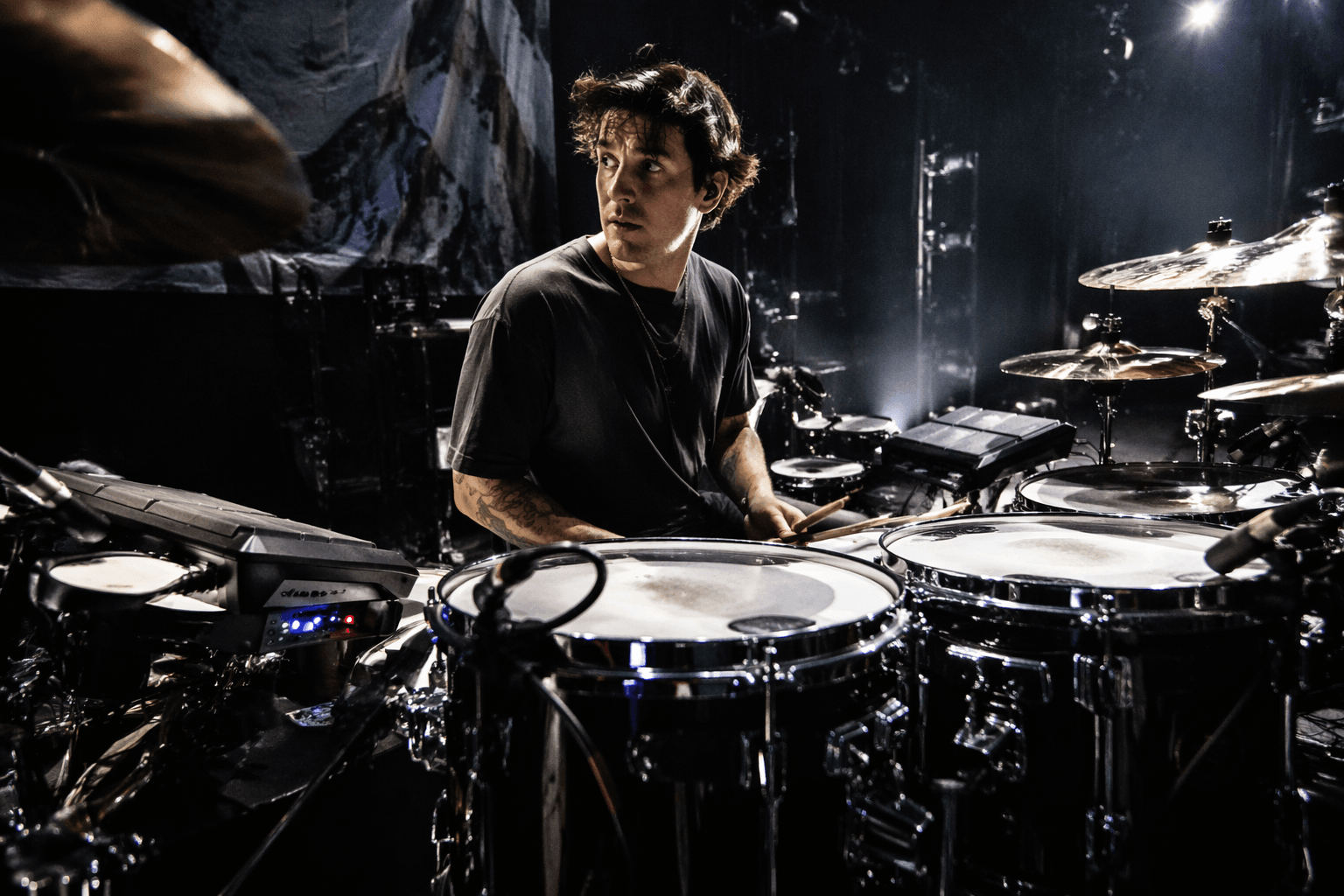
Gunnar Olsen’s work on Puscifer’s *Normal Isn’t* shows what happens when the drummer is asked to do more than keep time. In a band that treats songs as living structures, Olsen has to lock the pulse, react to sudden shifts, and help shape parts that blur acoustic drums, electronics, and deliberate randomness. That is the real challenge here: not playing louder, but staying flexible enough to make instability feel intentional.
Puscifer released *Normal Isn’t* on February 6, 2026, through Puscifer Entertainment, Alchemy Recordings, and BMG. It was their first new album in over five years, an 11-song set that the band said moves into darker, more guitar-driven territory while drawing on post-punk influences from the members’ early musical lives. For drummers, that matters because it places Olsen inside a record where feel, texture, and structure all have to move together without ever sounding stiff.
A record built to change shape
The defining idea behind *Normal Isn’t* is that normal is not the point. Maynard James Keenan said the band’s current music reflects “this time we are living in” and that the world does not appear normal. Mat Mitchell said the band wanted more rawness and edge and “got rid of the guard rails” on the album. Carina Round pushed that even further, saying that in Puscifer, “any idea can totally change without any preciousness.”
That philosophy changes the drummer’s job. In a conventional rock setting, the goal is often consistency. In Puscifer’s world, the better move is responsiveness. Olsen has to hear when a groove should stay nailed down and when it should loosen enough to let the arrangement breathe, wobble, or pivot. That balance is what keeps experimental music from collapsing into chaos.
Why Kansas City matters
One of the most revealing details about the record is where some of the drum tracking happened. New Noise noted that an unusual part of the process came when Mitchell met Gunnar Olsen at a friend’s studio in Kansas City, Missouri, to track drum parts. Modern Drummer added that Olsen helped shape parts from an off-the-grid Kansas City studio, and that those parts blur the line between percussion, electronics, and deliberate randomness.
That setup tells you a lot about the kind of drummer this album needed. An off-the-grid room does not suggest polished perfection or a rigid production pipeline. It suggests a space where instinct can lead, where the part can be built by ear, and where the drummer is trusted to help define the song rather than merely execute it. For anyone who plays progressive, art-rock, or studio-heavy music, that is the model: arrive ready to interpret, not just repeat.
When to anchor, and when to disturb
Olsen’s most valuable role on *Normal Isn’t* is knowing when to behave like the center of gravity and when to become part of the movement around it. In passages built on acoustic drums, he can give the band a spine. In sections where electronics, textures, or abrupt arrangement turns take over, the drum part may need to stop sounding like a traditional backbeat and start sounding like part of the design.
That is the lesson hiding inside the record’s experimental surface:
- Anchor the song when the rest of the arrangement is moving.
- Open up the part when the track needs air or tension.
- Let electronic textures and acoustic hits answer each other instead of competing.
- Treat odd structure as a cue to listen harder, not play busier.
That approach fits Puscifer’s broader identity. The band has spent more than two decades operating as a hybrid of band, experiment, and performance art, so Olsen’s drumming is being judged as part of a larger conceptual machine. In that setting, a fill is never just a fill. It can redirect the song’s mood, suggest a new section, or reinforce the feeling that the track is still becoming itself.
The album’s cast widens the frame
The personnel around Olsen makes the record feel even more like a collaborative workshop. *Normal Isn’t* includes Greg Edwards, Tony Levin, Sarah Jones, Danny Carey, and Mr. Ian Ross. Danny Carey appears on “Seven One,” Tony Levin plays bass on “Normal Isn’t” and “Seven One,” and Mr. Ian Ross narrates “Seven One.”
That lineup matters because it signals a project built from different rhythmic and textural languages. Levin brings a long-respected melodic bass presence, Carey adds a guest drum voice with unmistakable weight, and Jones broadens the album’s percussion identity. For a drummer reading the record as a guide, the takeaway is simple: in an arrangement this open, the drums are not a sealed box. They are part of an ongoing conversation.
A release that spread beyond the album
Puscifer did not treat *Normal Isn’t* like a standalone drop. Alongside the record, the band launched the comic series *Tales from the Pusciverse* and issued *Normal Isn’t: Puscifer Live at the Pacific Stock Exchange*, a 1 hour 2 minute concert film documenting the first-ever live performance of *Normal Isn’t*. The film was shot at Los Angeles’ original stock exchange, an art-deco landmark the band described as long rumored to be among the city’s most haunted sites.
That wider rollout says something important about how the band thinks. The album is not just a collection of songs, it is a piece of a larger world. Singles and visualizers like “Self Evident,” “Pendulum,” and “ImpetuoUs” extended that world before the full release arrived, and the concert film gave the material a physical stage before the audience had fully lived with the studio versions. For drummers, that means the parts are expected to work in more than one environment: on record, in a film, and eventually in the live room.
What you can borrow from Olsen’s approach
If you play music that refuses to stay in one groove, Olsen’s work on *Normal Isn’t* offers a practical mindset. The best move is not to force every section into a standard rock pattern. It is to stay available to the song’s logic, even when that logic keeps shifting.
The most useful habits are the ones that make you adaptable:
- Listen for the arrangement before you count the bar.
- Let the kick and snare define the frame when the track needs stability.
- Use texture, spacing, and dynamics to support the band’s strange turns.
- Accept that the part may evolve from rehearsal to tracking to performance.
- Treat intuition as a skill, not a backup plan.
That is why Olsen’s role stands out so clearly on *Normal Isn’t*. He is not just holding down the chair. He is helping decide what the music becomes as it moves. In a band that keeps redefining its own shape, that kind of drumming is not auxiliary. It is the mechanism that lets the whole machine keep changing without falling apart.
This article was produced by Prism’s automated news system from verified source data, official records, and press releases, then run through automated quality and moderation checks before publishing. The system is built and supervised by the people who set the standards it runs under. Read our full AI policy.
Did this article answer your question?