Japan's DRUM TAO Brings 32 Years of Taiko Highlights to Poway Audiences
DRUM TAO's Poway stop distilled 32 years of taiko highlights into two performances, offering drum-set players a rare live clinic in unison accuracy, stick height, and endurance.

Two performances. One day. Thirty-two years of material condensed into a single program. DRUM TAO packed the Poway Center for the Performing Arts on March 29 with "DRUM TAO: The Best," a highlights-format show that distilled the ensemble's most physically demanding and visually striking work since its founding in 1993.
The 2:00 PM and 7:00 PM shows marked a return visit to Poway OnStage, billed "back by popular demand," landing midway through a compact North American tour that ran from Berkeley and Los Angeles through Mesa and the Pacific Northwest before closing in early April. The program's format, a curated greatest-hits sweep rather than a new-work premiere, signals a deliberate accessibility strategy: pull the knockout material from 32 years of repertoire, stack the set list with crowd-tested pieces, and let the drums do the persuading.
Watching a DRUM TAO performance as a kit player is worth approaching as a technique clinic as much as a spectacle. Three fundamentals that anchor the ensemble's physicality translate directly into practice room work.
The first is unison accuracy. DRUM TAO's choreography is built around synchronized striking: when the ensemble hits simultaneously, the visual impact depends entirely on each stick landing at the same millisecond. Replicate that discipline by drilling a simple pattern at 60 BPM and recording the audio. Pull the waveform into any DAW and compare where your attacks land against the grid. Most players are surprised by how much drift exists in patterns they consider tight.
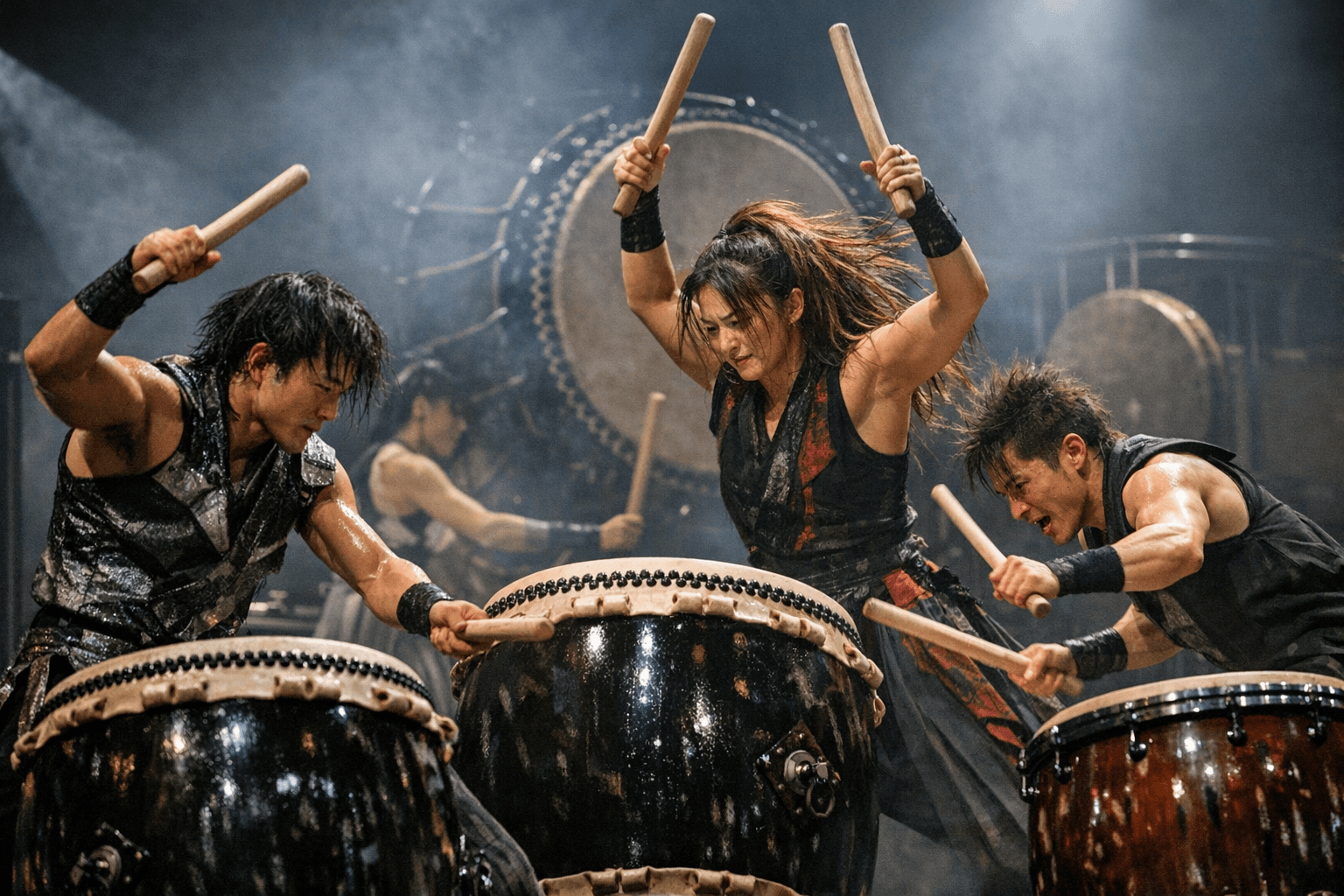
The second is stick height consistency. Taiko players train their furi, the preparatory stroke arc, to a uniform height across the entire ensemble. The sonic payoff mirrors the visual one: a consistent arc produces consistent velocity, which produces consistent dynamics. Film yourself from the front and check whether your dominant and non-dominant hands reach the same apex on every stroke. A mismatched arc almost always explains a dynamics problem that feels purely rhythmic.
The third is endurance. DRUM TAO's performers are athletes in the literal sense, and the physically demanding aesthetic the ensemble is known for requires cardiovascular conditioning that most kit players never build deliberately. Pick any groove at 100 BPM and play it continuously for eight minutes without breaking tempo, releasing grip tension, or losing stroke definition. It exposes posture collapse and dynamic fade in ways that short practice sessions never will.
The Poway stop placed DRUM TAO midway through a run that combined "traditional Japanese taiko drumming with acrobatics and stunning visuals" into a single theatrical event, framing percussion as a visual art form as much as an aural one. After 32 years of making that argument on stages across the world, the ensemble continues to make it convincingly.
Know something we missed? Have a correction or additional information?
Submit a Tip