King Crimson's Rotating Drum Seat, From Giles to Harrison and Beyond
Bill Bruford quit Yes to play in 17/16 — and that decision sparked five decades of King Crimson rotating through some of the most technically daring drummers in rock history.

Where the Beat Began: Michael Giles and the Blueprint (1969)
Bill Bruford walked out of Yes in July 1972 for one reason he never hid: "King Crimson was one of the only gigs for a rock drummer where you could play in 17/16 and still stay in decent hotels." That quote tells you everything about what made King Crimson irresistible to serious drummers across five decades. The band didn't just cycle through percussion talent; it attracted players who wanted to be challenged at a molecular level, then gave them permission to reshape the entire role while they were at it.
That process started with Michael Giles, King Crimson's original drummer and co-founder, who appeared on the debut record *In the Court of the Crimson King* in 1969. Giles brought a jazz-informed sensitivity to what was, on the surface, an aggressive rock context. His playing on "21st Century Schizoid Man" established the template: raw power held in check by musical intelligence. The technique to listen for is restraint within intensity — Giles never surrendered the groove to pure density, and that tension is what makes the track still sound muscular rather than cluttered. The practice challenge: play along to "21st Century Schizoid Man" and identify every moment where you would have added a fill — then don't. Giles's discipline is the whole lesson.
The Bridge Builders: McCulloch and Wallace (1970-1972)
Andy McCulloch took the seat for *Lizard* in 1970, navigating one of King Crimson's most orchestrally ambitious records. His role required textural awareness more than percussive brute force — the album's dense ensemble arrangements demanded a drummer who could support without overwhelming. Ian Wallace followed on *Islands* (1971) and the live document *Earthbound* (1972), bringing a direct, no-nonsense groove that suited the band's heavier live presentation. Wallace's post-Crimson career speaks to his adaptability: he went on to session work with Bob Dylan, Stevie Nicks, Don Henley, and the Travelling Wilburys, logging one of the most eclectic resumes in British rock drumming before his death in 2007.
Neither McCulloch nor Wallace is regularly cited in the same breath as Bruford or Giles, but their eras are worth the dig. They represent King Crimson in a phase of finding its next identity — and both demonstrate that even a transitional slot in this band demands high-level musicianship.
The Collision: Jamie Muir and Bill Bruford Together (1972-1973)
The most genuinely strange chapter in King Crimson's percussion history is also its most influential on the musicians who lived through it. When Bruford joined in late 1972, he did so alongside Jamie Muir, a Scottish percussionist whose approach had almost nothing to do with conventional drumming. Muir arrived on *Larks' Tongues in Aspic* (1973) as an experimenter: free-form, theatrical, and armed with found objects and unconventional sound sources alongside traditional percussion. He left the band in early 1973 to pursue a monastic Buddhist life at Samye Ling Monastery in Scotland, and rarely returned to music afterward. He died on February 17, 2025.
Muir's brief presence mattered enormously. Bruford later cited those six months playing alongside Muir as "highly influential" on his own development as a player. The entry point here is "Larks' Tongues in Aspic Part One" — listen to how two rhythmic personalities negotiate space without competing for it. Muir brings texture and surprise; Bruford brings architecture. The practice challenge: grab three non-drum objects (a cardboard box, a glass bottle, a metal tin) and improvise texture under a static groove you've recorded. Muir's logic wasn't about replacing drums — it was about expanding what percussion could mean alongside them.
The Bruford Era: Jazz Phrasing Meets Heavy Architecture (1973-1974)
With Muir gone, Bruford took sole command of the percussion chair through *Starless and Bible Black* (1974), *Red* (1974), and the live album *USA* (1975). This is the era that cemented his reputation. His approach — jazz-informed phrasing dropped into heavy, odd-metered rock compositions — produced some of the most analytically rewarding drumming in progressive rock. On *Red*, he deployed implied polyrhythms through specific kit orchestration: using the arrangement of notes around the kit to suggest one rhythmic layer while the underlying pulse implied another. The curiosity around what kit he actually used on *Red* remains an interesting footnote, the kind of detail that obsessive drummers still debate.
The essential track for this era is "One More Red Nightmare" from *Red*, where the polyrhythmic orchestration is clearest. Then cross-reference with the 17/16 Discipline groove (from the 1981 album *Discipline*), which Bruford traced to "a left-handed Swiss triplet" — a phrase of 17 sixteenth-notes cycling against an implied 4/4 feel. Practice challenge: set a metronome and count 17 sixteenth-notes as a repeating bar. Find where the accents naturally want to land, then resist them. That disorientation is exactly the tension Bruford weaponized.
The Double Trio: When Two Drummers Became the Point (1994-1997)
Robert Fripp's 1994 reformation of King Crimson didn't just add members — it doubled every section. The "Double Trio" lineup placed two guitarists (Fripp and Adrian Belew), two bassists (Tony Levin and Trey Gunn), and two drummers (Bruford and Pat Mastelotto) on stage simultaneously. Mastelotto came from an entirely different world: he had been the drummer for pop act Mr. Mister, and his early drum heroes had included Michael Giles himself. That circle-of-influence is worth sitting with.
What made the Bruford/Mastelotto pairing exceptional was that they didn't divide roles rigidly. A Modern Drummer interview from the period described the setup: rather than Mastelotto holding down the groove while Bruford decorated, the pair constantly switched functions. Mastelotto's locked-down, rockier feel and Bruford's jazzier, punchier phrasing were genuinely complementary rather than hierarchical. *Thrak* (1995) documents this best; the track "B'Boom" is a dedicated double-drum feature that strips away the rest of the band and lets the conversation between them speak for itself. Practice challenge: record yourself playing a steady groove, then play back the recording and improvise a complementary second part on top of it. That's the creative problem Bruford and Mastelotto were solving every night.
Mastelotto Alone: Electronic Hybridization (2000-2003)
When Bruford departed after the mid-1990s cycle, Mastelotto became King Crimson's sole rhythmic anchor for *The ConstruKction of Light* (2000) and *The Power to Believe* (2003). This phase showed his real range. His studio rig for *The ConstruKction of Light* included nine Roland V-drum pads, five DrumTec pads, a Korg Wavedrum, and two separate electronic drum brains running simultaneously. His work in the band's experimental ProjeKcts subgroupings, particularly ProjeKct 3, pushed further into IDM-influenced territory. The practice challenge: integrate one electronic trigger into your next acoustic practice session and build a single loop from it. Mastelotto's lesson is that hybrid isn't a compromise — it's an expansion of vocabulary.
Three at Once: The Final Formation (2014-2021)
The last King Crimson lineup took the multiple-drummer concept further than anyone had attempted. By 2014, the band was staging three percussionists simultaneously: Mastelotto was joined by Gavin Harrison (known for his polyrhythmic work with Porcupine Tree) and Bill Rieflin, who played both drums and keyboards. When Rieflin stepped back due to illness (he died in 2020), Jeremy Stacey, another multi-instrumentalist covering drums and keyboards, took his place. The percussion section became a three-voice polyrhythmic organism, each player maintaining an independent rhythmic identity while interlocking with the others.
This lineup also generated the band's most memorable "what could have been" moments. Jerry Marotta's potential involvement in one of King Crimson's configurations remains an intriguing sidebar. And Tool drummer Danny Carey — himself one of the most technically sophisticated players in rock — stepped in for a guest appearance mid-performance during the band's later touring years, a moment that crystallized exactly why accomplished drummers are drawn to King Crimson: the music creates space for that level of engagement because it was built for it.
The practice challenge for the triple-era is the hardest: pick three separate rhythmic ostinatos (say, a standard hi-hat pulse, a cross-stick pattern in 5, and bass drum phrasing in 3) and attempt to sustain all three simultaneously. King Crimson's final percussion section did this live, in real time, in front of audiences. It is a model for what percussive ambition, across a career and a band's entire history, can eventually become.
*From Giles's restrained jazz-rock in 1969 to three players building interlocking rhythmic architectures on a single stage in 2021, King Crimson's drum seat was never just a seat. It was an ongoing argument about what rhythm could do — and every player who sat in it changed the answer.*
Wait, let me format this properly as requested.
Where the Beat Began: Michael Giles and the Blueprint (1969)
Bill Bruford walked out of Yes in July 1972 for one reason he never hid: "King Crimson was one of the only gigs for a rock drummer where you could play in 17/16 and still stay in decent hotels." That quote tells you everything about what has made King Crimson irresistible to serious drummers across five decades. The band didn't just cycle through percussion talent; it attracted players who wanted to be challenged at a molecular level and then gave them permission to reshape the entire role while they were at it.
That process started with Michael Giles, King Crimson's original drummer and co-founder, who appeared on the debut record *In the Court of the Crimson King* in 1969. Giles brought a jazz-informed sensitivity to what was, on the surface, an aggressive rock context. His playing on "21st Century Schizoid Man" established the template: raw power held in check by musical intelligence. The technique to listen for is restraint within intensity — Giles never surrendered the groove to pure density, and that tension is what makes the track still sound muscular rather than cluttered. The practice challenge: play along to "21st Century Schizoid Man" and identify every moment where you would have added a fill — then don't. Giles's discipline is the whole lesson.
The Bridge Builders: McCulloch and Wallace (1970-1972)
Andy McCulloch took the seat for *Lizard* in 1970, navigating one of King Crimson's most orchestrally ambitious records. His role required textural awareness over percussive brute force — the album's dense ensemble arrangements demanded a drummer who could support without overwhelming. Ian Wallace followed on *Islands* (1971) and the live document *Earthbound* (1972), bringing a direct, no-nonsense groove that suited the band's heavier live presentation. Wallace's post-Crimson career speaks to his adaptability: he went on to session work with Bob Dylan, Stevie Nicks, Don Henley, and the Travelling Wilburys, logging one of the most eclectic resumes in British rock drumming before his death in 2007.
Neither McCulloch nor Wallace is regularly cited alongside Bruford or Giles, but their eras reward the deep listen. They represent King Crimson in a phase of searching for its next identity — and both demonstrate that even a transitional slot in this band demands high-level musicianship.
The Collision: Jamie Muir and Bill Bruford Together (1972-1973)
The most genuinely strange chapter in King Crimson's percussion history is also its most influential on the musicians who lived through it. When Bruford joined in late 1972, he did so alongside Jamie Muir, a Scottish percussionist whose approach had almost nothing to do with conventional drumming. Muir arrived on *Larks' Tongues in Aspic* (1973) as an experimenter: free-form, theatrical, armed with found objects and unconventional sound sources alongside traditional percussion. He left the band in early 1973 to pursue a monastic Buddhist life at Samye Ling Monastery in Scotland, and rarely returned to music afterward. He died on February 17, 2025.
Muir's brief presence mattered enormously. Bruford later cited those six months playing alongside Muir as highly influential on his own development as a player. The entry point here is "Larks' Tongues in Aspic Part One" — listen to how two rhythmic personalities negotiate space without competing for it. Muir brings texture and surprise; Bruford brings architecture. The practice challenge: grab three non-drum objects and improvise texture under a static groove you've recorded elsewhere. Muir's logic wasn't about replacing conventional drums — it was about expanding what percussion could mean alongside them.
The Bruford Era: Jazz Phrasing Meets Heavy Architecture (1973-1974)
With Muir gone, Bruford took sole command of the percussion chair through *Starless and Bible Black* (1974), *Red* (1974), and the live album *USA* (1975). This is the era that cemented his reputation permanently. His approach, jazz-informed phrasing dropped into heavy, odd-metered rock compositions, produced some of the most analytically rewarding drumming in progressive rock. On *Red*, he deployed implied polyrhythms through specific kit orchestration: arranging notes around the kit to suggest one rhythmic layer while the underlying pulse implied another. Even the question of what drum kit he actually used on *Red* is an ongoing curiosity among drummers — the kind of detail that obsessive students of the record still chase.
The essential track for this era is "One More Red Nightmare" from *Red*, where the polyrhythmic orchestration sits closest to the surface. Then cross-reference with the 17/16 *Discipline* groove from the 1981 album of the same name, which Bruford traced to a left-handed Swiss triplet: a phrase of 17 sixteenth-notes cycling against an implied common-time feel. Practice challenge: set a metronome and count 17 sixteenth-notes as a repeating bar. Find where the accents naturally want to land, then resist them. That controlled disorientation is exactly the tension Bruford weaponized across his entire Crimson tenure.
The Double Trio: When Two Drummers Became the Point (1994-1997)
Robert Fripp's 1994 reformation of King Crimson didn't just add members — it doubled every section. The "Double Trio" lineup placed two guitarists (Fripp and Adrian Belew), two bassists (Tony Levin and Trey Gunn), and two drummers (Bruford and Pat Mastelotto) on stage simultaneously. Mastelotto came from an entirely different world: he had been the drummer for pop act Mr. Mister, and his early drum heroes had included Michael Giles himself. That generational loop — Giles inspiring Mastelotto, Mastelotto then sitting beside Bruford who was inspired by Giles's band — is not a coincidence. It is how King Crimson's percussion culture actually transmits.
What made the Bruford/Mastelotto pairing exceptional was that they didn't divide their roles rigidly. Rather than Mastelotto holding down the groove while Bruford decorated, the pair constantly switched functions — roles completely reversed at times, with Bruford playing the beat and Mastelotto acting as colorist. Mastelotto's locked-down, rockier feel and Bruford's jazzier, punchier phrasing were genuinely complementary rather than hierarchical. *Thrak* (1995) documents this best; the track "B'Boom" is a dedicated double-drum feature that strips away the rest of the band and lets the conversation between them speak for itself. Practice challenge: record yourself playing a steady groove, then play back the recording and improvise a complementary second part on top of it in real time. That is the creative problem Bruford and Mastelotto were solving every night.
Mastelotto Alone: Electronic Hybridization (2000-2003)
When Bruford departed after the mid-1990s cycle, Mastelotto became King Crimson's sole rhythmic anchor for *The ConstruKction of Light* (2000) and *The Power to Believe* (2003). This phase showed his true range. His studio rig for *The ConstruKction of Light* included nine Roland V-drum pads, five DrumTec pads, a Korg Wavedrum, and two separate electronic drum brains running simultaneously — acoustic and electronic sources merged into a single hybrid voice. His work in the band's experimental ProjeKcts subgroupings, particularly the IDM-influenced ProjeKct 3, pushed further into electronic territory than most rock drummers were willing to go at the time. The practice challenge: integrate one electronic trigger into your next acoustic practice session and build a single loop from it before playing over it live. Mastelotto's lesson is that hybrid drumming is not a compromise between two worlds — it is a third vocabulary of its own.
Three at Once: The Final Formation (2014-2021)
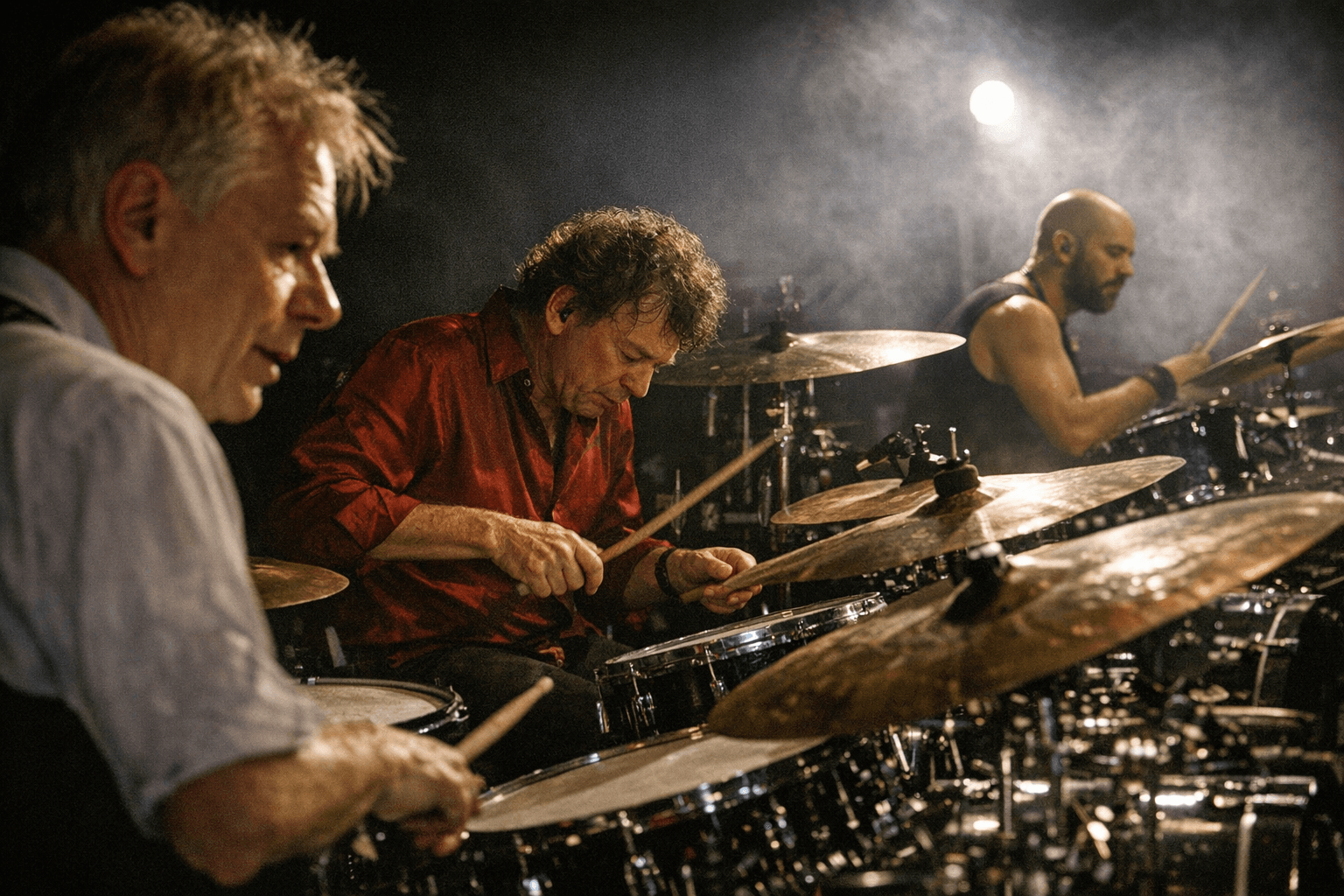
The last King Crimson lineup took the multiple-drummer concept further than anyone had attempted in a sustained touring context. By 2014, the band was staging three percussionists simultaneously: Mastelotto joined forces with Gavin Harrison, known for his extraordinarily detailed polyrhythmic work with Porcupine Tree, and Bill Rieflin, a multi-instrumentalist who covered both drums and keyboards within the same set. When Rieflin stepped back due to illness (he died in 2020), Jeremy Stacey took his place, another multi-instrumentalist bringing the same fluid hybrid role. The percussion section became a three-voice polyrhythmic organism, each player maintaining an independent rhythmic identity while the three parts interlocked.
This era also generated the band's most memorable "what could have been" footnote: Jerry Marotta's potential involvement in one of King Crimson's configurations remains one of the more intriguing sidebar stories in the band's history. And Tool drummer Danny Carey — himself among the most technically sophisticated percussionists working in rock — stepped in for a guest appearance mid-performance during the band's later touring years. That moment crystallized exactly why accomplished drummers keep gravitating toward King Crimson: the music creates room for that level of engagement because it was deliberately built that way from the very beginning.
The practice challenge for the triple-era is the hardest on this list: choose three separate rhythmic ostinatos, say a standard hi-hat pulse, a cross-stick pattern in five, and a bass drum phrase in three, and attempt to sustain all three simultaneously within a single performance. King Crimson's final percussion section did this live, in real time, night after night. It is the logical endpoint of a fifty-year experiment in what a drum seat can actually be asked to do.
This article was produced by Prism’s automated news system from verified source data, official records, and press releases, then run through automated quality and moderation checks before publishing. The system is built and supervised by the people who set the standards it runs under. Read our full AI policy.
Did this article answer your question?