Miami Bloco Unites Beginners and Veterans Through Brazilian Samba Percussion
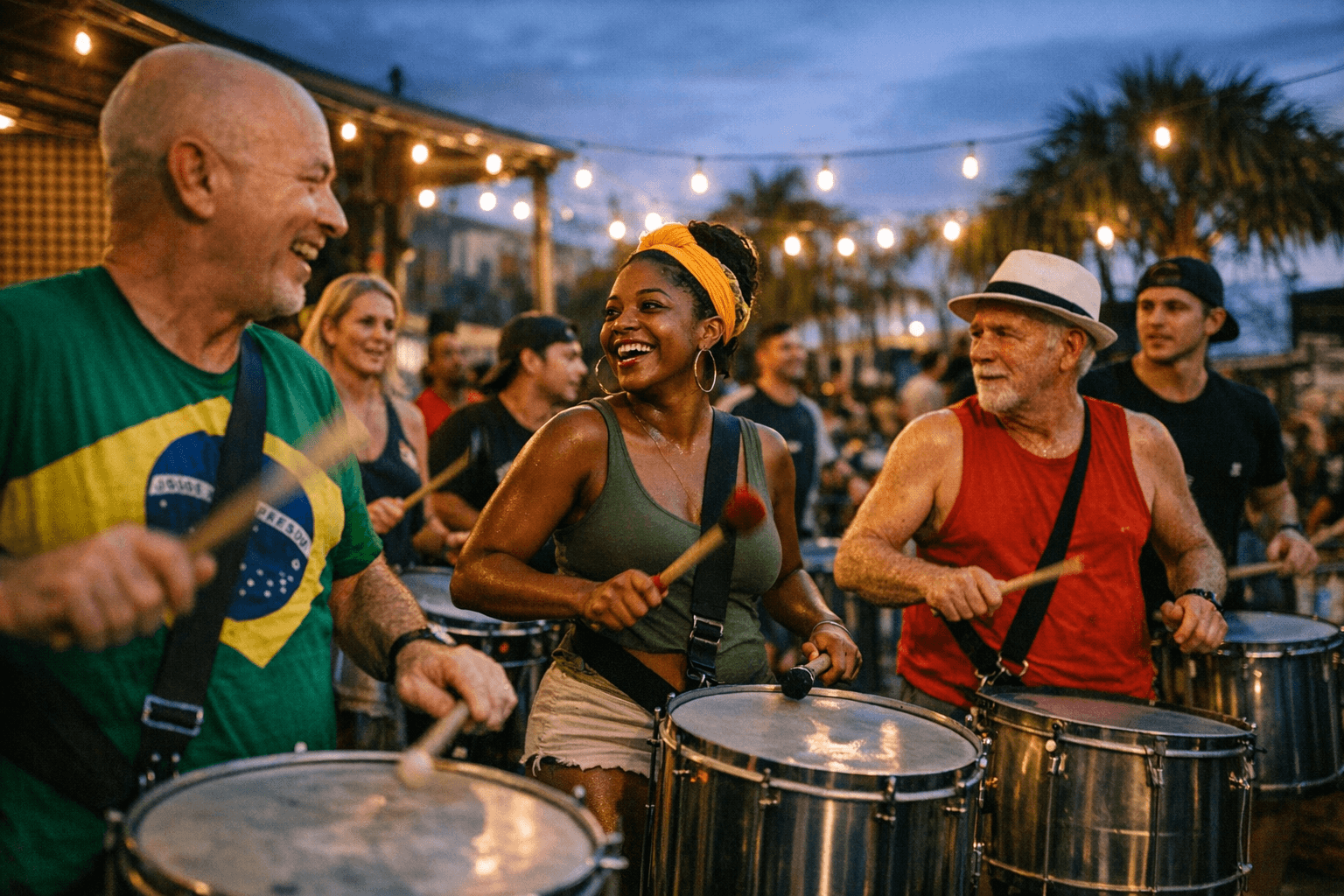
Miami Bloco's open rehearsals at Magic 13 Brewery welcome total beginners — no experience needed, all drums provided, just show up ready to play.
Where Samba Meets the 305
Miami Bloco is not a drum corps that auditions you at the door. Co-founded by creative director Suom Francis and artistic director Dr. Brian Potts, a classically trained percussionist who studied at the University of Miami, it is a 501(c)3 nonprofit that has spent nearly a decade building what may be the most accessible bateria in South Florida. The group's philosophy fits on a single line from Francis himself: "If you can carry the drum and you can follow direction, you're welcome." That is the entire audition.
Potts describes the band's growth as genuinely organic: informal rehearsals at barbecues and capoeira studios eventually formalized into a bateria that now performs at festivals and local venues across the region. The leap from backyard jam to main-stage ensemble did not happen by narrowing the door. It happened by widening it.
How the Group Is Structured
Miami Bloco runs three distinct on-ramps, each suited to a different level of commitment.
The most casual entry point is the free public rehearsal held Monday nights at Magic 13 Brewery in Little Haiti, running from 7 to 10 p.m. All drums are included — you pre-register, grab a drum, and join the rhythm. The event is deliberately social: samba percussion, dancing, and community connection are all part of the same Monday-night package. For anyone who has been curious about samba drumming but nervous about looking foolish in front of skilled players, this is the right first step. The instruments are there, the groove is already going, and nobody is watching you stumble through beat two.
The Bateria Academy is a six-week course built around six weekly in-person rehearsals, plus over seven hours of practice video lessons and context videos designed to give students a solid foundation in samba bloco percussion and the way Miami Bloco works as a community. Whether you are building on existing kit skills or starting completely fresh, the format is structured enough to deliver real technique but relaxed enough to keep the energy fun.
At the top of the pyramid sits the Bateria Saideira, Miami Bloco's official performance group, described as the largest active samba-enredo bateria in the USA as of 2025, blending professionals with trained community members from Miami and Broward Counties. Members range in age from 13 to 70-plus and perform in parades, street festivals, main-stage concerts, and major Miami events. Membership opens through an audition, announced to the mailing list, followed by a commitment to eleven seasonal rehearsals. The Saideira is the goal, not the starting point, and the academy-to-performance pipeline means that players who put in the work eventually get there.
The Instruments: Where to Start
A samba bateria is not one sound; it is a conversation between distinct voices, and knowing which role fits your current skill level takes a lot of guesswork out of showing up.
The three surdos form the heartbeat of the bateria. Surdos 1 and 2 hold down the foundational pattern, with the lower surdo emphasizing the strong second beat of the samba, while the third surdo, called the "resposta," adds rhythmic variation. The surdo is the classic beginner's entry point: the pattern is repetitive, the drum is large and easy to hear within the ensemble, and locking in with the other surdo players gives you an immediate sense of what it means to hold down a groove for eighty other musicians.
The caixa, a snare-like drum, gives the ensemble its steady backbone through a widely adopted groove pattern that defines the rhythmic identity of each samba school. It demands more consistency than the surdo and is a natural second step once you have the fundamental pulse internalized.
The repique, also called repinique, is a smaller drum played with one hand and one stick. It is the loudest instrument in the bateria and functions as the conductor, guiding the rhythm and typically introducing the ensemble at the start of each piece. This is advanced territory, best approached after you have a few seasons of rehearsal behind you.
The tamborim plays varied patterns that engage with the melody and the repique, and its foundational pattern, the "telecoteco," is a must-know for any samba enthusiast. It is small, light, and deceptively technical — the wrist technique alone takes weeks to develop cleanly.
Practicing the Core Groove at Home
Miami Bloco's pedagogical model asks participants to learn parts at home and bring them to ensemble rehearsals, supporting skill development for novices while giving experienced players the chance to mentor and lead. That home-practice component is what makes the Monday-night and academy rehearsals feel like a culmination rather than a first-contact experience.
For surdo players drilling at home, the goal is simple: lock the strong beat on beat two and let beat four breathe. Mute the head slightly on the off-beat hit with the free hand, and practice with a metronome set between 90 and 110 BPM. The Bateria Academy's supplemental video library, bundled into the six-week course, covers these fundamentals in detail so you are not relying on YouTube guesswork. For caixa players, slow the pattern down to half tempo and isolate the ghost notes before layering in the accents. The telecoteco on tamborim is best learned by looping a short recording of the actual pattern and shadowing it on a practice pad before you ever pick up the instrument itself.
The Bigger Picture
In 2022, Miami Bloco gained a residency at the historic Miami Beach Bandshell as part of the Rhythm Foundation's Bandshell Laboratories, a move that marked the group's arrival as a recognized cultural institution, not just a neighborhood jam. Each season runs from community workshops where Potts makes music with up to 40 new students per session, through the Bateria Academy, and culminates in a stage show featuring the full Bateria alongside guest artists who represent Miami's diverse musical landscape.
The Local 10 feature situates Miami Bloco within a global resurgence of participatory percussion, where samba, bloco, and other ensemble forms serve as vehicles for cultural expression and social connection. In a city as fragmented by geography and background as Miami, that framing is not an exaggeration. Potts put it clearly in a prior interview: "Samba is a culture that spans generations, and it spans cities and neighborhoods and it brings everything together in a very harmonious and powerful" way. The testimony from new members backs it up: initial hesitation about drumming dissolves once the academy structure makes the activity concrete and the community makes it worth showing up for.
For anyone in South Florida who has tapped rhythms on a steering wheel and wondered if there is something more, Monday nights at Magic 13 Brewery are the answer. Pre-register on the Miami Bloco website, show up at 7 p.m., and pick up a surdo. The rest follows from there.
This article was produced by Prism’s automated news system from verified source data, official records, and press releases, then run through automated quality and moderation checks before publishing. The system is built and supervised by the people who set the standards it runs under. Read our full AI policy.
Did this article answer your question?