MusicRadar reveals how it tests electronic drum sets
MusicRadar's e-kit checklist puts feel, latency, hi-hat realism and apartment noise ahead of shiny spec sheets. Use it before you buy.
Hit ghost notes, play quick doubles and open and close the hi-hat, and two electronic kits that look almost identical online can feel completely different under the sticks. If you want to spend money wisely on an e-kit, the details that matter are the ones your hands, feet and ears notice in the first ten minutes.
Start with feel, not the spec sheet
The core of the test is playability: pads, response to velocity, natural rebound, and whether the snare, kick and cymbals translate your touch without awkward triggering artifacts. Hi-hat realism belongs near the top of your shortlist too, because a convincing hi-hat pedal and pad setup is often where an e-kit either sells the illusion or collapses.
Latency sits in the same bucket as feel, because a fast response is part of the playing experience, not just a technical detail. If the sound arrives late, or the trigger response feels lazy, the kit will never fully disappear under your hands. Before you buy, hit ghost notes, play quick doubles, open and close the hats, and see whether the module keeps up without smearing the groove.
Use the checkout in MusicRadar’s own test path
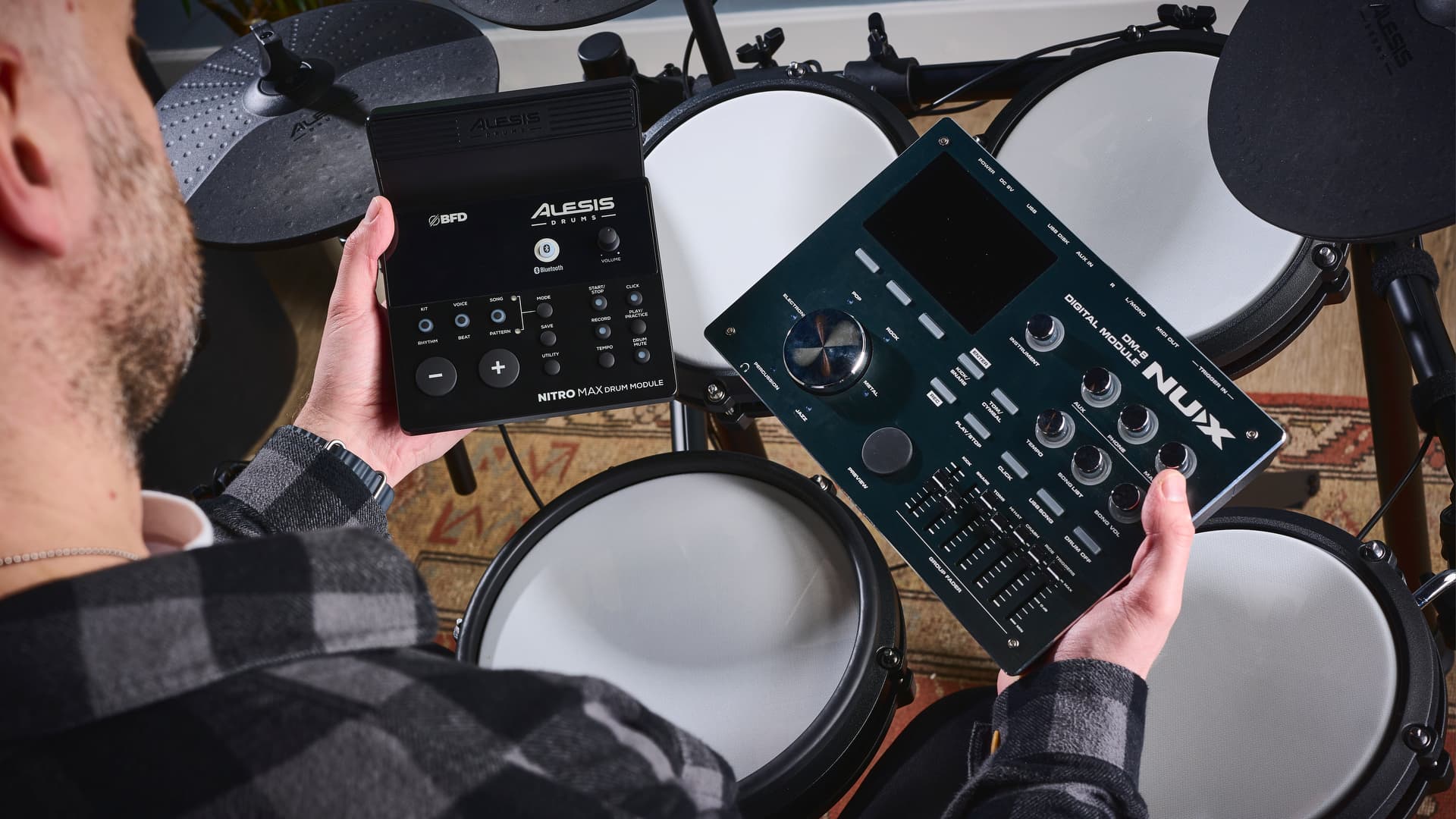
A solid e-drum checkout follows a specific sequence, and that sequence is a practical buying checklist in disguise. The guide moves through how products are chosen, unboxing/setup, cables, pedals and foot controllers, pads and playability, module, recording, on-board songs, coach modes, USB/SD, claims, meet our experts and hands-on demos. That is a useful reminder that the purchase is not just the kit in the box, but the whole chain of setup, response and usability.
If you are trying a kit yourself, follow that same order. First, see how painful the rack is to assemble and whether the cables are tidy or annoying. Then check the pedals and foot controller, because a sloppy kick pedal or a flimsy hi-hat controller can wreck an otherwise strong kit long before the sound engine becomes the issue.
A simple in-store or home test plan looks like this:
1. Assemble the kit and note whether the hardware feels stable or fiddly.
2. Plug in the pedals and foot controllers and make sure they track cleanly.
3. Play the pads at low and high velocities to hear how the module handles dynamics.
4. Work the hi-hat through open, closed and half-open positions.
5. Move through the module’s menus to judge how fast you can actually change kits, edit sounds or find practice tools.
Treat the module like the real product
The module is where a lot of electronic drum disappointment begins or ends. The sound library, on-board songs, coach modes, recording options and USB/SD functions are not extras for most players; they are the reason the kit gets used at all. A kit with good pads but a clumsy module workflow can feel dead in practice, especially if you want to record ideas quickly or jump between sounds without menu-diving.
That is also why connectivity matters. USB/MIDI, app integration and expansion inputs are part of the bigger usability picture for players who want a writing tool, a quiet practice rig or a live-ready setup.
Buy for the room you actually play in
Electronic drums are often bought for reasons that have nothing to do with stage volume. Some players need apartment-friendly noise, some want a portable live rig, and others want something that doubles as a studio sketchpad, so a serious test has to ask how the kit behaves in all three settings. Recording electronic drums, setting up an electronic drum set and making an electronic drum set sound better all point to the same reality: the kit is only part of the equation.
Noise is not just about the module. Mesh heads, kick-pad feel, pedal thump, rack vibration and cymbal pad clatter all affect what leaks into the room, and a kit that looks quiet on paper can still be a headache in a flat. That is why MusicRadar’s buying guides include a noise comparison alongside categories like best low volume, best beginner electronic drum sets 2025 and best electronic drum sets under $500/£500.
Use the wider guide ecosystem as a reality check
The e-kit methodology sits inside broader editorial criteria rather than a one-off opinion. You see the same approach across buying guides, from best electronic drum sets 2026 and best beginner electronic drum sets 2025 to best Roland electronic drum sets 2026, best Yamaha e-kits, best Alesis electronic drum sets 2025 and best electronic drum set for kids 2025.
This article was produced by Prism’s automated news system from verified source data, official records, and press releases, then run through automated quality and moderation checks before publishing. The system is built and supervised by the people who set the standards it runs under. Read our full AI policy.
Did this article answer your question?