New Zealand teens turn plastic buckets into a viral drumming phenomenon
Five Tauranga teens turned bright orange buckets into a tight, camera-ready percussion act, proving arrangement and presentation can matter as much as gear.

A bucket band that plays like a lesson in modern drumming
Five New Zealand teenagers have done something a lot of drummers only talk about: they made a basic object feel essential. Beat Street Drummers lean on bright orange Mitre 10 plastic buckets instead of a conventional kit, and the result is bigger than a gimmick. Their slick, high-energy clips have pushed past 100 million views and attracted more than a million followers, which puts this squarely in the realm of serious viral drumming, not just a school-band curiosity.
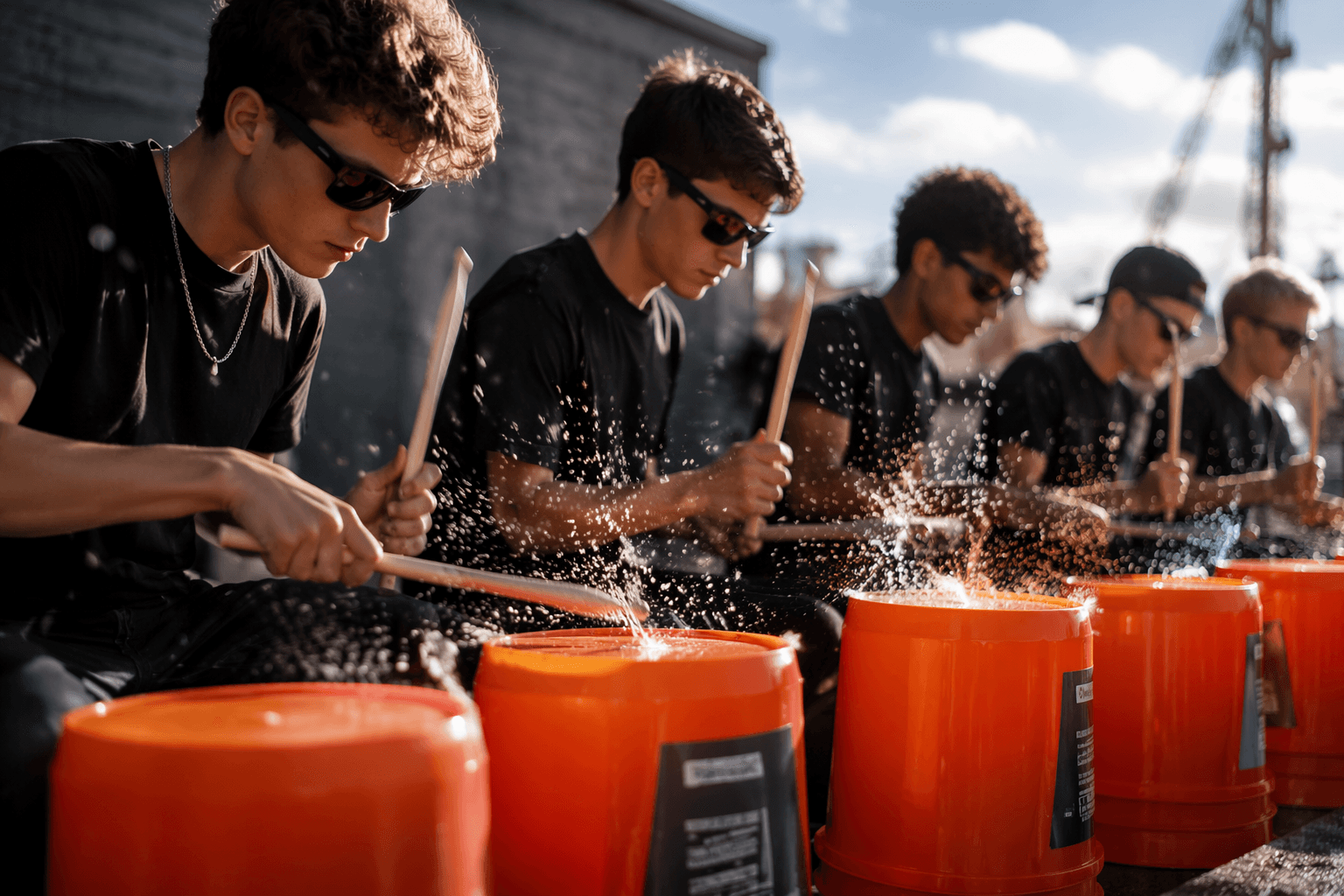
What makes the project hit is how little it tries to disguise itself. The teens sit shoulder to shoulder in hoodies, T-shirts, and sneakers, often performing in a farm shed, on a street corner, or inside a hardware store. That plain setting is the point, because the visual contrast between everyday surroundings and precise ensemble playing makes the groove feel immediate and shareable.
Why the setup works on camera
This is accessibility-driven drumming at its sharpest. The orange buckets read instantly, the players are grouped tightly enough to feel like one instrument, and every movement has purpose. You are not watching a drummer hidden behind cymbals and toms; you are watching rhythm become a group event, with each strike easy to follow and every hit landing in plain sight.
That clarity matters. A lot of bucket-based performance dies when it looks messy or random, but Beat Street Drummers turn repetition into drama by keeping the arrangement compact and the visual language clean. The setup says you do not need a premium kit to make compelling percussion, only a strong pulse, a unified idea, and enough ensemble discipline to make the camera believe the groove before the second chorus arrives.
The numbers behind the rise
The scale here is hard to ignore. Earlier New Zealand coverage said the group had posted just 13 videos since launching in April and already racked up 11.5 million views. One Macklemore cover reportedly pulled 2.8 million views in 24 hours, and by February 20, 2026, another video was said to be nearing 20 million views.
Their public-facing accounts show how wide the audience has become. Their TikTok profile showed 277.3K followers and 3.2M likes when checked, and their YouTube Shorts presence plus Linktree confirmed activity across TikTok, Instagram, Facebook, Snapchat, and YouTube. SunLive also reported that one of their latest videos had reached 17.6 million views on Instagram, while another story said the group was already appearing at summer festivals and moving toward nearly 20 million views on a single cover clip.
That matters for drummers because it shows how fast a tight concept can travel when the format is built for short-form platforms. Beat Street Drummers are not surviving on one lucky post. They are repeating a look, a sound, and a performance style that social feeds can understand in a second.
Who the players are
Local coverage identified the group as five Tauranga teens named Noah, Daniel, Tristan, Elliot, and Lucas. One report gave their ages as 18, 18, 17, 15, and 14, which makes the level of coordination even more striking. Two of the players, Noah and Lucas, are 18, Daniel is 17, Tristan is 15, and Elliot is 14.
The buckets are part of the identity too. SunLive described them as bright orange Mitre 10 buckets, and that specific gear choice gives the project a distinctly New Zealand visual signature. It also makes the act instantly recognisable, which is a huge advantage when your performances are competing in the same feed as comedy clips, dance trends, and polished pop marketing.
They come across less like a one-off school talent act and more like a band with a visual brand already in place. That is probably why the project has been booked for live appearances, including festival programming. Once a bucket setup can work both on a phone screen and in front of a crowd, it stops being a novelty and starts becoming a career path.
What you can learn from the arrangement
The real lesson for drummers is not “buy buckets.” It is how Beat Street Drummers shape a performance so the audience gets the idea immediately. Their format rewards strong ensemble writing, obvious sticking, and choreography that serves the groove instead of fighting it.
A few practical takeaways jump out:
- Keep the arrangement readable. If every player is doing the same thing all the time, the eye has nowhere to go. Build call-and-response moments, stacked rhythms, and obvious entrances so the groove feels arranged rather than improvised.
- Make sticking clarity part of the show. On buckets, sloppy hand motion looks especially weak because there is no kit hardware to hide behind. Clean rebound, even spacing, and synchronized accents do more work than flash.
- Treat choreography as part of the chart. Sitting shoulder to shoulder works because the ensemble looks locked in, not random. Small turns, shared accents, and coordinated motion make a simple pattern feel bigger than it is.
- Design for the camera, not just the room. A farm shed, a street corner, or a hardware store becomes interesting when the performance is tight enough to reframe the space. The backdrop should feel ordinary so the playing feels extraordinary.
That is the deeper appeal of the whole thing. The group’s success shows how a percussion act can live outside the traditional drum kit and still feel musical, disciplined, and visually complete. For hobby drummers, that is a useful reminder that the best “gear upgrade” is not always gear at all.
Part of a longer bucket-drumming lineage
As new as this feels online, the idea itself is not new. Bucket drumming is commonly traced to New York City street performance in the 1980s, and Larry Wright of the Bronx is widely credited with popularizing five-gallon bucket drumming. That lineage matters because it places Beat Street Drummers in a real tradition of DIY percussion, not in some internet-only bubble.
What they have done is translate that street-born energy into a language built for short clips, repeatable hooks, and highly shareable visuals. That is why the project reads as more than a stunt. It is a modern update of an old drumming instinct, taking an ordinary object and making the groove feel like the biggest thing in the frame.
In the end, the orange buckets are the hook, but the discipline is the reason the idea sticks. Beat Street Drummers turned a simple household object into a global-scale percussion identity because the playing is clear, the image is unified, and the format knows exactly how to travel.
This article was produced by Prism’s automated news system from verified source data, official records, and press releases, then run through automated quality and moderation checks before publishing. The system is built and supervised by the people who set the standards it runs under. Read our full AI policy.
Know something we missed? Have a correction or additional information?
Submit a Tip