Ray Luzier defends first takes, urges drummers to play together
Ray Luzier’s “Goodbye” story is a reminder that first takes can carry the feel editing scrubs away. His advice is simple: get in a room, play with people, and let the performance breathe.
The first take that stayed on the record
Ray Luzier’s best studio lesson is blunt: sometimes the take that lands first is the one that matters most. When he revisited Army of Anyone’s “Goodbye,” he said the version that made the record was the band’s first take, even though he ran the part many more times afterward. That detail turns the song into more than a studio anecdote, because it gets to the heart of what real playing preserves: feel, commitment, and the push-and-pull that happens before the brain starts overcorrecting every note.
For drummers, that is the practical takeaway. A first take can lock in a groove before hesitation, self-editing, and grid-thinking flatten it out. Luzier’s point is not that preparation does not matter. It is that the live interaction between hands, feet, and bandmates often captures something studio correction cannot recreate after the fact.
Why “Goodbye” still matters
The Army of Anyone story has extra weight because the band was never a long-running project. Army of Anyone was a supergroup built around Richard Patrick, Dean DeLeo, Robert DeLeo, and Luzier on drums, and it released only one studio album in November 2006. “Goodbye” was the band’s first single, and it reached No. 3 on Billboard’s Mainstream Rock Songs chart that same year.
That history is what makes the first-take story hit harder. The song became the defining recorded document from a one-album band, so the performance itself had to do the heavy lifting. In a project with limited shelf life, the take that stays on the tape becomes the memory of the whole group.
What real playing preserves that editing erases
Luzier’s anti-editing point lands because he is not talking like a theorist. He is talking like a player who has spent years inside major rock machines, and he is pushing younger drummers toward the habits that actually build time and touch. His advice was direct: play the instrument and practice with other musicians instead of leaning on studio fixes.
That matters because editing can tidy up a performance without teaching a drummer how to lead a room. Real playing preserves the things that give a track life: microtiming, dynamics, the way a chorus lifts because the band is breathing together, and the confidence that comes from committing to the take. When those elements are cut apart and repaired piece by piece, the result may be cleaner, but it can lose the human drag and lift that make a groove feel alive.
- Play with other musicians, not just along with tracks.
- Treat the first pass as a performance, not a draft.
- Focus on time, touch, and confidence before correction becomes the habit.
- Use editing as a tool, not a substitute for ensemble feel.
That is the broader message running through Luzier’s comments. He is defending a style of drumming where the player owns the moment, rather than building a part that only works after the software has done the heavy lifting.
A long view shaped by more than one band
Luzier’s perspective carries more authority because it spans more than one chapter of rock history. He has looked back on his time with David Lee Roth, Army of Anyone, and nearly two decades with Korn, and that long arc gives his comments real context. He is not reacting as a nostalgia act or a young player protecting a theory. He is speaking as someone who has lived inside both classic frontman chaos and the disciplined reality of a band that has stayed on the road and on the charts.
Korn hired Luzier in October 2007 and made him an official member in 2009. That timeline matters because it shows how deeply embedded he has become in the band’s identity. Nearly two decades later, his comments still sound like someone who knows what survives from tour to tour and what disappears when a performance gets over-polished.
Korn’s crowd tells the same story
Luzier’s recent comments about Korn’s South American run reinforce the same theme from the stage rather than the studio. He said the audience included multiple generations, which is the kind of detail that only comes from seeing the room night after night. That family-centered crowd mix supports his view that Korn’s operation is built on reliability and musicianship, not just spectacle or shock value.
The band’s live profile is still huge enough to matter in the current festival cycle. Billboard reported that Korn was included in the 2026 Sick New World lineup announcement, which keeps the group in the conversation at major festival and stadium level. For a drummer, that matters because it shows the demand for performances that still have physical impact, not just immaculate postproduction.
The same message keeps coming up in public
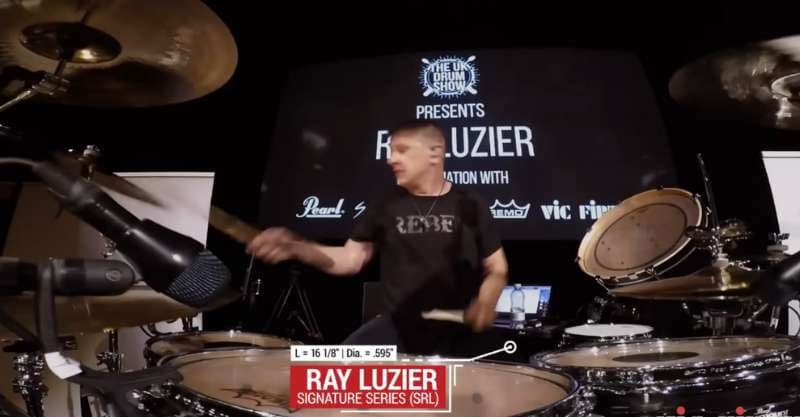
Luzier has been making this point in more than one setting, including a Pearl Drums event at Musicians Institute in Hollywood, California, on April 18. That appearance fits neatly with the interview’s larger message: his public commentary keeps circling back to the same drummer-first values of feel, touch, and playing with other people.
He also closes the loop by speaking about drummers supporting drummers, which gives the conversation a useful community angle. The idea is not to reject modern tools outright. It is to remember that the core of the job still happens when sticks hit heads, the band locks in, and a take says something honest before anyone starts fixing it.
The lesson for players who care about the take
Luzier’s “Goodbye” story is worth remembering because it is not romantic nonsense about one lucky mistake. It is a concrete example of what happens when a performance already has the right pulse and chemistry. The first take stayed because it had the thing that editing cannot invent: conviction shared in real time.
That is the real point of the story. First takes are not automatically better, but the best ones protect the very thing over-editing can erase: the feeling that three or four musicians made a statement together, in one room, before the moment got dissected into pieces.
This article was produced by Prism’s automated news system from verified source data, official records, and press releases, then run through automated quality and moderation checks before publishing. The system is built and supervised by the people who set the standards it runs under. Read our full AI policy.
Did this article answer your question?