Analysis: The Gygax Controversies Reignite as Luke Gygax Returns to Official D&D Projects
A Gygax is back writing official D&D, and it's already reigniting every old debate about authorship, royalties, and who really owns the soul of the game.
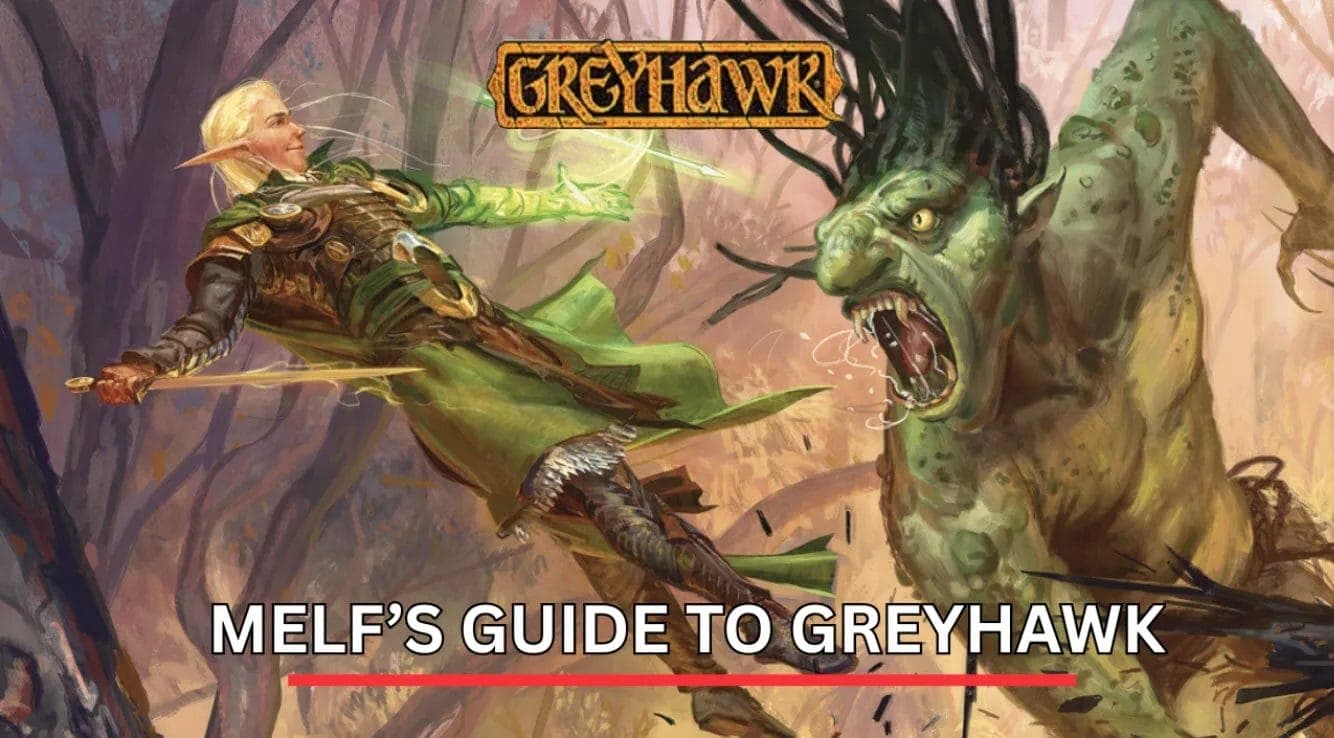
When Dan Ayoub, Wizards of the Coast's VP of Digital Product and D&D Franchise, took the stage at Gary Con XVIII on March 19, 2026, alongside Luke Gygax, the optics alone were enough to send shockwaves through the RPG community. The pair announced *Melf's Guide to Greyhawk: The Shield Lands*, an official sourcebook Luke will author for Wizards. Ayoub framed the collaboration openly as an effort to "mend the rift between family and franchise." That single phrase activated decades of accumulated grievance, mythology, and genuine affection in a fandom that has never quite resolved its feelings about the Gygax name.
What's Actually Being Made
The book carries the full title *Melf's Guide to Greyhawk: The Shield Lands*, confirmed by Luke Gygax in an Instagram post revealing the cover art. That cover is a painting by legendary illustrator Jeff Easley, depicting Melf, the Male Elf Ranger that Luke personally played in his father Gary Gygax's original Greyhawk campaign sessions in the 1970s. The painting's own story has already become part of the announcement's mythology: it was auctioned at Gary Con for charity, purchased for $5,000 by actor Vince Vaughn, who then gifted it directly back to Luke. Luke later described it as "the only painting of Melf that reflects my vision of him as played by me in my father's Greyhawk campaign." Beyond the cover, the book will feature new cartography from Anna B. Meyer, the Greyhawk community's go-to mapmaker, and additional design work from Jay Scott, another longtime contributor to Greyhawk fandom.
Crucially, this project was not born inside Wizards of the Coast. Luke had been assembling it as an unofficial release, likely destined for DMsGuild, before conversations with Ayoub redirected it into the official pipeline. That pivot from fan-adjacent project to sanctioned WotC publication is exactly the kind of institutional decision that signals something larger is happening.
Melf as Living Artifact
Melf is not a marketing character invented for this book. He is a direct throughline to the game's earliest days, and his signature spell, Melf's Acid Arrow, has appeared in every major edition of D&D. Luke described the setting with unmistakable personal weight, noting that the names on Anna Meyer's famous Greyhawk map include not just Gygax family members but childhood friends, that the Shield Lands were where he adventured as both Melf and Otis the Ranger, and that classic modules like *Against the Giants* and *Descent into the Depths of the Earth* are woven into his actual memories. "All those places are seminal memories for me," he said at Gary Con, framing the project as a chance to "keep the Gygax in Greyhawk." That authenticity is precisely why the collaboration draws attention, and precisely why it draws scrutiny.
The Controversy Timeline You Need to Know
Understanding why this announcement lands with such force requires walking the history.
The foundational dispute goes back to 1974, when D&D was first published and Dave Arneson was credited as co-creator alongside Gary Gygax. Arneson's "Blackmoor" campaign had introduced the conceptual architecture of the game: individual heroes, experience points, dungeon delving. Gygax codified and commercialized those ideas. When TSR published *Advanced Dungeons & Dragons* in 1977, Gygax argued it was a sufficiently distinct product to exclude Arneson from royalties. Arneson disagreed, and in 1979 he sued. The case went to the brink of trial before a settlement was reached in March 1981, granting Arneson a 2.5% royalty on core AD&D books and permanent co-creator credit. A follow-up suit over the *Monster Manual II* in 1984 went to Arneson again.
Within TSR itself, Gary Gygax was eventually ousted in a boardroom struggle led by Lorraine Williams. He later published *Dangerous Journeys*, prompting TSR to sue him for intellectual property infringement. When Wizards of the Coast acquired TSR, WotC's then-president Peter Adkison purchased Gygax's residual D&D rights. The estate that Gary left behind became its own contested territory: Gail Gygax, Gary's widow, controlled much of it, while his children from earlier relationships, including Luke and Ernie, operated in a legally adjacent space that created recurring friction.
Gary Gygax's own public record carries additional baggage. He made remarks widely characterized as "biological determinist" regarding women in roleplaying, comments that GeekNative's retrospective flags in its timeline and that modern editorial standards at Wizards would make untenable to reproduce uncritically.
The 2021 NuTSR episode adds another layer specific to Luke. When a company calling itself TSR relaunched using Ernie Gygax's involvement as its legitimacy anchor, the backlash was swift. The company's public statements ranged from hostile to incoherent, and the RPG industry broadly rejected it. Luke's response was unambiguous: "FYI: I am not involved with any TSR company nor is Gary Con nor anyone else in my family outside of Ernie. Full stop. That is all." His willingness to draw that line publicly matters now, because it establishes a record of Luke as distinct from the more incendiary uses of the Gygax name.
What This Means for Greyhawk as a Setting
Greyhawk has been intermittently revisited across virtually every edition of D&D, but it has never received the sustained official support that the Forgotten Realms has commanded since the mid-1980s. The Shield Lands, the region at the center of this sourcebook, occupy a place in Greyhawk lore analogous to the Sword Coast in the Realms: a politically fractured frontier with rich history and constant conflict. Bringing official 5E (or current-edition) mechanics and cartography to that region, authored by someone who played there as a child alongside Gary Gygax himself, is not a routine setting refresh. It is an argument that the setting's creative lineage matters.
Watch for announcements on several fronts as this project develops: whether the book includes organized play material or adventure modules (Luke mentioned at Gary Con that he will be writing adventures alongside the sourcebook), how Wizards credits the historical contributors in the book's front matter, and whether the product arrives in print as well as digital. That last point drew pointed community attention after the Gary Con announcement, as Wizards' own channels were conspicuously quiet about it.
The Trust Question at Your Table
The debate this project will generate is not really about the Shield Lands. It is about what it means when a major corporate IP holder reaches back toward its founding family to assert continuity of legacy. For Greyhawk fans, elation is entirely reasonable: a living link to the original campaigns is authoring a sourcebook for a setting that has been underserved for years. The creative team assembled around Luke, Anna Meyer, Jay Scott, and Jeff Easley, represents deep community credibility, not a cash-grab licensing arrangement.
The suspicion is also reasonable. The Gygax name carries real historical weight on questions of attribution, royalty fairness, and who gets credit when collaborative creative work gets commercialized. Nothing about this announcement resolves those older disputes. GeekNative frames the collaboration explicitly as a test case for how modern Wizards will balance authentic voices tied to D&D's origins against contemporary editorial standards and corporate risk management. That framing is correct.
If this comes up at your table, the most productive approach is to separate the product from the politics without pretending the politics don't exist. Luke Gygax's record in 2021 suggests he is not interested in using his father's name as a culture-war cudgel. The book's creative team is composed of genuine Greyhawk devotees. The Shield Lands are worth exploring. None of that requires ignoring the Arneson royalty settlement, Lorraine Williams' boardroom coup, or the uncomfortable parts of Gary Gygax's public record. A 52-year-old game carries 52 years of history, and the most honest way to come to the table is to know it.
The announcement at Gary Con XVIII is the opening move in what will be a much longer conversation. The real test comes when the book is in hand and the community can see exactly which version of Greyhawk's history Wizards and Luke Gygax chose to tell.
This article was produced by Prism’s automated news system from verified source data, official records, and press releases, then run through automated quality and moderation checks before publishing. The system is built and supervised by the people who set the standards it runs under. Read our full AI policy.
Did this article answer your question?