D&D Seasons Explained: What the 2026 Framework Means for Your Table
Wizards of the Coast's new 3-month Season model bundles a major book, tie-in accessories, and D&D Encounters store content around a single theme starting in 2026.
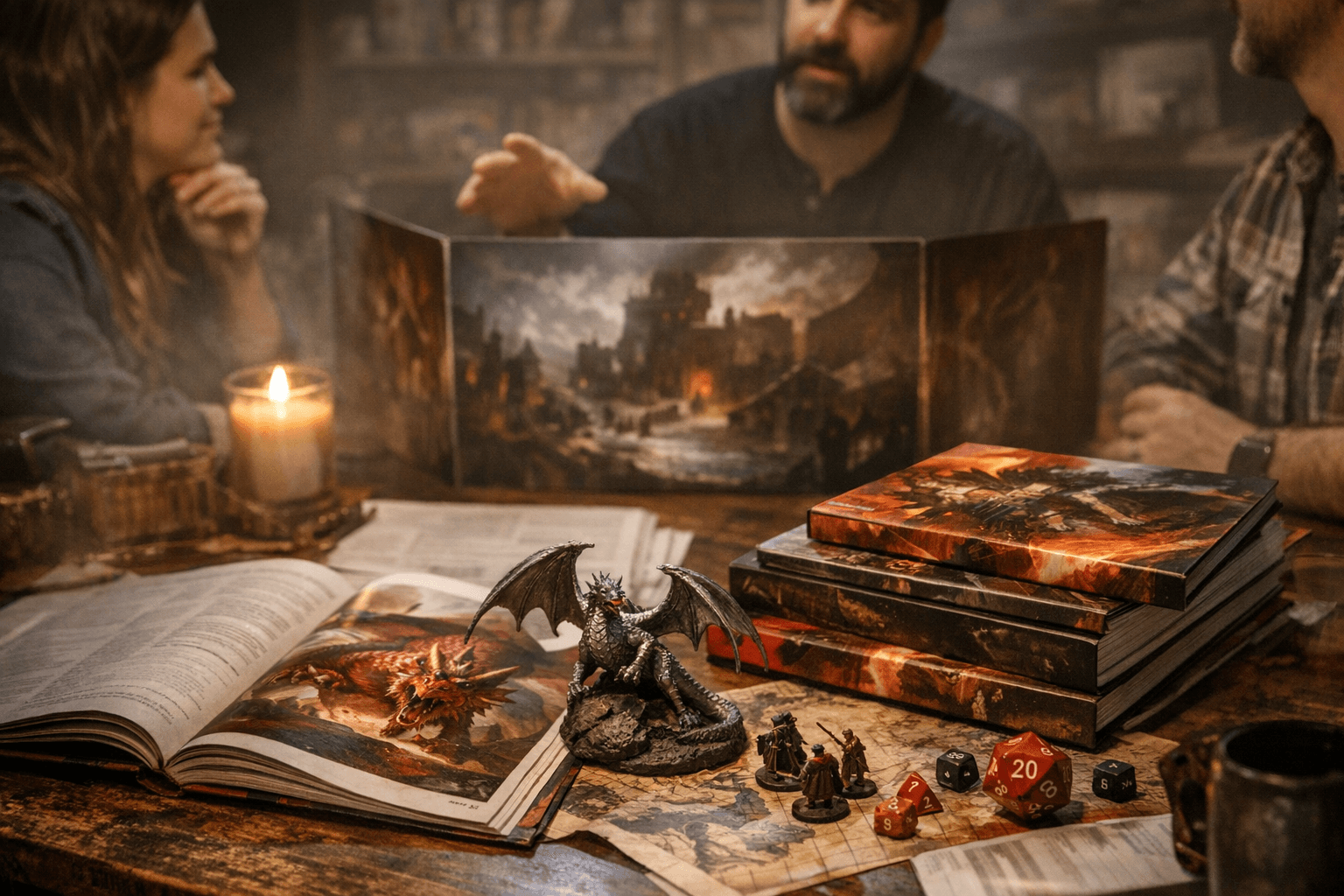
Wizards of the Coast announced a new publishing and marketing structure at GAMA Expo in early 2026 that reframes how D&D releases, organized play, and retail programming will work going forward. Called D&D Seasons, the framework organizes "specific periods of time in which new books, accessories and organized play events will be all focused around a single theme." For DMs planning long-term campaigns, store owners building event calendars, and community organizers scheduling public play, understanding how Seasons work is now essential context for the year ahead.
What a D&D Season Actually Is
Each Season runs for exactly three months and follows a consistent internal structure. A major book release serves as the centerpiece, anchoring the theme for that period. That central release is then followed by tie-in accessories including decks, DM screens, and map packs, all designed to complement and extend the book's theme. Organized play initiatives tied directly to the Season's theme round out the release window, meaning your local game store events and community play nights will reflect the same thematic focus as the books on the shelf.
The three-month cycle is tight by design. Rather than scattering releases across an unpredictable calendar, Wizards of the Coast is concentrating player attention, retail inventory, and organized play programming into focused bursts. Think of it less like a subscription and more like a campaign arc with a built-in product cadence underneath it.
The 2026 Season Lineup
Three specific Seasons are planned for the remainder of 2026. Two have been named explicitly: the Season of Magic and the Season of Horror.
The Season of Horror has already generated notable visual branding, with official D&D art depicting an aerial view of Castle Ravenloft at night tied directly to that Season. Ravenloft's appearance signals that the Horror Season will likely draw on gothic and dark fantasy territory, which opens obvious doors for DMs running Curse of Strahd adjacent material or homebrew horror campaigns.
The Season of Magic, meanwhile, has its own accompanying art featuring a fey sorceress casting a spell, suggesting a high-magic or fey-adjacent thematic focus. A third Season for 2026 has been referenced but its name has not been confirmed in available materials.
How D&D Encounters Fits In
Beyond the books and accessories, Seasons have a dedicated retail channel: the recently relaunched D&D Encounters program. Stores will receive exclusive content tied into each Season through Encounters, making local game stores the physical home for themed organized play. The relaunch of Encounters is significant on its own; the program was a cornerstone of D&D's organized play ecosystem during the 5th Edition launch years, and its return signals that Wizards of the Coast is once again investing in brick-and-mortar community infrastructure.
The specific mechanics of how stores receive and distribute Season-exclusive content through Encounters, including eligibility requirements and distribution details, have not yet been fully detailed in available materials. Store owners who run organized play should contact their distributors and watch for Wizards of the Coast retailer communications for specifics as each Season approaches.
What This Means for Your Table
The Season framework is primarily a publishing and marketing structure, but its implications for active tables are real and worth thinking through deliberately.
If you are running a long-term campaign, a three-month Season window maps reasonably well onto a story arc. The Season of Horror's focus, for example, could align naturally with a gothic horror chapter of a homebrew campaign, letting you pull from newly released accessories like relevant map packs or DM screens that are thematically matched to what you are already running. Rather than hunting down thematically scattered supplements, the Season model delivers a coherent set of tools on a predictable schedule.
For one-shot and short-arc DMs, each Season's centerpiece book plus accessories essentially packages a ready-made thematic toolkit. A three-month window gives you enough time to run multiple sessions exploring that theme before the release cadence moves on, without the pressure of integrating a major release mid-campaign.
For Store Organizers and Community Event Planners
The Season framework is arguably most impactful at the organized play level. With organized play initiatives explicitly tied to each Season's theme, and store-exclusive content flowing through D&D Encounters, local stores now have a built-in programming scaffold: three distinct themed blocks per year, each anchored by a major release and supported by exclusive materials.
Practically, this means event calendars can be built around Season windows rather than constructed from scratch each month. A store running D&D Encounters nights during the Season of Horror, for instance, can lean into the Castle Ravenloft aesthetic across its events, using the Season's map packs and accessories as table dressing and props. That thematic cohesion tends to drive repeat attendance because players feel like they are part of a unified story experience rather than a series of disconnected sessions.
The key logistical step for store organizers is establishing a relationship with Wizards of the Coast's retail program and ensuring enrollment in D&D Encounters before each Season opens, since exclusive content is distributed through that channel.
The Bigger Picture
The Season model reflects a clear strategic intent: concentrate community attention, retail momentum, and organized play energy into coordinated thematic windows rather than letting them diffuse across a fragmented release calendar. Official D&D art has already been produced around the seasonal concept, including imagery of Eladrin in their four seasonal forms of Winter, Spring, Summer, and Fall, suggesting that the visual and narrative identity of Seasons will be a recurring design pillar, not a one-year experiment.
With the Season of Magic and the Season of Horror confirmed for 2026 and a third Season still to be announced, the framework is already taking shape as the structural backbone of D&D's year. The relaunched D&D Encounters program as the delivery mechanism for store-exclusive content ties the publishing calendar directly to local game store programming in a way the community has not seen at this scale in years. For players, DMs, and store owners alike, paying attention to which Season is active and what it contains is now part of how you stay current with D&D in 2026.
This article was produced by Prism’s automated news system from verified source data, official records, and press releases, then run through automated quality and moderation checks before publishing. The system is built and supervised by the people who set the standards it runs under. Read our full AI policy.
Did this article answer your question?