Lansdowne Public Library Offers Free Beginner Dungeons and Dragons Class This March
Lansdowne Public Library's free "How to D&D" on March 31 covered both playing and running campaigns in 2.5 hours, with zero registration required.
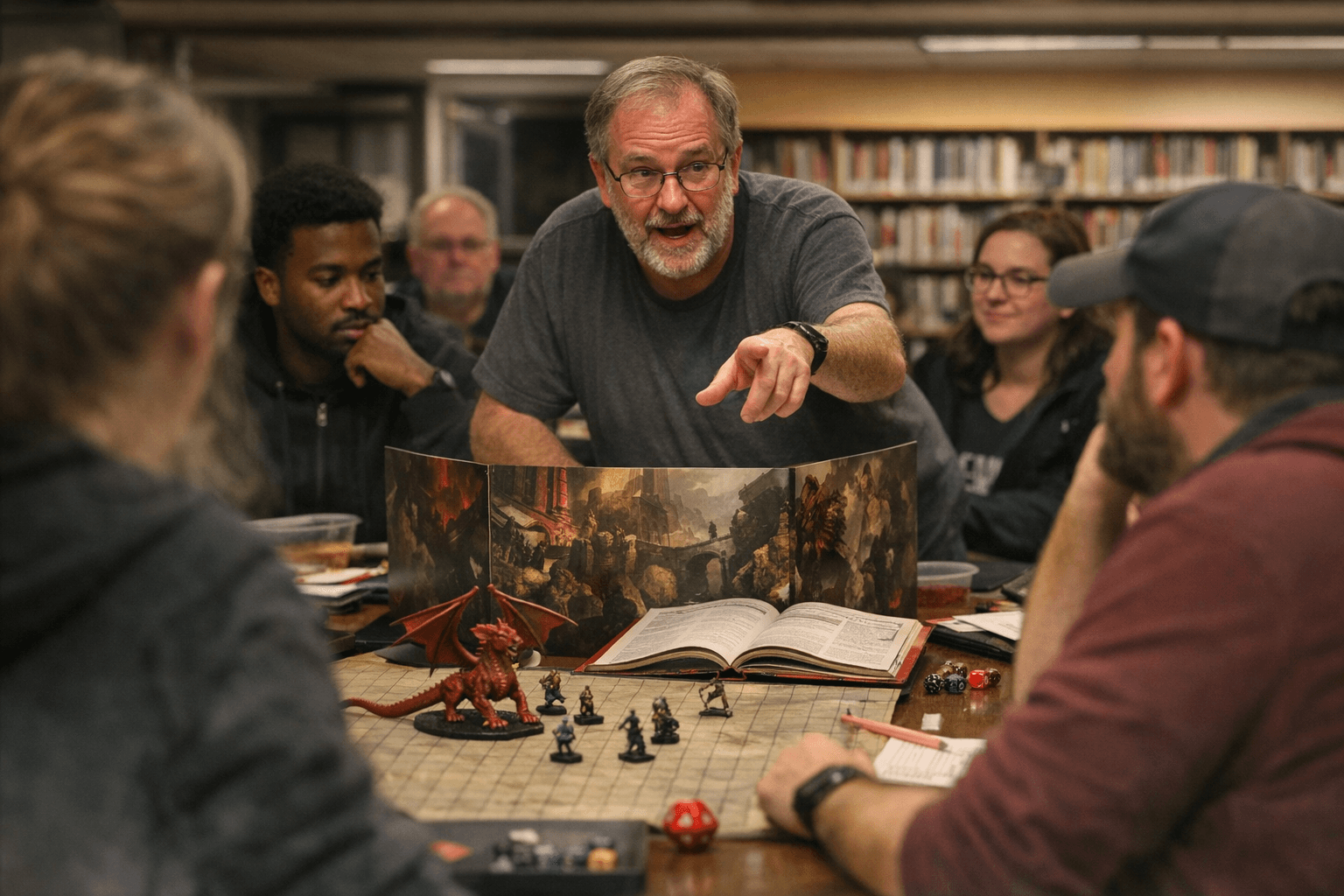
Lansdowne Public Library ran a 2.5-hour "How to D&D" workshop on March 31 that covered both the player and DM sides of a campaign, with no registration, no experience required, and no cost: a format any civic space can replicate in a single evening.
The session at 55 S. Lansdowne Ave, Lansdowne, PA ran from 6:00 to 8:30 PM and was open to all ages. Walk-ins were explicitly welcome, removing the friction that keeps curious newcomers from joining private games or organized play events that require advance signup. The structural choice that makes this format scalable is covering both how to play and how to run a campaign in one block: someone who shows up unsure of what a d20 does leaves with enough knowledge to not just sit at a table, but eventually run one.
That design reflects a broader movement among public libraries to treat tabletop RPG programming as community infrastructure. Lucas Maxwell's "Let's Roll: A Guide to Setting up Tabletop Role-Playing Games in your School or Public Library," published by Facet Publishing and available through the ALA Store, was written specifically to help librarians build sessions within real time constraints. Washington State is currently funding library tabletop gaming programs through September 2026 under an active grant initiative. The through-line in all of it is the same: D&D programming supports literacy, collaborative problem-solving, and creative storytelling without requiring a store membership, expensive materials, or any prior hobby knowledge from attendees.
Two and a half hours is the right window. It is enough time to explain core mechanics, walk through a short encounter using pregenerated characters (which cut the one-hour character-creation bottleneck that stalls most beginner nights), and send people home confident enough to return. Keeping the session under three hours also matters for drop-in programs specifically, because a time commitment that doesn't require rearranging an evening gets more bodies in the door. One DM per four to five players is the ratio that keeps a first session from collapsing into chaos. The single handout that does the most work for anxious newcomers is a simplified action economy card: what you can do on your turn, in plain language, with no page numbers to chase mid-session.
For any library or friendly local game store ready to run a similar night, the Lansdowne model is the template: post publicly, require nothing, cover player basics in the first hour, introduce DM fundamentals in the second, and close with open Q&A and a live table for anyone who wants to keep rolling. Organizers posting to community boards or library calendars can adapt this description directly:
Free D&D Workshop: Learn to play and run Dungeons and Dragons in a single evening. No experience, no materials, and no registration required. All ages welcome. Drop in any time during the session and leave knowing how to build a character, make an ability check, and run your first encounter.
Programs like the one at Lansdowne are the on-ramp for players who eventually fill convention tables, stock local game stores, and sustain the online communities that keep the hobby alive long past any single Tuesday night.
This article was produced by Prism’s automated news system from verified source data, official records, and press releases, then run through automated quality and moderation checks before publishing. The system is built and supervised by the people who set the standards it runs under. Read our full AI policy.
Did this article answer your question?