The Most Broken Spells in D&D 5e, Ranked for DMs and Players
The 2024 rules closed some of 5e's most notorious loopholes, but Simulacrum can still chain infinite copies through Wish, and Forcecage remains a boss-killer even with its new 1,500 GP price tag.

Six spells have defined what "broken" means across D&D 5e's two major editions. With the 2024 Player's Handbook now reshaping encounter design at tables everywhere, several of those spells landed in genuinely different territory, some legitimately patched, others barely touched. What follows is a spell-by-spell status check: what each one actually does under the current rules, whether the broken reputation holds up in real play, and a three-part practical response for your table. Think of it as a patch note your campaign can act on tonight.
1. Wish
The 9th-level Conjuration spell available to Sorcerers and Wizards sits at the top of this list because the 2024 revision changed essentially nothing about it. Wish can replicate any spell of 8th level or lower, alter reality in ways the spell text leaves deliberately open, and, critically, serve as the Simulacrum loophole described below. The "stress effect" language, which gives a 33% chance the caster permanently loses the ability to cast Wish after any non-listed application, remains the primary intended safety valve. That valve only works if the DM enforces it without softening the blow for a beloved PC.
2024 status: Unchanged. Every claim about its power survives real play fully intact.
Rules-legal counterplay: Enforce the stress effect by the book every single time. A character who uses Wish to reshape terrain, reverse a death, or perform any action outside the explicit list rolls that d100 immediately, in front of the table, no exceptions.
Table agreement: Before the campaign reaches high levels, build a short explicit list of what Wish cannot do at this table. Wish cannot permanently kill a named NPC, cannot undo an already-resolved story beat, cannot duplicate a specific other PC's unique class feature.
Lightweight house tweak: Any Wish effect outside the listed spell-replication uses also requires the caster to succeed on a DC 15 Arcana check. On a failure, the DM interprets the wording literally, granting the intent but creating a significant unintended consequence. This adds dramatic friction without removing the spell from play.
2. Simulacrum
The 7th-level Illusion spell creates a physical duplicate of the caster with all the same spell slots. The 2024 revision explicitly disallows the duplicate from casting Simulacrum and destroys the original copy if the caster casts it again. That looks like a clean patch. It is not. The errata left the door open for the duplicate to use Wish to "mimic" the effects of Simulacrum as a technically different outcome. The chain: original casts Simulacrum, copy uses Wish to mimic Simulacrum, and the table now has two fully stocked Wizards. At high levels, Simulacrum's value extends well beyond the chain, since mimicking a party member or even a boss NPC doubles effective action economy in ways that ignore encounter CR entirely.
2024 status: Nominally nerfed, but the Wish loophole survives RAW. The core claim holds at tables that don't explicitly close it.
Rules-legal counterplay: True Seeing (6th level) reveals Simulacrums for what they are, opening targeting options for smart enemies. Dispel Magic cast at 7th level can remove the Simulacrum outright, no saving throw.
Table agreement: Agree before the campaign that one Simulacrum is the ceiling, regardless of what Wish can technically mimic. The 2024 errata's clear intent was a cap of one, and "technically different outcome" is lawyer-speak that most tables can just decline.
Lightweight house tweak: Rule that any use of Wish to replicate Simulacrum's effect triggers the same original restriction: the copy is destroyed if the caster casts it, and the copy cannot use Wish to do it again. This closes the chain in a single sentence.
3. Forcecage
Already infamous for eliminating boss encounters in the 2014 edition, Forcecage in 2024 picked up two new costs: a minimum 1,500 GP material component and a Concentration requirement. The Concentration addition is the genuinely impactful change. In 2014, Forcecage ran independently and could not be Counterspelled after the fact. Now, it can be Dispelled like any Concentration effect. That said, the 7th-level nature of the spell still makes Counterspell challenging for most monsters, and Disintegrate, the other listed counter, requires line of sight, which means the attacking creature needs some way to perceive an invisible cage before it can target it.
2024 status: Meaningfully more expensive and now Dispellable. The claim that it is boss-breaking holds, but DMs have more legal tools to respond.
Rules-legal counterplay: Give boss monsters or high-CR foes Freedom of Movement or an innate Teleport ability. Both exist in the Monster Manual and are thematically coherent for powerful villains.
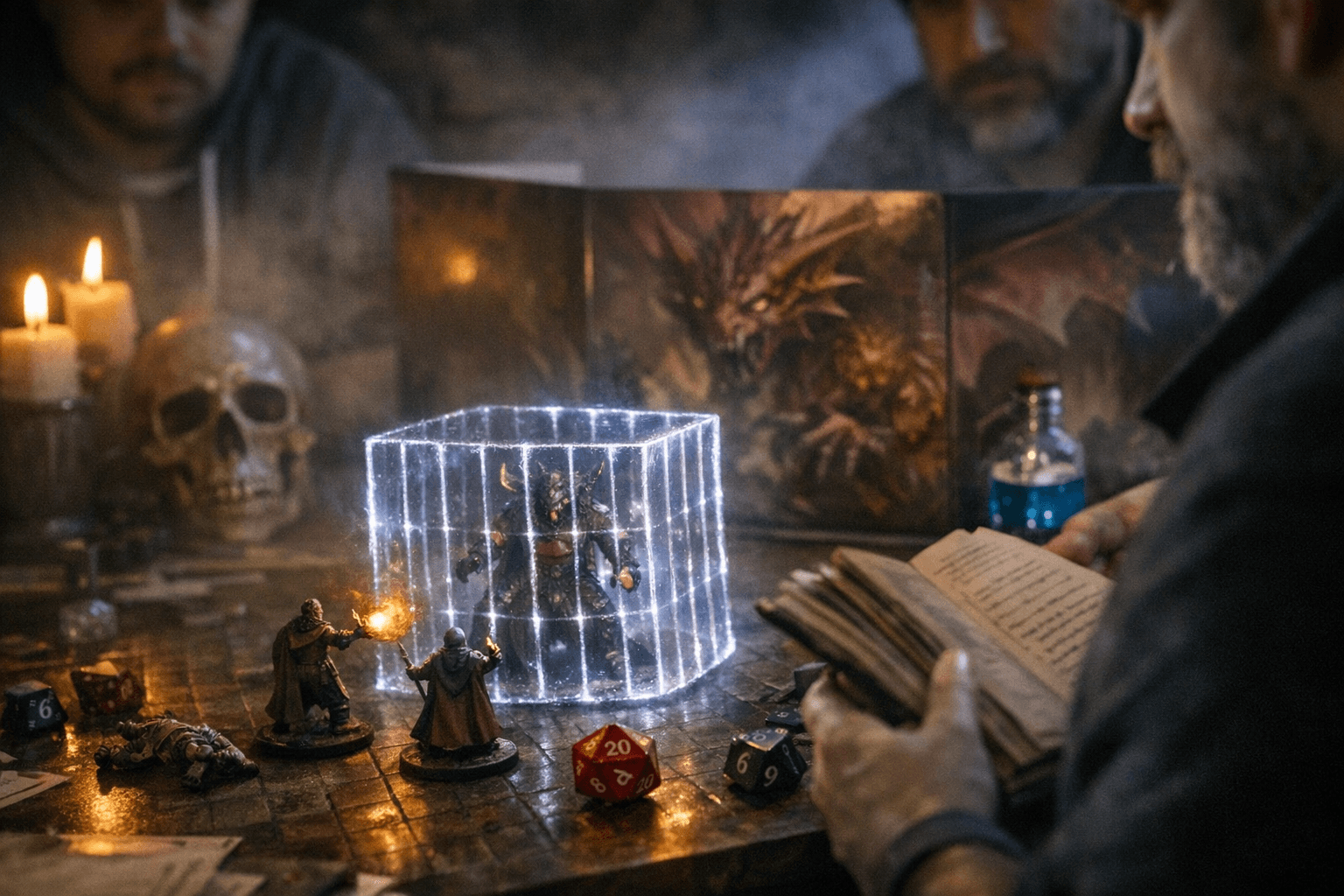
Table agreement: Named villain encounters get a brief pause before Forcecage resolves. If the cage would trivially end the encounter and the story hasn't earned that moment, the group agrees to reconsider or redirect before the spell completes.
Lightweight house tweak: Raise the material component floor to 5,000 GP for the 2024 version at your table. At high-tier play, 1,500 GP is nearly trivial. Five thousand is still achievable but introduces a resource cost that makes players weigh the decision.
4. Animal Shapes
The 8th-level Transmutation available to Druids receives remarkably little attention relative to its potential impact. Any number of willing creatures can be transformed into a Large or smaller Beast of the caster's choice, with the 2024 revision offering minimal changes from the 2014 version. The abuse case is straightforward: an entire party reshaped into high-HP Beasts gains an effective hit point buffer that stacks action economy with minimal concentration investment. The Druid retains Concentration but floods the encounter with durable bodies.
2024 status: Largely unchanged. This is one of the spells where GameRant's "broken" label applies as strongly in 2024 as it did in 2014.
Rules-legal counterplay: Area-of-effect spells that force multiple saving throws are the cleanest counter. Target the Druid's Concentration with focused ranged fire before the Beast wave becomes unmanageable.
Table agreement: Agree that transformed party members don't carry weapons, spell focuses, or magic items into Beast form. The flavor supports it; the balance benefit is significant.
Lightweight house tweak: Cap the number of simultaneous transformations at four, matching typical party size. Larger or smaller parties can adjust the cap accordingly. It changes nothing for normal play and limits the "infinite army" edge case without touching the spell's design.
5. Spirit Guardians
At 3rd level, Spirit Guardians delivers area-denial, speed reduction, and repeated damage in a package that scales deceptively well into higher tiers. The 2024 update reframed how the WIS saving throw triggers: rather than firing when enemies move into or start their turn in the 15-foot space, the save now activates when the Guardians "enter" a creature's space, when enemies enter the Guardians' space, or when they end their turn there. A once-per-turn cap was added. This change matters and GameRant's "lawnmower" framing captures the 2024 version accurately; the Cleric running through clustered enemies still procs the 3d8 damage on each one, just with the single-proc limit per turn.
2024 status: The once-per-turn cap is a real constraint. The claim that it is a standout 3rd-level slot survives; the claim that it produces unlimited procs per move does not hold in 2024.
Rules-legal counterplay: Intelligent enemies grapple the Cleric. A grappled creature's speed becomes 0, which stops the "lawnmower" movement entirely. Ranged attackers can simply stay beyond 15 feet.
Table agreement: Nail down the "enters the space" trigger at Session Zero. Agreeing on the exact sequence before play starts prevents mid-combat rules debates at exactly the wrong moment.
Lightweight house tweak: Add a 5-foot dead zone directly adjacent to the Cleric where the Guardians do not deal damage. The flavor rationale is that the spirits protect the caster rather than harm creatures at arm's reach. It reduces the aggressive push-through penalty slightly without gutting the spell's area control purpose.
6. Contagion
The 5th-level Necromancy spell is the clearest example on this list of a genuine 2024 nerf. Its 2014 version was notorious for Slimy Doom, an affliction that combined CON Disadvantage with a stun trigger whenever the target took damage, creating a practical stunlock against bosses who failed three consecutive CON saves. The 2024 revision replaced that mechanic entirely: on a failed CON save, the target now takes 11d8 Necrotic damage, gains the Poisoned condition, and suffers Disadvantage on saves for a chosen Ability score. Still strong against mid-tier enemies, but the boss-killing stunlock is gone.
2024 status: Substantially nerfed. The 2014 "broken" label does not transfer cleanly to the current version. A DM running a 2024-rules campaign can adjust encounter design without fear of the stun chain.
Rules-legal counterplay: Lesser Restoration removes the Poisoned condition outright. High-CON monsters, constructs, and undead with condition immunity are natural hard counters that require no house ruling.
Table agreement: Confirm that the Disadvantage from Contagion does not stack additively with other sources of Disadvantage applied simultaneously. Redundant Disadvantage is already how the rules work, but naming it explicitly prevents the "but I have two sources" argument.
Lightweight house tweak: Limit the secondary Disadvantage to saves thematically tied to the affliction's disease type. Filth Fever affecting STR-based saves is coherent; the same affliction forcing Disadvantage on CHA saves through creative player framing is not. One sentence at the table closes this.
The through-line across all six is the same: the 2024 revision did meaningful work on some of these spells and almost nothing on others. Contagion was genuinely fixed. Simulacrum and Wish were nudged. Forcecage got more expensive. Animal Shapes and Spirit Guardians are largely carrying their 2014 profiles into current play. Knowing which category each spell falls into is the difference between redesigning encounters around a threat that no longer exists and being caught flat-footed by one that absolutely does.
This article was produced by Prism’s automated news system from verified source data, official records, and press releases, then run through automated quality and moderation checks before publishing. The system is built and supervised by the people who set the standards it runs under. Read our full AI policy.
Did this article answer your question?