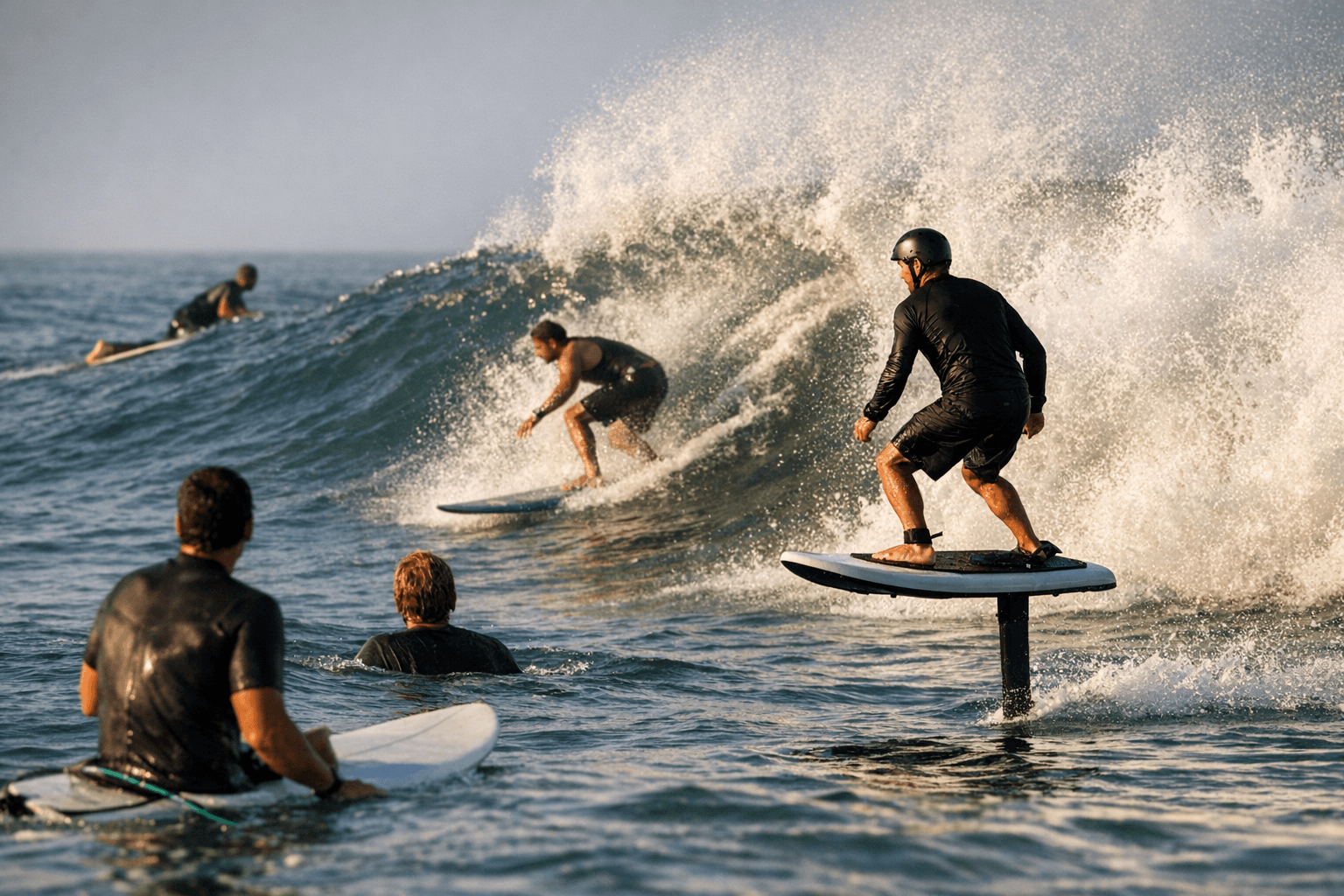
Boise Rider Documents First-Time DIY eFoil Build With Safety Focus
Derek’s Boise eFoil build is a 126-cell reality check: the savings are real, but so are the battery, safety, and tuning demands.
What Derek is building, and why it matters
Derek’s Boise project is the kind of DIY eFoil build that strips away the fantasy fast. He weighs 190 pounds, has zero foiling experience, rides at Lucky Peak Reservoir, and is trying to keep the whole build around $2,700 all-in. That combination makes the thread useful, because it is not a garage trophy build for an expert chasing novelty. It is a first attempt from a rider who wants something usable, safe, and broad enough that his girlfriend and a couple of friends can ride it too.
That last detail changes the whole brief. Once other people are going to stand on the board, safety is no longer a side note. It becomes part of the layout, the battery strategy, the disconnects, and the way the board itself is shaped.
The parts stack is the real story
The propulsion plan is straightforward on paper and serious in practice: a Flipsky 65161 120KV motor, a Flipsky 75200 Pro V2.0 ESC with a built-in power button, and a Flipsky VX3 Pro remote with a wireless receiver. That combination gives Derek a modern DIY electric drive system without leaning on custom-machined one-off hardware. It also makes the build more modular, which matters when you are learning what works and what does not.
The foil side is equally deliberate. Derek is basing the setup on a Gong Allvator V2 package pieced together from Bons Plans, including an aluminum mast, top plate, fuselage connector, fuselage, a large X-Over V2 front wing, and a 48 cm stabilizer. That is not the kind of tiny, twitchy wing set you pick if you want a first ride to feel forgiving. The larger front wing and long stabilizer point toward earlier lift, calmer low-speed behavior, and less punishment for beginner mistakes.
The board itself is planned at about 60 inches long, 25.5 inches wide, and 4.7 inches thick, with roughly 95 liters of volume. That is a very intentional choice for a first-time rider at 190 pounds. A softer, more forgiving outline gives him a better chance of remounting, balancing, and sorting out takeoffs without the board feeling nervous underfoot.
The battery is where the build stops being casual
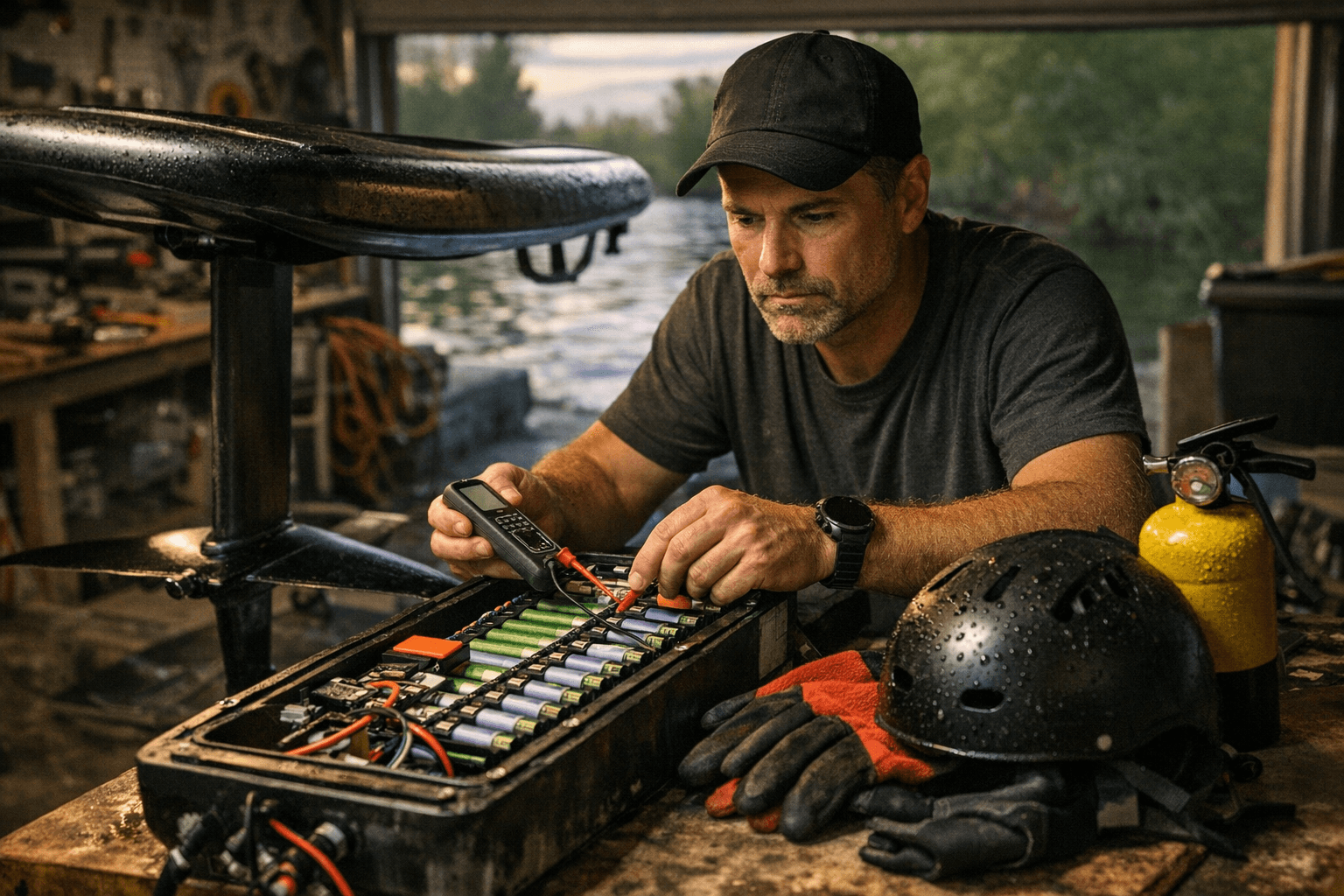
Derek’s battery plan is the part most riders should study twice. He is building a 14S9P pack with BAK N21700CG-50 cells, totaling 126 cells, about 45 Ah, and roughly 2,331 Wh. That is a substantial pack for a first DIY eFoil, and it explains why the thread reads more like a serious engineering plan than a hobby sketch.
He is not just listing cells and voltage. He is spelling out the layout, wiring approach, bus-wire redundancy, and estimated current demand. That matters because eFoils pull hard at launch, then settle into a very different draw once the board is up and riding. If the pack is too small, too weak, or badly wired, the first problem shows up exactly where it hurts most, during lift-off.
The current estimates make the design intent clear. Derek expects roughly 50 to 70 amps during takeoff and 80 to 100 amps at full throttle. That is a useful reality check for anyone romanticizing a DIY build as an easy weekend electronics project. A 2,331 Wh pack gives him room to work with, but it also raises the stakes on thermal management, cell matching, and build quality.
Safety is built into the parts list
The safety hardware is one of the strongest parts of the project. Derek plans to use a JK BMS BD6A20S10P 100A with active balancing, a 100A ANL fuse, and an XT90H main disconnect. That is the kind of setup that says he understands the difference between “it powered on” and “it is safe to own.”
Active balancing is especially important in a pack this size, because a 14S9P configuration gives you a lot of stored energy to manage and a lot of cells that need to stay in step. The 100A fuse is there for fault protection, and the XT90H disconnect gives him a practical way to isolate the system. For a board that other people may ride, those are not extras. They are the basics.
Charging is planned through a 58.8V 5A charger, which fits the battery architecture and keeps the system in the expected range. That charger choice also tells you this build is being treated as a usable machine, not just a one-off proof of concept.
What this build teaches about first-time DIY eFoils
The clearest lesson here is that modern DIY eFoils are drifting toward bigger batteries, more serious battery management, and parts that can be serviced or upgraded later. Derek is not chasing exotic one-off machining or vacuum-bagged carbon wizardry. He is leaning on hand tools, a Bambu Lab A1 Combo 3D printer, and modular hardware that can be assembled, swapped, and repaired without a full shop.
That is the practical lane for a first build. It also means the limits are obvious. A DIY setup like this can be tailored to the rider, the water, and the learning curve, but it will almost never feel as integrated as a factory board. Cable routing, waterproofing, thermal control, and board balance all depend on the builder getting details right. The smallest miss can show up as drag, dead space in the layout, or a board that feels awkward when it starts to rise.
Performance-wise, Derek’s choices point to stability and controllability over outright speed. The large front wing, 48 cm stabilizer, and 95-liter board volume all lean toward easier takeoff and better low-speed manners. That is exactly what a first-time rider needs, especially one who wants to let a couple of other people try it too. The tradeoff is simple: more forgiveness usually means less race-bike sharpness.
DIY savings versus buying complete
This is where the decision gets real. A first DIY eFoil can absolutely undercut a complete setup on sticker price, especially if you already own tools, can fabricate mounts, and are willing to spend time on fit, wiring, and tuning. But the savings shrink fast once you count failed parts, replacement hardware, sealing supplies, test gear, and the hours it takes to make everything trustworthy.
An entry-level complete setup buys you integration. The battery, controller, charger, board, and foil are meant to work together, and the support burden is far lighter. Derek’s route buys customization and the satisfaction of building something himself, but it also asks him to solve the problems that a commercial package hides. If your priority is riding sooner and troubleshooting less, complete wins. If your priority is learning the system and shaping it around your own needs, a project like this starts to make sense.
The Boise build is a sharp reminder that the first DIY eFoil is not really about bragging rights. It is about whether you can turn a 126-cell battery, a 120KV motor, and a forgiving foil platform into a board that launches cleanly, stays safe, and still feels worth the effort after the novelty wears off.
Know something we missed? Have a correction or additional information?
Submit a Tip